
Advice needed

Joined
Mar 21, 2016
Messages
272
This is my first successful san mai blade. I am very happy I got it to weld successfully, no voids or delams at all.

The problem is my forging is pretty sketchy and there were deep spots and high spots and I ended up with some mild steel on one side of the tip.

The tip is pretty much where it needs to be so I can't just take more off that side.

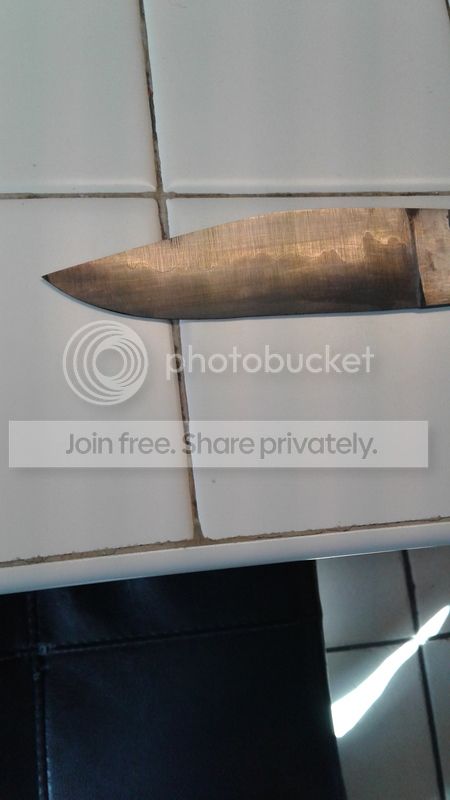
This is at 220 belt finish etched for the sake of pictures. I hope you can see in the pics what I mean.
The good side.
Problem side.
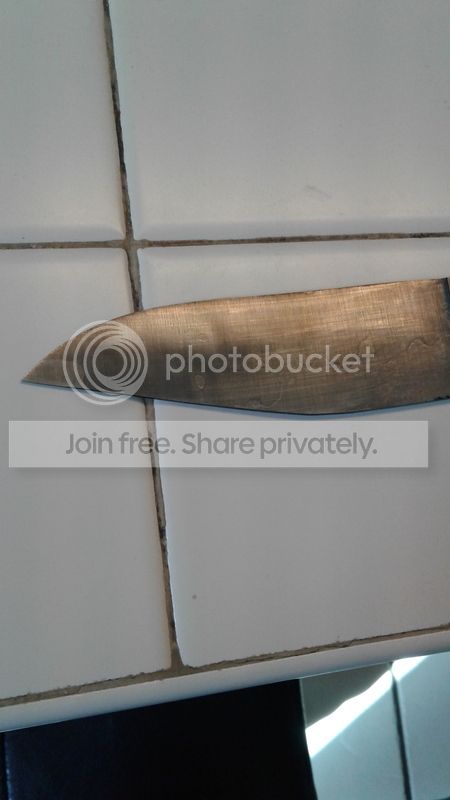
I don't want to grind the tip off and I'm not sure I wouldn't have the same problem if I did. Only in one side like this how much will it effect performance? I planned to give this to a friend but if it's not going to perform then I will just junk it.
 
Pre grinding the core was dead straight, so grinding out flaws I must have (drifted?) to one side.
 
to me it looks like there is too much decarb and rough surface to judge what is actually there. you could shine up the spine and give it an etch to tell where the center core actually goes.
 
Not decarb, I left it pretty thick for ht probably took a 16th off each side.

I took your advice and cleaned up the spine and etched, spent about 10 minutes trying to take a picture and gave up.

I can clearly see the core and that is nearly all that's left. The mild steel is very thin and I can see where it stops at so thanks that was good advice.
I think I can get past the mild steel at the tip, it's going to be VERY thin but I think I can work it out.

To build this bullet I started with 1/8th 1084, between 11 gauge (roughly 1/8th) mild steel ,1018 I think.

Should the parts of the billet be thicker? I think I would have came out better with more mild steel.
 
I would have used 1/4" 1084 and 1/8" mild steel. Once welded solid, draw it out and get the core straight along the side where the edge will be. Grind to get flat if needed. Then shape the blade, sand, etch, HT, sand etch , ....
 
If using mild steel you need to remember it's going to forge down faster then the core. Me personally would have done 1/8" 1085 core and around 1/4" for the mild steel. This gives you some wiggle room for grinding. Weld it up and draw it down in thickness and if your concerned about core thickness then do a quick grind on the edge and see if it's the thickness you want. If it's still to thick then keep forging it down. Remember to keep removing the scale buildup as it will create a nasty finish on the billit. Also that scale is coming from the mild steel so every time you heat it and work it down your loosing more and more mild steel.

Some times it's best to calculate out how thick you need your core befor you start, saves you a lot of time. You can figure it out with some math if you know the height of your grind, thickness of your finished edge, how far from the edge you want the weld line to be as well as spine thickness. Let me do and example for you.

Say your edge bevel is 1.25 long and the spine is .250 thick and you want a finished edge thickness of say .020 with a weld line height of say 1/2" up from the edge.
.250-.02=.230
.230/1.25=.184
.184x.50=.092
.092+.020=.112 core thickness to have the weld line up 1/2" from the .020 thick edge.
 
Last edited:
If using mild steel you need to remember it's going to forge down faster then the core. Me personally would have done 1/8" 1085 core and around 1/4" for the mild steel. This gives you some wiggle room for grinding. Weld it up and draw it down in thickness and if your concerned about core thickness then do a quick grind on the edge and see if it's the thickness you want. If it's still to thick then keep forging it down. Remember to keep removing the scale buildup as it will create a nasty finish on the billit. Also that scale is coming from the mild steel so every time you heat it and work it down your loosing more and more mild steel.

This exactly what happened.

I knew the mild steel would move faster than the 1084 but it still moved much more than I expected. I didn't know about the scale and ended up with some pits, I also ended up with a sort of offset either from forging or grinding. While the core was straight, the outside layer was thicker on one side than the other.

This was my 3rd attempt at forge welding, the first one didn't weld at all, the second I let some scale form and had some delam.

I am pretty happy overall since it's at least solid!

I got the spot at the tip down to a point that I'm not concerned about it, still a bit there but it's not touching the tip and sharpening will get past it on the edge.
 
Back
Top