AEB-L for hunter/Utility type knives?

Joined
Jul 4, 2012
Messages
533
Well we got our new evenheat oven in and have been thinking about some different steels...Have read a lot of good about the general cutting ability of AEB-L but everything seems centered around kitchen duty. Im wondering about outdoor duty..Will it hold up with a typical hunter/drop point geometry? Im guessing it would but Id like to hear some opinions on this steel in knives meant for something other than the cutting board..
Any thoughts are appreciated :)
 
The only drawback to AEB-L is chipping. If the blade is not gonna see any/much bone contact then you can leave it at HRC 59-60. If it is gonna be splitting rib cages and pelvic bones then it needs to be drawn back to HRC 58. Just my .02.
I find that people who have minimal sharpening equipment like AEB-L because it is easy to sharpen. It was formulated to have just enough carbon to get hard but not enough to form carbides. This allows it to take a nice keen edge. Its main industrial use is blades for disposable razors.
In case you don't have a H/T recipe here is what I use.

Harden @ 1950 with a 15 min. soak.
Plate quench
Freeze treatment in dry ice & alcohol. (15 min.)
Temper 2 hours @ 375-400.
Another freeze
Final temper.

Try one and let us know what you think.
 
Last edited:
AEB-L is the same steel used in Mora's (although it goes by a different name), which seem to hold up pretty well.

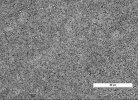
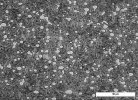
From what I have been reading lately, it has a really, really fine carbide structure which makes edge wear really evenly (no carbide tear out), and also means it will retain very high levels of sharpness for a long time in comparison to many of the large carbide PM steels which will hold a lower level of edge retention for much longer due to the carbides acting like mini saw teeth. Additionally with the lack of large aggregated carbides it should theoretically be tougher as well in the same more homogeneous concrete is tougher than concrete with huge rocks in it.

Here is a picture of it's grain structure:
1181826502-13C26.jpg

And the PM version of 154CM for comparison:
1181826784-CPM154.jpg

Having said that, here was the recommended heat treatment I found with the information (originally from Roman Landes, a metallurgist and knife maker), which to my untrained eye seems fairly complicated, and perhaps that may be necessary to give it all the above good qualities. I don't know. I don't take much interest in heat treating the steel, just it's final qualities.

Furnace: Vacuum, protective gas, or salt bath
Preheat 1: 450-600°C equalize 3-5 min
Preheat 2: 850-950°C equalize 3-5 min
Austenize: 1065°C eqalize 3-5min, hold 5min
Quench: oil preheat to 60°-80°C; N2 4bar
Cryo 1: immediately after quench min. -70°C or lower, hold 1h
Temper1: 150°C for 1h, then quench in Water
Cryo 2: immediately after quench min. -70°C or lower, hold 1h
Temper 2: 150°-180°C for 1h, then quench in Water

On a side note, I also sent you a PM and an email Lisa about the camp axe you made for Croaton on the other forum. Please let me know if they never made it through.

 
AEB-L is similar to 13C26 from Sandvik. We get 13C26 locally easier as AEB-L, but most makers use 12C27 locally.

Here are some details from Sandvik.

Sandvik 14C28N - Combination of hardness and corrosion resistance
Sandvik 7C27Mo2 – High corrosion resistance
Sandvik 12C27 – The well-rounded knife steel
Sandvik 12C27M – Dish washer safe
Sandvik 13C26 – Razor edge sharpness
Sandvik 19C27 – Excellent wear resistance

The following table on Sandvik's website illustrating different knives and what steel can be used is very interesting.
Table of knife steels

Play around on their site, I have learned a lot about steels, uses, carbide's etc. They have a lot of links.

Currently, I am still trying to perfect O1 and will from there move to 12C27M as 12C27 is being discontinued. Similar properties, just more corrosion resistant.

For me, hunting and utility knives have to have a balance between edge stability, durability (strength and toughness), sharpenability, wear resistance. Of course you as you go after one property of the steel, you sacrifice some other properties. It is all give and take.
 
I hate to open up the steel demons box again :) , but here is a recent thread that took a turn into AEB-L discussion. I posted a bit on it, especially post #11.
http://www.bladeforums.com/forums/s...at-steel-are-you-guys-using-for-chef-s-knives

IMHO & FWIW -
If you can do an AEB-L HT, you can get a tougher and harder knife from another ( better) steel. They all will require:
A controlled and programmable HT oven, and foil packets.
Quench plates or oil quench.
Sub-zero chill with dry ice and alcohol, or LN ( Note - Go directly from quench to sub-zero, with only an ice water bath to cool below room temp. Do not do a snap temper.)
Accurate temper oven

AEB-L and 440-A/B/C steel's main attraction is low cost and ease of sharpening.

You can pick from Elmax, CPM-D2, CPM-154, CPM-S35VN, CPM-S90, etc. for a little more per blade.....and get a better knife.
The steel is only a small part of the knife cost, even with the most expensive of these choices. I bet most stabilized handle blocks cost more than the steel in the knife.
 
Stacy, I always appreciate your input on steels.
The recent thread includes a link to Devin Thomas' discussion on AEB-L. Devin's main argument for it is the tiny carbide size. Does that seem like as big an advantage to you as it does to him? The price is attractive, and if it's fairly simple to get fine carbides with a subzero HT, that seems like a Good Thing...
Thanks for any info.
 
Indeed that is a big plus. The edge gets VERY sharp. It doesn't hold as long as the harder steels, but it is a great cutter when freshly steeled or sharpened.

I in no way meant to malign AEB-L as a bad steel, just not the hardest or toughest. To get the max from it, you have to do the HT dead right. One portion is that it goes immediately from quench to sub-zero at -95 or lower. Cool it in a bowl of ice water after the quench, and them right into the really cold stuff.


While on the subject of inexpensive steel, I wanted to share the source for the low cost tapered steel.
It was from Rob Fisher, at www.fisherknives.com . It is 420M, which is similar to AEB-L but a little lower in carbon. His site has the info and HT. Ten feet of 1.125" wide steel is $34. He has it in .875", 1.125", 1.5", and 1.75". You can make the knives really fast...just profile and HT. All the rest can be done post-HT.
 
Back
Top