After hours of sawing and filing (pic and a question)...

Joined
Sep 16, 2002
Messages
1,577
here is what I have so far on my first knife attempt. It's about 95% finished profile wise; I just need to do some final refinement with the files.

I have a question about cutting the bevels...how do you get a nice even plunge line? I'm doing this all by hand and the file certainly moves and slips around, especially when first cutting into an area.

Thanks for any advice or comments!

http://s77.photobucket.com/albums/j53/PJ234/?action=view&current=IMG_0835.jpg
 
use a round file to set your initial plunge line. that way you can use your large bastard to start removing the bulk of the grinds. I use a file guide with the round file to keep the lines the same on both sides.
 
I applaud your grit and determination and I like the profile of that knife. Be looking forward to seeing it when your finished .
 
I G-clamp a piece of 1/4 ground flat stock over my blade where I want the plunge to be, then use that as a file guide. It doesn't have to be hard steel. I use a large, 12 inch, square bastard file and the one I have cuts a slight rad at its corners. I then use a shaped support behind wet and dry paper to clean it up ready for HT.
 
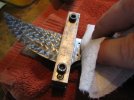
A photo of a file guide as suggested in previous posts. I use it for bolster alignment, but it works just as well for lining up bevels. The other side of the file guide is a mirror of this side, allowing you to file in your bevels without worrying about alignment.
 

Attachments

  • 21Cleaning tang with acetone prior to gluing bolster on.jpg
    21Cleaning tang with acetone prior to gluing bolster on.jpg
    61.6 KB · Views: 145
Thanks for the advice and encouragement so far! For those recommending the file guide, are these readily available for purchase or do you just make them yourself? Also, does everyone use a round file to 'cut in' as clw3 does, or is this a matter of personal taste?

Also looking for opinions on the top rear corner of the tang...that angled corner happened by accident. Should I leave it? Round it? Make the bottom corner match?
 
The thing that's nice about a round file to cut-in your plunges is that when you're done, the plunges will have a nice radius. If you use a flat bastard (I want to et your baaabee :D), the plunge will be more square. It's a good idea to avoid sharp angles for heat treatments, so most makers have a radius to the plunge.

I really like the profile. It takes a lot of work to get there, but it's looking nice!

I use a couple pieces of scrap steel I had laying around and I drilled some holes for bolts to go through. I clamp this on my piece where I want the plunge to be and go from there. You can take one piece of scrap with a straight edge to it and C-clamp it in place to serve as a guide. Now, scrap won't be hardened, so it will wear. Be carefull not to push into the guide, or your will eat it away and loose your straight edge and consistancy. File guides are available through most knife supply stores, not sure about general hardware stores. Most commercially available file guides will be hardened so you won't have to worry about biting into the guide with the file. Something to serve as a guide will definately make the plunges more consistant and even for a nice eye pleasing blade.

As for the butt of the handle (I assume that's where you're referring to by the top rear corner of the tang), the best guide I've found is to grab the knife in hand like you would be using it. Does it feel comfortable? Is it biting into your hand? I would personally round the top of the rear tang for a smooth feel against your palm, and I would slightly round off the bottom of handle butt as well.

Have fun!

--nathan
 
The thing that's nice about a round file to cut-in your plunges is that when you're done, the plunges will have a nice radius. If you use a flat bastard (I want to et your baaabee :D), the plunge will be more square. It's a good idea to avoid sharp angles for heat treatments, so most makers have a radius to the plunge.

I really like the profile. It takes a lot of work to get there, but it's looking nice!

I use a couple pieces of scrap steel I had laying around and I drilled some holes for bolts to go through. I clamp this on my piece where I want the plunge to be and go from there. You can take one piece of scrap with a straight edge to it and C-clamp it in place to serve as a guide. Now, scrap won't be hardened, so it will wear. Be carefull not to push into the guide, or your will eat it away and loose your straight edge and consistancy. File guides are available through most knife supply stores, not sure about general hardware stores. Most commercially available file guides will be hardened so you won't have to worry about biting into the guide with the file. Something to serve as a guide will definately make the plunges more consistant and even for a nice eye pleasing blade.

As for the butt of the handle (I assume that's where you're referring to by the top rear corner of the tang), the best guide I've found is to grab the knife in hand like you would be using it. Does it feel comfortable? Is it biting into your hand? I would personally round the top of the rear tang for a smooth feel against your palm, and I would slightly round off the bottom of handle butt as well.

Have fun!

--nathan

Thanks nathan, that's helpful; I'll have to try to fashion some sort of file guide from my scraps. Everytime I picked up the file from the bench and caught a glimpse of the Flat Bastard stamping, I thought of that character and wondered if that was the inspiration for his name.
 
If you're using mild steel for your file guide, you can grind off one side of your round file and make it smooth so that it won't bite into your file guide.

or

You can make your file guide out of knife grade steel and harden it like you would your knife blade. Then when you temper it, don't temper it at as high a temperature as you would a knife made out of the steel. You still need to temper it, to remove brittleness and take out some of the stresses that hardening created. This will give you a harder file guide that can take a file skating against it constantly.
 
A photo of a file guide as suggested in previous posts. I use it for bolster alignment, but it works just as well for lining up bevels. The other side of the file guide is a mirror of this side, allowing you to file in your bevels without worrying about alignment.

thanks for posting that pic. I need to make one of these. I am still fixing the plunge lines on my first hand filed knife. That would have saved me some time.

Also, I never thought of using a round file to start the plunge.
 
thanks for posting that pic. I need to make one of these. I am still fixing the plunge lines on my first hand filed knife. That would have saved me some time.

Also, I never thought of using a round file to start the plunge.

You're welcome. If I remember correctly, you're going to law school in Western Washington, aren't you? If you ever get to the Portland area, let me know and we'll tip a few and talk knives. Maybe even make something.
 
In a pinch you can use a piece of file with the teeth ground off, and C clamped in place. I did this for a while until I made some guides.
 
One more question, what type of grind/bevel would be easiest to achieve filing by hand without the aid of jigs, etc?
 
Pretty much all of your filing bevels will be flat. So basically, you're looking at a flat grind.

Many people just starting out worry about what the exact angle of their bevel will be and try to match that from the very beginning. My recommendation is to know what finished edge thickness you want and start from there. In other words, mark the center line of the edge of the blade. Then file down to near that line (about 1/2 the thickness of a dime from the line on each side) using a steeper angle than the finished bevel will be. That way you establish close to your edge thickess and can "walk" the grind back up towards the spine. You may want to draw out or scribe a guide line where you want your bevel to stop. Then establish pretty near your pre-heat treat edge thickness and work from there up to your guide line.

Hope that makes sense!

--nathan
 
I had read a couple of places about starting at a 45 degree angle at the edge, but couldn't remember where I read it and if that was recommended for hand filing or machine grinding.

So by flat grind, are you talking full flat or sabre or ??? What would be easiest to achieve by hand? Is most of this filing best done by draw filing to achieve an even line, or 'normal filing' perpendicular to the blade?
 
sorry to be off point but. Scott, your pic of the blade with the file guard on. how did you make the circular pattern on that blade it looks great? once again sorry to be off point, i tried to e-mail but couldnt. thanks....willy
 
I had read a couple of places about starting at a 45 degree angle at the edge, but couldn't remember where I read it and if that was recommended for hand filing or machine grinding.

So by flat grind, are you talking full flat or sabre or ??? What would be easiest to achieve by hand? Is most of this filing best done by draw filing to achieve an even line, or 'normal filing' perpendicular to the blade?


I find a full flat to be easiest. You definitely want to draw file. Good luck with it and take my advice with a grain of salt as I am also new at this.

-Mike
 
Back
Top