
after the hardening comes..?

Joined
Jan 2, 2006
Messages
1,073
okay... so i have my w2 tanto..
i havent hardened it yet... but assuming that goes as planned...
what is the best way to remove the rest of the stock?
before i ran it in my grinder but that is no longer flat... (part of the reason i am going to hand tools)
so i cant use a file because of the hard back... what do i use to remove thatlast stock before i start polishing?
and how "sharp" do i get it before polishing?

after reading this article about don fogg:
http://www.dfoggknives.com/copy_of_index/sword.htm
he mentions nachalantly "....then i sharpen the blade" thats all he says... am i putting too much work into it? what is it i am missing?

thanks for your help
~Chris
here is a pic of the knife just after filing (the sharpie marks are where i need fine adjustments
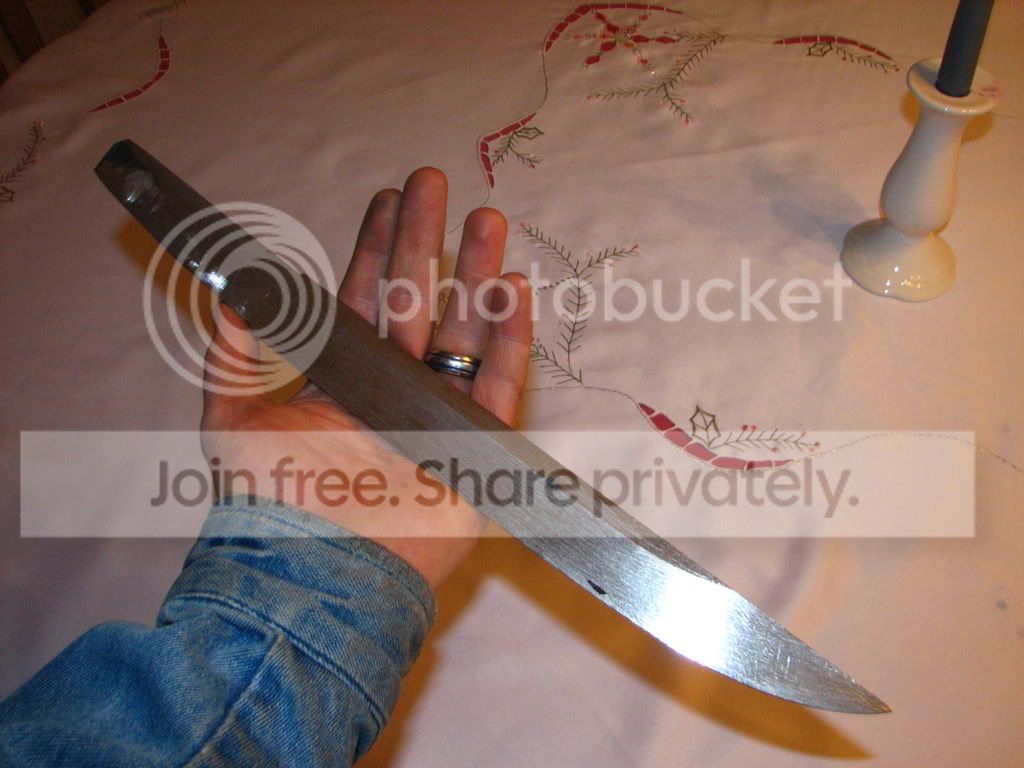
IMG_1115.jpg
 
Make sure you temper it after hardening. ;)

I always grind after heat treating, to remove decarb, correct any warpage, and get the grind lines the way I want.
 
perhaps just use files?

I dont really know, I always use my belt grinder.

If I were doing this all by hand, well...
I guess I would use files* to get down to the place where I could start to use stones and the polishing.
Some guys make a type of steel scraper that they work with both hands.

*The best type of files I have ever ran into for getting rid of steel fast is the Nikelson MagicCut files
 
i would use files the only problem is... the edge is almost as hard as the files... so they dont "bite" but they do in the back... so i may have to do the grinding and then "clean it up"
i got one of those cheap griners from northern tool... so teh platten is no longer flat... any idea how i could flatten it?
thanks
~chris
 
If I had a belt grinder thats what i would use.
However if I had only a stone bench grinder I would not risk it.
Too much work into the blade at this point to mess up.

In the end, I think you are going to need to use files as you can burn or crack the hardened edge with a fast moving grinder.
I have done that myself.
I know that a file seems to not want to bite, but I dont know what else to use.
In the Wally Hayes "KATANA" video I think he used files at this point.

After you get the edge almost sharp, Wally Hayes switched to sandpaper and a long two-handed sanding block.

Your blade looks so great, I hope you can finish it!
 
i would use files the only problem is... the edge is almost as hard as the files... so they dont "bite" but they do in the back... so i may have to do the grinding and then "clean it up"
i got one of those cheap griners from northern tool... so teh platten is no longer flat... any idea how i could flatten it?
thanks
~chris

I wouldn't worry about "flat" at all. The bevels on few Japanese blades are flat and are usually convex. You could try carefully slack belt grinding down to the edge. The trick would be not ruining your ridge line which will be tricky anyway when you go to abrasive papers and such and not overheating the edge.
 
I have the same sort of dilema right now eighty-seven, I've got this big bowie blade almost ready to HT, but no belt grinder, so I don't know how much to leave on the edge... can't have the edge de-carburise, but can't sit there with a stone for 3 days either! No point filing after HT, it'll eat the files for breakfast! ( the blade is the same brand of file I shaped it with) The best idea I've come up with so far is to wrap some heavy grit emery cloth around something rigid (like a wooden block) and just grind away at the edge with it after the quench.

That's why I'm building a grinder...;)
 
I have the same sort of dilema right now eighty-seven, I've got this big bowie blade almost ready to HT, but no belt grinder, so I don't know how much to leave on the edge... can't have the edge de-carburise, but can't sit there with a stone for 3 days either! No point filing after HT, it'll eat the files for breakfast! ( the blade is the same brand of file I shaped it with) The best idea I've come up with so far is to wrap some heavy grit emery cloth around something rigid (like a wooden block) and just grind away at the edge with it after the quench.

That's why I'm building a grinder...;)

One solution is to grind it to the finished thickness, and coat it with something to prevent decarb. Then all you have to do after heat treat is sharpen it, and maybe touch up the polish. :)
 
well... i have a cheap belt grinder... and it should work if i am careful. but i have done everything by hand so far.... so i will try the emery cloth and see how that goes. i just put the knife through the last normalizing process. i put a layer of clay on it to cool it slower... so we shall see!
my most apprehension is about the temp. i have no way to guage that, but color and the basic knowlege of physics... the forge tends to be hotter if i have it all "closed up" meaning less air escaping. so if i open it up... it should be a little cooler... and i can turn down the gas
if i use a magnet... 1450 is right on the edge of magantism right?
so i then wait till it is sold on the borderline... and then stick it back in till it is JUST demagnatized...
will that work?
thanks
~Chris
 
patton...
are you saying you take it down to the final edge before heat treat? and then use clay to make it as if it has a thicker edge?
*slightly confused*
~Chris
 
Knifemaker87,
If you haven’t hardened it yet the blade should be soft unless it was not cooled slowly enough. It could have been overheated and quenched wile grinding also. This will cause harder spots in the steel. One thing you can do is anneal the blade again or you can get a block of wood and wrap sandpaper around it and go to work.
The thickness of the edge should be about half the thickness of a dime before quenching. Much thinner and warpage may occur.
To repair the platten on the grinder use the same methods used to make the blade flat, files, sand paper etc. Another option is to get a piece ceramic glass and glue it on the steel platten.
 
half the thickness of a dime?!
wow... much thinner than i have been doing it. i just normalized it for the last time... and bent it...
so back to the file board... i am heating it now to bent it back... but if the edge needs to be that thin... i have a margin of error. i still have work to do on the edge..
thanks
But as to the hard spots... i was refering to the fact that with a hamon you have a hard edge and soft back... so it bites i the back but not on the edge
thanks again
~chris
 
patton...
are you saying you take it down to the final edge before heat treat? and then use clay to make it as if it has a thicker edge?
*slightly confused*
~Chris


You can buy compounds that coat the steel and prevents oxygen from reaching the surface. You might be able to get similar results by coating the blade with really watered-down clay. You don't want a real thick coating at the edge, or it won't get hard there. (obviously)
 
I'm not sure I followed all the questions and answers going back and forth in this thread, BUT, let me mention one more thing. (Mike Arsenault touched on it above.)

After HT- that is, quenching to achieve full hardness and then tempering to reduce full hardness to usable hardness- you're right, you will have a tough time shaping with files.

However, abrasives, especially Silicon Carbide (wet or dry) paper will still remove metal just fine.

If you've got some flattening to do, get the coarsest paper you can find (80 is probably too fine, 60 will still be time-consuming, 36 or 40 is your best bet) and wrap it around your file. Then go to town.

The difference between no-name SiC papers and brand-names like Norton or 3M is a small difference in $$, but a BIG BIG difference in the time it will take.
Also a big difference in how long one sheet will last you.

Wish I knew who said this first, but expensive abrasives are cheaper than cheap abrasives.

:thumbup: :thumbup:
 
I got a digital thermometer from Harbor Freight the other day. I can't remember what the top temp was but i know it was higher than 1500 degrees farenheight. I think it was on sale for around $20 or $25 and it came with the type K thermocouple. it reads both farenheight and celcius. I have an older one that i have been using that only reads celcius which was frustrating always having to convert temps. But they seem to help a lot for my stuff. Don't forget to temper IMMEDEATLY after quenching and cleaning the oil (unless you quench in water) off of the blade to avoid any stress cracks. When i was first starting i quenched a blade in oil, cleaned the blade down to the metal with sandpaper, inspected for cracks, did not see any and decided to wait til the next afternoon to temper it, needless to say the next afternoon it was full of tiny cracks all over the hard edge of the blade.
 
Try these diamond "stones" instead of files, before a sanding block:
http://www.harborfreight.com/cpi/ctaf/displayitem.taf?Itemnumber=36799
I'm finding them really useful in that role, flattening the flats and smoothing the curves on hardened steel (worn-out file in my current project.) They cut pretty well, better than the files I have. They sure let you see where the low spots are. I've used them with pleasing results to reprofile some production knives, too.

The platen on my cheapo grinder isn't that worn yet, but I only have 100-grit belts at the moment :o so the diamond stones are my next step.

P.S. Where can I get a piece of ceramic "plate" to keep my platen flat and smooth? 4"x12" or so would be the max size I'd need. I have glass but I think I will keep that for a final sharpening surface.
 
The simple solution is to wrap a piece of sandpaper around the file. A good sandpaper will work on the hardest steel and the file provides a flat surface for the paper.
 
Several things.
First - Once hardened and tempered, it will be much harder to remove metal and SCRATCHES. If hand finishing the blade, sand it to at least 400 grit prior to HT.
Second - If hand finishing, go a little farther toward final thickness..020-.030 at the edge.
Third - Use abrasive stones to take the metal down after HT.Clamp the blade to a board mounted such that you can sit of stand next to it (clamping the board in a vise works, use a C-clamp to clamp the blade). A coarse/fine bench stone will work, as well as diamond "stones". Wet-or-Dry paper wrapped around a block of micarta or hard wood takes over next. Continue until it is at 400 grit and shaped to the final thickness. The edge may well get sharp during hand finishing ,so be careful. Blunt it with a stroke of two of a bench stone to keep from cutting yourself and the sanding paper. Once the blade is at 400, switch to wet paper, going back to 220.The strokes should be in only one direction - smooth and long. Continue on up to 2000. The blade will have a fine finish at this grit. You can continue to finer grits, but it is probably unnecessary. The edge should be sharp again by now. To polish the blade, finish the edge, (and bring up the hamon if there is one), you glue a piece of hard leather on a 10-12" long block of hardwood. Charge this with flitz , rouge, or whatever you want as the final polish (Flitz works very good). Start with slow,smooth ,long strokes, taking your time. Recharge the polish often, wiping the excess from the blade with a soft cotton cloth every few minutes. BE VERY CAREFUL WHEN POLISHING THIS WAY. The edge will get unbelievably sharp and can cut you to the bone with one slip or bump. So stress the word SLOW .
Fourth - Blades like your should have a convex grind (called Appleseed in Japan) to allow for the sanding and polishing to do the entire job. Done right the blade is one of the most awesome looking . If you are going to be using this in the woods and hacking on tree limbs, then I would suggest that you re-sharpen it on your normal bench stones (or whatever you use to sharpen)after the final polishing (several Japanese blade polishers just fainted!) . This will add a secondary bevel that will hold up better to the use/abuse you may give the blade. The true hand polished Appleseed edges are made for cutting flesh with the minimum of resistance, but not for chopping wood.
Hope this helps, Stacy
 
wow... that is GREAT!
(however... i think you meant "once the blade is at 400, switch to wet paper..")
didnt want anybody to get confused
thanks!
~Chris
 
Back
Top