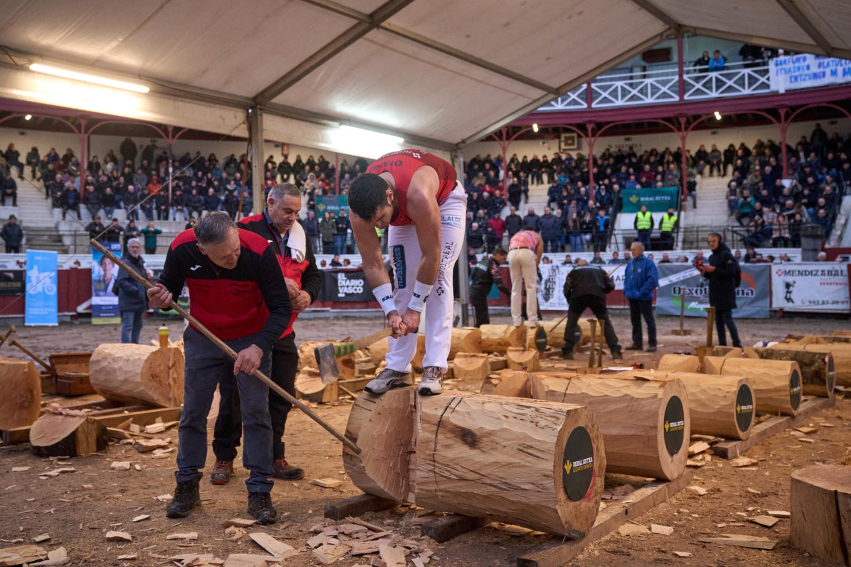
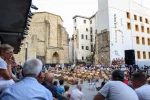
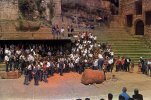
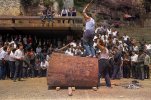
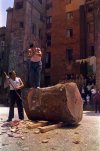
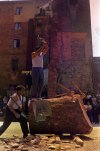
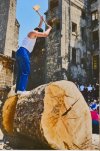
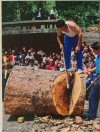
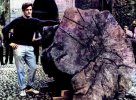
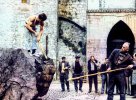
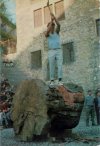
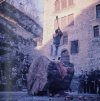
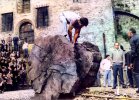
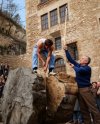
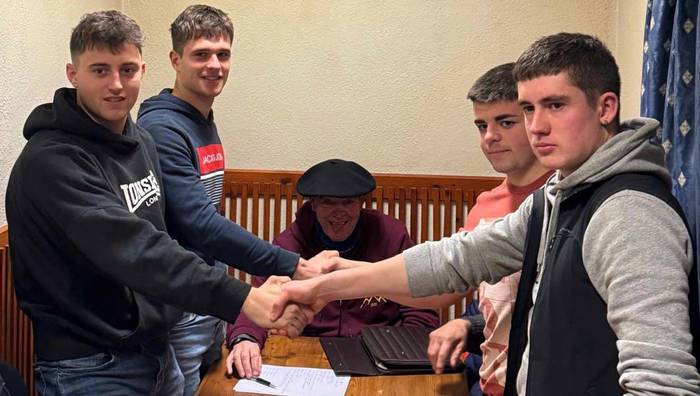
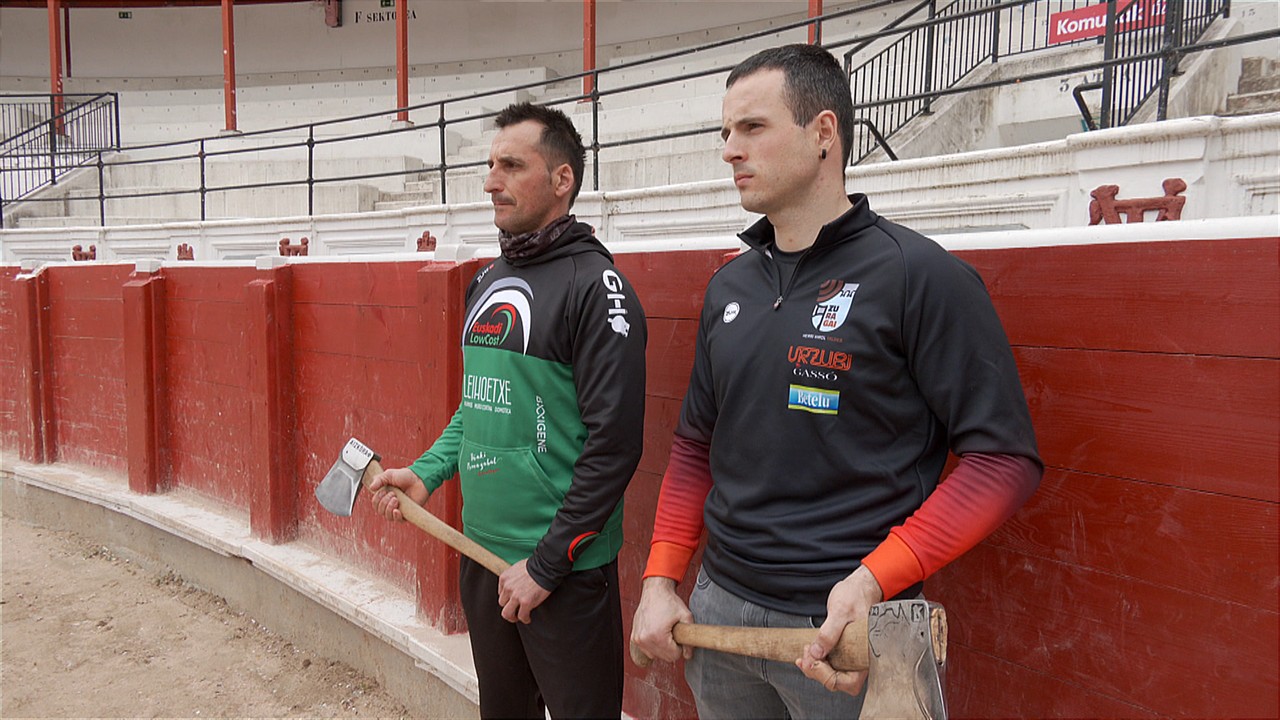
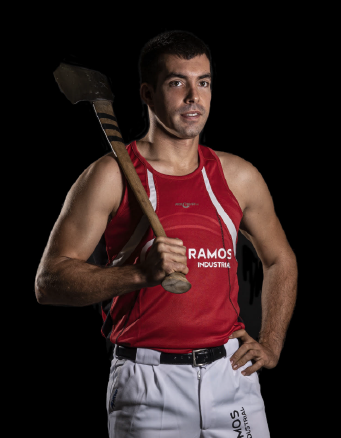
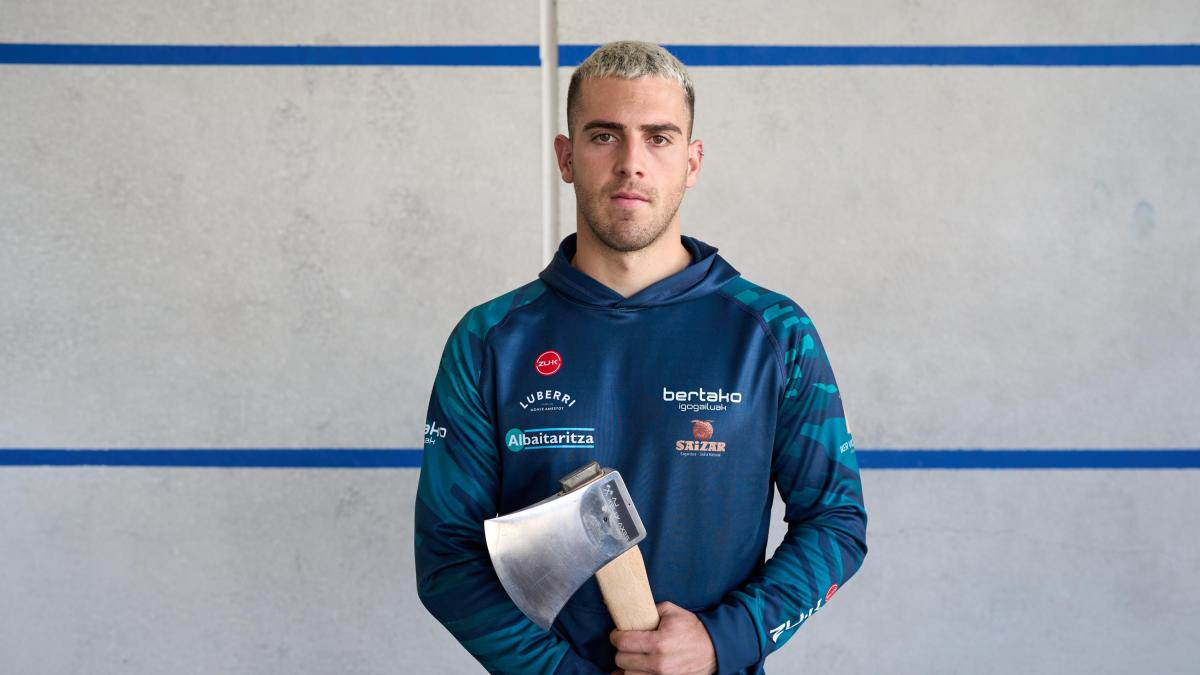
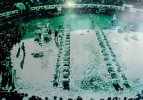
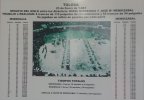
Each axeman had a different approach to the task. Eneko started by cutting the medium logs, with the strategy of tackling the four in a row in the middle part of his work. Iker, aware of the scale of the challenge he was about to face, opted to cut the toughest pair of big logs first and leave the other two for the middle part of his work.
* Note that once you choose a row, you must cut all the logs in that row one by one. You can opt for a different approach for each row, but once you're there, there's only one way back, if you don’t finish the cut properly. This is what happened with Eneko on the first log. After he cut the third log, the judge made him go back to finish the first one. And there's only one way forward, cutting each log in front of you.
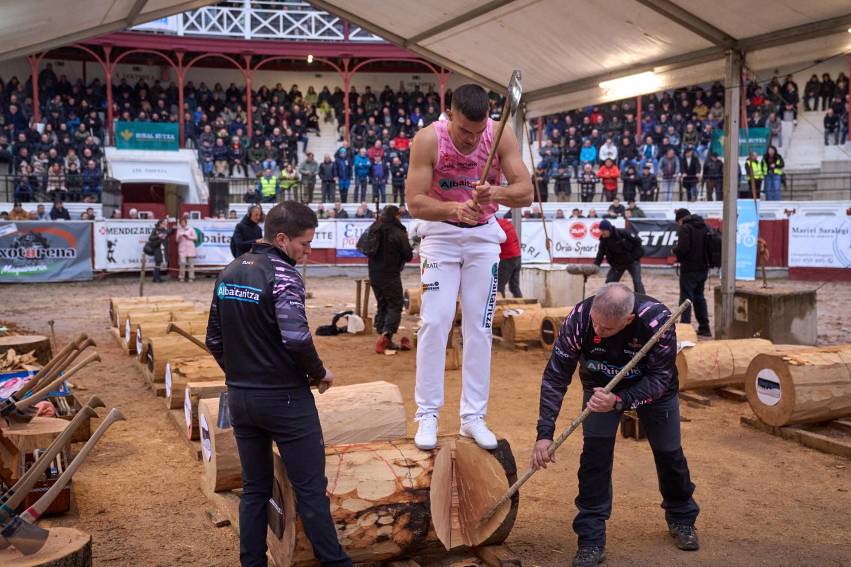
Iker cut the first kerf of the first good big log with just one axe, without stepping the notch. He demonstrated strength, technique, and understanding of the wood.
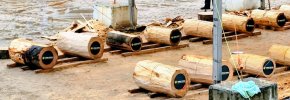
* Note. Those 53 cm big logs named "oinbiko" are considered to be double the work as a 40 cm medium ones named "kanaerdiko". And common approach in Basque axemanship is to cut a kerf with two axes, big one for the outside, small axe for the inside. Indeed the are named as "azal aizkora" outside axe and "barru aizkora" literally inner axe. Iker cut a big log as it was a medium log using only one axe, making a perfect kerf and without losing any time and stamina, impressive.
And this is the main point I wanted to make. Beech is a species, not a specific type of wood. Any given species can show a huge variability in its wood. Within any species, fast-growing wood is not the same as slow-growing wood; trunk wood is not the same as branch wood; and even within a single trunk or branch, the wood at the base is not the same as in the middle or at the end. Soil, sunlight conditions and water availability affect wood development, and even if all other factors are the same, a tree growing in a windy area will not be the same as one growing in a calm area. Even within the same forest, and even when dealing with cloned trees, there are differences between trees at the forest edge and those growing in the interior.
We all go through a learning phase in which, at some steps, we think that each wood species has fixed properties. Let what I am writing here serve to help those who are in that phase understand the reality of nature.
The wood Iker brought was extreme. It was clean, green wood, like the other wood used in the challenge: the fibers were straight, and there were no knots or branch nubs. However, as Iker himself stated in
interviews on the same day:
"The hardest wood I may have ever cut was the one I cut today, and that kind of work requires a very high level of precision and effort. I am satisfied with the work I have done."
This statement was made by the same Iker who has competed for years all over the world cutting all types of species including those present in the Sydney Royal Easter Show.
The best way to see it is to see the Basque TV streaming, but you also can take a look to this video. Here you can see how different we the wood each axeman were cutting.
Those big logs decided the challenge. It took Iker more time than Eneko to cut the medium logs, but that may have been due to the relaxation we noticed once he saw his advantage was large enough.
Eneko’s comments on this aspect were as follows:
"...I struggled with that oinbiko block. The wood was incredibly hard; it even kicked the axe back at me. However, the judges approved the log, it was brought out into the arena, and I was assigned to cut it in the draw. That’s how the game works."
* Note his team took that log as valid that same morning.
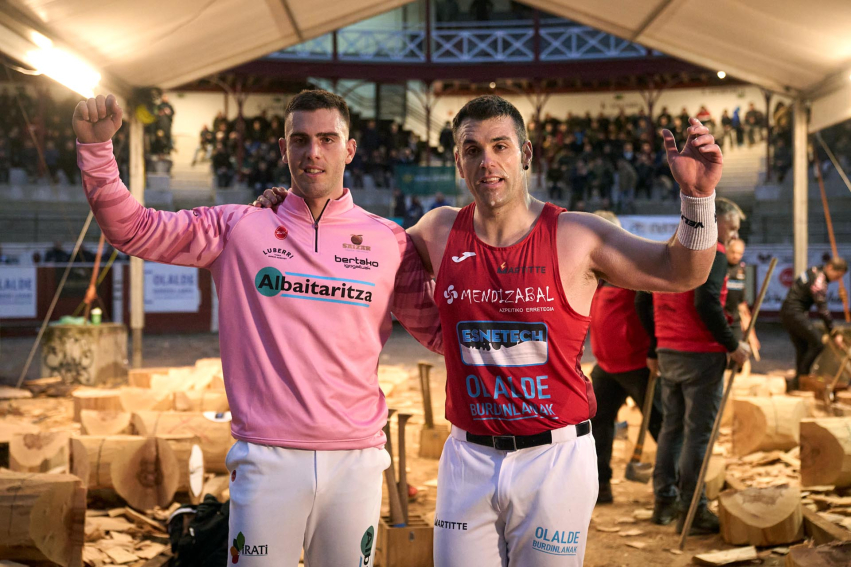
Nevertheless, after 51 minutes and 10 seconds of hard work and 1,995 blows, Iker Vicente won the challenge, demonstrating to everyone (something Eneko also admitted) that he is the best Basque axeman.
 Source
Taking all his experience into account, I would add that he is also the most complete competitive axeman the world has ever seen.
Now, some axe porn. We saw all kinds of axes. There were a few Basque ones (Jauregi was present for sure) but plenty of Australian axes. Most of them were from the Keech family: Keech and Keesteel. They are highly regarded here, and even the grind Basque axemen use on them may change their designation (especially among those who pay close attention to detail), though we continue to call them Australian axes. We think we briefly saw a Brute Forge axe, and there were no standard Tuatahis. The latter have been losing favor among axemen in recent years in favor of old Keech-family and local axes due to their softness.
But in this competition, we saw something different: Iker used special Tuatahi axes for a significant amount of time. These axes were the result of a collaboration between
Iker Vicente, Tuatahi Axes, and AJ Kelly Axes. It’s still too early to make any judgment, but they performed well and we didn’t notice any flaws.
Hope you find this interesting. Best regards
Source of some images I have published here.
Edit: The video of the event has been published, here it is. I love how Iker ended the challenge, after cutting all that wood and getting through the last knot in the final log, he finished with a short sprint. Impressive. Enjoy the video.