All About Austenitizing on New Website - KnifeSteelNerds.com

I hope the information you have previously published in your BladeForum contributions will be included in your new website. Having one place for all info is a great help.
I will definitely be reposting my handful of bladeforums threads with some updates and modifications I just have to decide in what order to do everything.
 
With regard to preheating, would knives be considered complex shapes? They seem simple, but then people start drilling holes, tapering tangs, making notches, etc.
 
With regard to preheating, would knives be considered complex shapes? They seem simple, but then people start drilling holes, tapering tangs, making notches, etc.
Drilled holes are an obvious stress riser. Knives are helped out by the fact that they are very thin though. It would be interesting if we could get the point of view of an experienced tool and die maker.
 
I am not a T&D maker, but I consider a knife a simple shape, not a complex one. A gear is a complex shape, with many changes of direction on the surface and acute angles. Added to that, we are not really concerned with dimensional stability in hardening, as we will be grinding it post-HT.

While holes are stress risers, they rarely are a problem with knives, and the part that takes the most stress is the blade, and the handle is where the holes are. I think sharp 90 degree angles at the shoulders of the ricasso are far more of a risk for a stress riser.
 
Last edited:
I am not a T&D maker, but I consider a knife a simple shape, not a complex one. A gear is a complex shape, with many changes of direction on the surface and acute angles. Added to that, we are not really concerned with dimensional stability in hardening, as we will be grinding it post-HT.

While holes are stress risers, they rarely are a problem with knifess, and the part that takes the most stress is the blade, and the handle is where the holes are. I think sharp 90 degree angles at the shoulders of the ricasso are far more of a risk for a stress riser.

Stacy, did you just use the word “knives”?

Hoss

Just fooling around, I edited the typo. I was typing "a knife" and changed it to "knives", but it didn't take right. - Stacy
 
Last edited by a moderator:
  • Like
Reactions: MJV
Looking at my stats it looks like Part 1 is being read a lot more than parts 2 and 3. It starts to get good after part 1.
 
Do industrial bits and cutters of high speed steel use the prequench procedures?
 
Larrin, thanks for sharing - great website.

I've also read your blurb about the lost 3v modified steel patent... very interesting. But I somewhat call BS on the patent... if you look at it, the ranges for elements are ALL OVER, and WIDE. I really don't think these types of patents should exist, it covers too many possible configurations. I'm interested in your thoughts on the reasonableness of such?

"1. A powder metallurgy cold-work tool steel article of hot isostatic compacted, nitrogen atomized, prealloyed powder having improved impact toughness, said prealloyed powder consisting essentially of, in weight percent, carbon 0.5 to 1.2, nitrogen 0.02 to 0.20, silicon 0.3 to 1.3, manganese up to 1, chromium 6 to 9, molybdenum 0.6 to 2, tungsten 0.5 to 3.0, vanadium 0.2 to 2.0, niobium 1.0 to 4.0, and balance iron and incidental elements and impurities."

 
Larrin, thanks for sharing - great website.

I've also read your blurb about the lost 3v modified steel patent... very interesting. But I somewhat call BS on the patent... if you look at it, the ranges for elements are ALL OVER, and WIDE. I really don't think these types of patents should exist, it covers too many possible configurations. I'm interested in your thoughts on the reasonableness of such?

"1. A powder metallurgy cold-work tool steel article of hot isostatic compacted, nitrogen atomized, prealloyed powder having improved impact toughness, said prealloyed powder consisting essentially of, in weight percent, carbon 0.5 to 1.2, nitrogen 0.02 to 0.20, silicon 0.3 to 1.3, manganese up to 1, chromium 6 to 9, molybdenum 0.6 to 2, tungsten 0.5 to 3.0, vanadium 0.2 to 2.0, niobium 1.0 to 4.0, and balance iron and incidental elements and impurities."
Our patent system is not particularly great. They grant patents with claims that are too wide frequently. The companies ask for chemistry ranges that are as wide as possible so that competitors cannot make slightly modified versions even though the actual product they make will target a much narrower range. Patents on steels at least are so technical that anyone without direct expertise is unlikely to be able to call BS on “over-claiming” or parenting things that have already been patented, etc.
 
Do industrial bits and cutters of high speed steel use the prequench procedures?
They can probably make them just fine without the prequench process and it would be more costly to use it so my guess is no.
 
It's far too easy for any large company to go thru all the possible combinations for this steel: C 0.2-2.0%, Ch 5-20%, Mo 0.4-4%, W 0-8%, Ni 0-4%, Mn 0.1-1%, Si 0.2-2% V 0.2-4% and the balance Fe, with minor other possible impurities...
[/sarcasm]

I'm guessing that overlaps with about half (or more) of all steel standards, so I'll put an exception in for those, as prior art, but get every other possibility outside those ranges.
Perfectly fair right?

At some point basic logic needs to apply, but I won't hold my breath. The companies with $ buy up all the patents to stifle innovation instead of promoting it. It's been that way for a long time now. That's why many other countries won't even bother trying to honor American patents. Apologies for the side-topic comment, but I think getting the world to honor patents that are actually meaningful & valuable is more important in the long view future. (This comment is nothing specific to you or intended in any derogatory sense except vs the patent office). I realize most of us agree that genuinely unique contributions to science/engineering/building should be rewarded. I hope I'm being reasonable...

Great website - I very much like how you present information.
 
They can probably make them just fine without the prequench process and it would be more costly to use it so my guess is no.

I was curious, as the M2 blades I've been using look very fine when broken, but there's no way I could tell a difference between ASTM 8 and 11 by eye I'm pretty sure. Still, for all the effort makers put into refining grain size one blade at a time, industry does a very good job at a staggering production rate.
 
I am going to sticky this now. Look for it up at the top of the page.

It is still open for all posting and discussion.
 
I love internet pages that have footnotes for technical data. I found the articles written cleanly, with good illustrations. If you don't understand the process after reading this article, you probably never will.

That said, I'd much rather see this combined with the HT Sticky than made into it's own sticky. The glut of stickies seems to be slowly returning with youtube links, japanese blade ID, HT Sticky, and a redundant custom search engine.
 
The current sticky is temporary. Where to place it is being addressed right now. It will either be a new metallurg sticky, or part of the HT and metallurgy one.
 
Larrin,

Thank you for your valuable contributions.

I wonder if you could address figure 5-13 on the Austenizing Part 1 page. Here the chart shows the temps at which grain growth happens more rapidly for different tool steels. I was following along with the material which all makes sense but I noticed that in the chart the rate of grain growth for W1 starts leveling off again around 1800˚f while the others do not. What is happening there?


Also, I found the information on prequenching/multiple quenching very interesting.
 
Larrin,

Thank you for your valuable contributions.

I wonder if you could address figure 5-13 on the Austenizing Part 1 page. Here the chart shows the temps at which grain growth happens more rapidly for different tool steels. I was following along with the material which all makes sense but I noticed that in the chart the rate of grain growth for W1 starts leveling off again around 1800˚f while the others do not. What is happening there?


Also, I found the information on prequenching/multiple quenching very interesting.
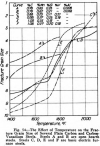
I looked at an older edition of the Tool Steels book to see if they addressed that at all and I didn't find anything. I did find another chart in the older edition with different additions to other carbon steels:
Simple carbon steel grain growth.png
As you can see there are other steels that leveled off at a certain grain size, though at higher temperatures. This leads me to think that it is one of the following scenarios:
1) The grain size becomes large enough that the driving force for grain growth has sufficiently decreased to the extent that grain growth slows.
2) Some other type of coarse particles come into play when the grain size is sufficiently large.
 
Ok, let me see if I understand it correctly (assuming scenario 1). Because grain boundaries are high energy areas for grain nucleation, when grains grow so large that they have consumed a vast amount of surrounding grains there are eventually so few boundaries left from which to grow new grains that production of new grains falls off rapidly.
 
Back
Top