There is a lot of info in the PID forge sticky, as well as many great threads, like Silver_Pilate. He did a bang-up job with that build.
For some good blown forge plans, see the stickies.
In the perfect build, the blower should be a true forge blower. They may look like a cheaper squirrel cage unit, but they run different. They also cost more. Most forge and blacksmith supply companies sell them. To run a normal size propane forge, you don't need a big blower. I find 50-100 CFM more than enough for a HT forge.
Here are some from Centaur Forge.
http://www.centaurforge.com/Blowers/products/169/
As you can see from the above link, the Dayton style blowers that you can find on ebay for $30-50 will work. While not meant for the back pressure of a burner, they will provide air at enough pressure to do the job. Check the CFM before buying.
Here are a few that are the type people use.
http://www.ebay.com/itm/ActiveAir-4...926?pt=LH_DefaultDomain_0&hash=item45f50699c6
http://www.ebay.com/itm/Dayton-Blow...443?pt=LH_DefaultDomain_0&hash=item2eb753e9a3
Placing a 2" gate valve in the air pipe from the blower allows you to control the volume while letting the blower run at full sped. ON a two-stage controlled forge, when setting the HI setting, run the blower at full speed and close the gate valve until the burner is running at the desired setting. In the LOW setting, use the speed control to slow the fan enough to have a proper flame with the lower gas output. This is a better arrangement than the two speed control method I posted in the PID Controlled Forge plans.
A flare allows the gas to drop its velocity and mix a bit more as it enters the chamber.
On a venturi burner, the gas velocity down the pipe is needed to make the venturi and draw the air into the tube. When it reaches the chamber it needs to drop in speed a bit or it may blow out the flame. The flare provides a larger volume of gas/air to pass through the last few inches at a lower pressure.....and that lowers the speed at exit.
On a blown burner, the the flare is not really an issue, as the gas is not injected and the air is under pressure. This is why a blown forge runs at much lower gas pressure.
You can grind a little flare on the inside of the pipe with a cylinder burr if you want.
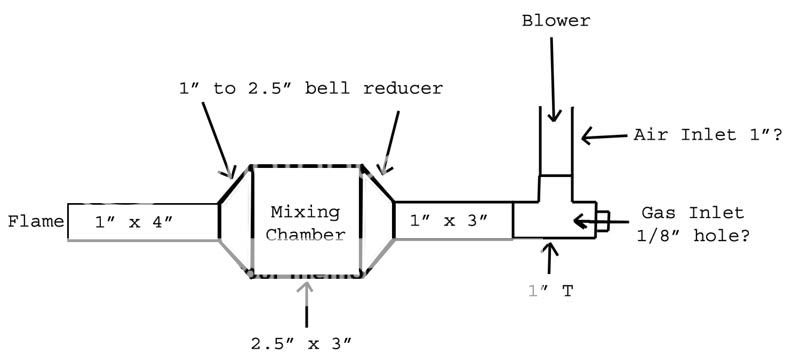
Placing a mixing chamber in the burner tube really does the most good.
It is just two bell reducers with a 3" long pipe nipple between them. This allows the 1" burner tube to expand to 2.5" or 3" and mix the gas . Then it goes back to 1" and the velocity increases and it enters the forge chamber ready to burn. The mixing chamber should be about 4" from the end of the burner tube.
Kevin Cashen had a great section on his website where this is well explained.
FWIW, if you can get Sch 40 stainless pipe for the burner tube and Sch 80 stainless pipe for the flare, the burner will last a lot longer.
Use 1" pipe for burner tube, and 1.25" for the flare. A little grinding or hammering will make them force fit as you did on the burner you built. Grind a taper on the inside of both pipe ends to give it a smooth ..."flare". Even the small change in size from 1" to 1.25" will allow the gas to drop in velocity. If you can, weld them together after making any adjustments.
Last year, I made some flares from titanium tubing, but have not tested them yet. I used a drift to make the flare.