Am I the only one who can't sharpen a knife?

Having the knife almost sharp BEFORE you sharpen it is a good way. (Don Hanson III)
My biggest problem with 'sharp' knives as a new maker was leaving my edge too thick for all sorts of unsubstantiated reason.
Here's a simple rule - "Geometry cuts. Heat treatment determines how long". Roman Landes.

A thing edge cuts better than a thick edge.
And a thin edge is easier to get sharp than a thick one.
^^^Karl Knows^^^ Thin is in, it's where it's at. :cool:
 
This is something I went through for the first 3-4 months of my knifemaking journey as well.

Sharpening free-hand on a belt grinder takes practice but once you can do it, it is very fast to get a hair shaving edge. Most of the posters have posted the key points already:
-get your edges down to .010"
-have consistent angle
-don't burn your edges, deep in water constantly.
-make sure to get a burr before moving on to next grit
-knock off the burr by slicing a piece of wood

The secret I found is to continue practicing, that literally is the secret. holding the same edge angle takes a lot of practice on a belt grinder. One tip is to adjust your platen to your desired angle, so instead of having to guess at the angle you are coming in, just keep the spine at 90. This helped me a lot.

I start out with a 120g belt, go to 320g, then 600g or 800g, switch to a leather stropping belt with green compound to knock off the burr, then hone on a strop paddle with honing oil.
 
Thanks for all the great responses, guys. I am tempted to get a clamp system like Lansky, but I'm hardheaded, so first I want to try to get good at sharpening with a stone. It just seems like something I should be able to do.

My blades are all 1084 and 1095. I use a Craftsman 2x42. I'm not sure what grit the whetstone is, but it has a coarse side and a fine side. I hold the blade at about 20 degrees.


I free hand sharpen with diafolds. I clamp the knife and move the sharpener.
I made some triangular blocks I use to align the sharpener.
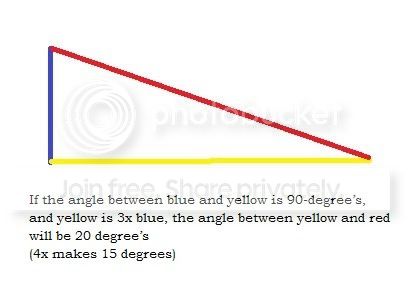
Here's a quick way wo find 20 degrees and 15 degrees:

driehoek_zpstrp5qdwd.jpg
 
So far nearly every response has mentioned guides, clamps, systems, specific tools, stones, gadgets, etc. I mean no offense, but I consider all this a moot point until the guy thoroughly understands what he's trying to accomplish & how to go about it. What he really needs is someone to give him lessons and pointers in person. A tiny burr or wire edge is easy to miss in person, and dang near impossible to see on a Youtube video. Written words just aren't the same when learning to feel how much pressure to use, or feeling it when you increase the angle just enough for the edge to bite the stone. If he doesn't have a mentor close by him, then about the only option is lots of practice, and trial & error. A lot of the tips we give won't make sense until after he's already figured out how they apply to his equipment/tools.

And once you understand how the steel interplays with the stones, the specific tools used to get there are much less important. A piece of ceramic bathroom tile, found piece of sandstone, chromed screwdriver, cheap combination stone, old leather belt, scraps of abrasives from the shop, etched glass, toilet tank lid, concrete, and plenty of other stuff can all be used to help put an edge on a blade if needed.

Generally speaking, the edge should be as thin as it absolutely can be without taking too much damage. But not every edge should be polished to 3000 grit at 15 degrees per side. Sometimes it's better to have a really toothy aggressive edge at 7 degrees, or a medium grit for a nice mix of push cutting & slicing ability with a convex relief to blend in with the grinds, or a belt edge at 10 degrees with a polished microbevel, or fully convexed to 18-20 degrees. And so on.

 
Understanding blade geometry, steel classification, belt, stone, diamond ceramic abrasiveness along with understanding what takes place during heat treating are all areas of blade smithing. It is a real plus to study with an established smith, but it still takes time. Its a learning process. Gaining knowledge comes by making mistakes, over heating an edge, to steep an angle.
"The edge should be as thin as possible" on some knives, but not all knives. Thats part of learning as well; what goes where and with which steel. Those who have spent decades at this look back at what we thought we knew at the beginning and laugh at what little we did know.

I agree with you Possum you can sharpen with any object that is harder than the steel being sharpened, but you have to put the time in to understand the process in total. I've been doing this 17 years and I am still learning.

Regards, Fred
 
Thats part of learning as well; what goes where and with which steel. Those who have spent decades at this look back at what we thought we knew at the beginning and laugh at what little we did know.

I agree with you Possum you can sharpen with any object that is harder than the steel being sharpened, but you have to put the time in to understand the process in total. I've been doing this 17 years and I am still learning.

I hear ya. I started sharpening almost 30 years ago, and thought I knew a little, until I decided to start shaving with an antique straight razor. Wow, that was humbling. It took me a couple years of playing with it off & on until I could finally get a comfortable shave on my chin. And that's what I'm getting at. Even coming from a background where I knew how to put a hair whittling edge on a pocketknife over 20 years ago, I struggled. I read all kinds of articles and forum threads on the subject, watched videos on youtube, bought a couple expensive stones, a new strop, etc., and it was all useless until I put in the time to really understand it myself. If I had a neighbor to show me what was going on, I could have probably shortened that to a week or two.
 
So far nearly every response has mentioned guides, clamps, systems, specific tools, stones, gadgets, etc. I mean no offense, but I consider all this a moot point until the guy thoroughly understands what he's trying to accomplish & how to go about it. What he really needs is someone to give him lessons and pointers in person. A tiny burr or wire edge is easy to miss in person, and dang near impossible to see on a Youtube video. Written words just aren't the same when learning to feel how much pressure to use, or feeling it when you increase the angle just enough for the edge to bite the stone. If he doesn't have a mentor close by him, then about the only option is lots of practice, and trial & error. A lot of the tips we give won't make sense until after he's already figured out how they apply to his equipment/tools.

And once you understand how the steel interplays with the stones, the specific tools used to get there are much less important. A piece of ceramic bathroom tile, found piece of sandstone, chromed screwdriver, cheap combination stone, old leather belt, scraps of abrasives from the shop, etched glass, toilet tank lid, concrete, and plenty of other stuff can all be used to help put an edge on a blade if needed.

Generally speaking, the edge should be as thin as it absolutely can be without taking too much damage. But not every edge should be polished to 3000 grit at 15 degrees per side. Sometimes it's better to have a really toothy aggressive edge at 7 degrees, or a medium grit for a nice mix of push cutting & slicing ability with a convex relief to blend in with the grinds, or a belt edge at 10 degrees with a polished microbevel, or fully convexed to 18-20 degrees. And so on.

^^^This needs to be repeated^^^ Good Stuff!

Seems learning to sharpen a knife should come before learning to make one?
 
There is a lot of wisdom in what you say. The allure of making knives sometimes outweigh the proper steps in learning. Sharpening is an art by itself and I really do think guys should be able to do it before moving on to the next steps. I took me months of doing only free hand sharpening on my belt grinder before I got the hang of it.... and also learned that there are some cheap steels that will not take an edge.

This isn't directed at the OP but I see too many guys get into knives and the first thing they do is work on their logo and "brand", very little time is put into practicing the basics. Free hand sharpening on the belt grinder may come natural to some people but for me it was months of practicing and dozens on dozens of scrapping practice blades before I got an acceptable edge.

There are some sure fire ways to get a blade sharp using jigs, but to free hand like the OP is talking about on his belt sander just takes practice.
 
There is a lot of wisdom in what you say. The allure of making knives sometimes outweigh the proper steps in learning. Sharpening is an art by itself and I really do think guys should be able to do it before moving on to the next steps. I took me months of doing only free hand sharpening on my belt grinder before I got the hang of it.... and also learned that there are some cheap steels that will not take an edge.

This isn't directed at the OP but I see too many guys get into knives and the first thing they do is work on their logo and "brand", very little time is put into practicing the basics. Free hand sharpening on the belt grinder may come natural to some people but for me it was months of practicing and dozens on dozens of scrapping practice blades before I got an acceptable edge.

There are some sure fire ways to get a blade sharp using jigs, but to free hand like the OP is talking about on his belt sander just takes practice.

Good observations, for sure. I've been collecting knives for years and decided it was time for me to start making them. As just a collector, I kept my knives "sharp enough," but now as a maker, I want to do better than that. So yes, in retrospect it would have made more sense to get really good at sharpening before I learned any bladesmithing, but that's not how it worked out, and I can't say I have any regrets. I've done few things in my life that bring me as much joy and satisfaction as making a knife.

Plus, I'm the kind of person who likes to plunge into something and teach myself. I don't have another smith showing me the ropes. It's fun, but there's obviously a lot that I'm not learning, and I'm not as productive or successful as I could be. Oh well.

At least most of the blades I've made are sharp enough to gut a trout!
 
I use a wicked edge as well.. it's great for getting the profile right. . Once you sharpen it with that you'll be able to stone sharpen no problem.. every once in awhile I'll go back and straighten my personal knives back up with it. . As for the ones i make is quick and easy. .

Sent from my SM-G906K using Tapatalk
 
Understanding blade geometry, steel classification, belt, stone, diamond ceramic abrasiveness along with understanding what takes place during heat treating are all areas of blade smithing. It is a real plus to study with an established smith, but it still takes time. Its a learning process. Gaining knowledge comes by making mistakes, over heating an edge, to steep an angle.
"The edge should be as thin as possible" on some knives, but not all knives. Thats part of learning as well; what goes where and with which steel. Those who have spent decades at this look back at what we thought we knew at the beginning and laugh at what little we did know.

I agree with you Possum you can sharpen with any object that is harder than the steel being sharpened, but you have to put the time in to understand the process in total. I've been doing this 17 years and I am still learning.

Regards, Fred

This kind of knowledgeable input is why I am so glad Fred chose to stay around these forums. I do think there is some benefit to using a 'guided' sharpening system, and I would count the bubble jig among guided systems. I use one occasionally now, but it was very helpful in my learning curve! I now use the Chef from Edgepal, a custom made sharpening system from Sweden: http://www.edgepal.com/english-5444885 it uses magnets to hold your blade, and is very easy to set to a specific edge. I can get any knife to a shaving edge on my belt sanders, but I honestly can't tell you exactly which angle I achieve.--I think for knives I sell, it is better to use a system where I can sharpen to a specific set angle, and I can communicate that to my customer--and also set a specific edge on a knife if a customer requests.

I will add this one view--it's true that folks can use almost anything harder than the knife steel they are working on to get an edge, BUT I think if a person is wanting to obtain a good sharpening medium, in todays world, especially with the wide amount of steels available to us, I feel strongly that a diamond 'stone' is the best thing a person can use, especially with a 'guided' system if they can't produce the edge they are after on a belt sander.
 
There is a decent video on youtube by Chris Carter of Carter Cutlery. According to him and he proves it. The method is more important than the media used. There is a video where he sharpens on a cinder block and strops with a newspaper. I follow his method and have great success whether I am using the Lansky, the Smith field sharpening systems or if I am using my power sander. Normally I use my 1x42 sander with a surgi sharp jig to save time. I start with a 150 grit. Once I have a burr I move up to 320 grit, after 1-2 passes I move up to 600 grit. Then Chris has a step where he gently drags the cutting edge along a piece of wood to remove any remaining wire burr on the edge. This step makes a noticeable difference from my experience. Even at 600 grit it barely cuts but once the burr is gone on the wood block it really cuts. Then strop to make it very sharp. You can strop on a wide variety of things. I have a leather belt for my 1x42 that I power strop with. Personally before I would invest in more equipment I would check my method.
 
Last edited:
I have a side business of releasing white doves at weddings and funerals that return back to my house after the release. With that said it's a lot of work. EVERY day I have to clean the loft of droppings. I use two standard putty knifes, a smaller one for perches and a larger one for the floor. Both are used scraping WOOD only! In about 6 months both end up being very sharp just from scraping the wood and start slicing at every little splinter in the wood. I have to take them to my belt sander to flatten them. They both will pass any knife bending test and will cut you with ease! lol So the medium you use to sharpen isn't the issue it just may take more time.
With that said for my knives I get my initial bevel on knife belt sander and finish with a KME sharpener. The key is consistent angle and getting a burr along the entire side before switching sides and ultimately switching grits. Diamond stones are your best friend. BUT don't push to hard or you'll just wear out the diamonds faster than you should. Let the diamond stone do it's work and don't try to hog it off with more pressure.
 
If a Rockwell hardness tester could be used to test at the edge i'm sure there would be not so many people still suggesting the use of a dry belt grinder to sharpen a blade, and dunking often means very little at the very edge's level.
Under coolant a low speed belt grinder it is a completely different beast, very similar to the water wheels used in the past, capable of doing a proper job.
But anyone, with a sprinkle of water on the correct set of diamond bench stones, to reach quickly the aphex, and the whetstones for finishing, can make a very quick job to create and mantain a killer edge that lasts. At least i won't sacrifice not a single HRC to a dry belt, just to save the last couple of minutes of my overall job.
 
Last edited:
If a Rockwell hardness tester could be used to test at the edge i'm sure there would be not so many people still suggesting the use of a dry belt grinder to sharpen a blade, and dunking often means very little at the very edge's level.
Under coolant a low speed belt grinder it is a completely different beast, very similar to the water wheels used in the past, capable of doing a proper job.
But anyone, with a sprinkle of water on the correct set of diamond bench stones, to reach quickly the aphex, and the whetstones for finishing, can make a very quick job to create and mantain a killer edge that lasts. At least i won't sacrifice not a single HRC to a dry belt, just to save the last couple of minutes of my overall job.

It's speculation without empirical data. But I'm in agreement here,
Thus I use Japanese waterstones to sharpen.
 
It's speculation without empirical data. But I'm in agreement here,
Thus I use Japanese waterstones to sharpen.

I've read studies that give a broad range of results when it comes to belt sharpening. There are far to many variables to make a concrete claim. We use many sharpening techniques, from diamond plates, dry belt sharpening are slow speeds, wet belt machine. Each has a purpose. It's knowing what system and technique to use in specific situations.

Fred
 
Back
Top