

waynorth
Dealer / Materials Provider
- Joined
- Nov 19, 2005
- Messages
- 33,346
Back in 1871, the Italian Government enacted a law preventing folding knives from locking open, to prevent the deadly effects of knife fighting. A rather stupid law, but that is what most governments are famous for!!
Thus the Sfilato was born, and slipjoint knives returned to predominate. I don't know when the law was changed because locking and push-button knives are now common.
Knowing that Italians in general scoff at, and ignore, stupid laws, maybe it is still on the books!
Around the turn of the last century, brothers Felix and Michael Mirando left Frosolone, Italy for the U.S.A. First working for Empire Knife Co. in Winsted, CT, they eventually went out on their own making skeleton knives, and wound up forming the Imperial Knife Co. just before WW1.
The brothers learned forging and knife making from their father, Cosimo in Frosolone. A small town, known for the the Sfilato style of knife, among others, the skills learned there eventually translated into one of the most innovative and productive knife companies in New England. And the good fortune spilled over into Frosolone, where you will see the name Mirando on streets and buildings!
And who here has not owned an Imperial knife at one time or another??
This knife came from the Imperial collection, when Schrade USA, once named Imperial Schrade, went bankrupt and was sold off.
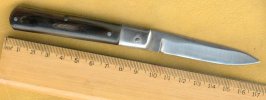
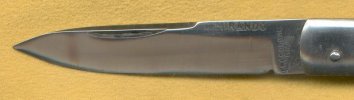
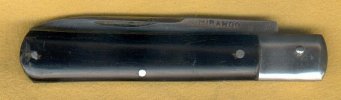
Papa Cosimo came to America to help out the boys, and was once listed as a knife repairer in the public directory. The C. Mirando stamped on the blade, and the knife's location in the collection, provide pretty good provenance, and I believe that Papa built it! A good surmise, would be that it was built before the 1st World War, but that is not currently known for sure.
The Horn handles, slim spear/dagger type blade with a false edge on one side are apparently indications of a true Sfilato, and I suspect the very stiff springing would be a requirement also, helping to mitigate the lack of the desired lock.
Enjoy!

I would like to thank Alfredo (Martineden) for valuable information contained herein!!
Thus the Sfilato was born, and slipjoint knives returned to predominate. I don't know when the law was changed because locking and push-button knives are now common.
Knowing that Italians in general scoff at, and ignore, stupid laws, maybe it is still on the books!
Around the turn of the last century, brothers Felix and Michael Mirando left Frosolone, Italy for the U.S.A. First working for Empire Knife Co. in Winsted, CT, they eventually went out on their own making skeleton knives, and wound up forming the Imperial Knife Co. just before WW1.
The brothers learned forging and knife making from their father, Cosimo in Frosolone. A small town, known for the the Sfilato style of knife, among others, the skills learned there eventually translated into one of the most innovative and productive knife companies in New England. And the good fortune spilled over into Frosolone, where you will see the name Mirando on streets and buildings!
And who here has not owned an Imperial knife at one time or another??
This knife came from the Imperial collection, when Schrade USA, once named Imperial Schrade, went bankrupt and was sold off.
Papa Cosimo came to America to help out the boys, and was once listed as a knife repairer in the public directory. The C. Mirando stamped on the blade, and the knife's location in the collection, provide pretty good provenance, and I believe that Papa built it! A good surmise, would be that it was built before the 1st World War, but that is not currently known for sure.
The Horn handles, slim spear/dagger type blade with a false edge on one side are apparently indications of a true Sfilato, and I suspect the very stiff springing would be a requirement also, helping to mitigate the lack of the desired lock.
Enjoy!
I would like to thank Alfredo (Martineden) for valuable information contained herein!!
Last edited:


