
-
The BladeForums.com 2024 Traditional Knife is available! Price is $250 ea (shipped within CONUS).
Order here: https://www.bladeforums.com/help/2024-traditional/
You are using an out of date browser. It may not display this or other websites correctly.
You should upgrade or use an alternative browser.
You should upgrade or use an alternative browser.
angle of edge
- Thread starter migmaq
- Start date


Spydermade86
Gold Member
- Joined
- Jul 28, 2022
- Messages
- 737
I think there are a lot of variables that will determine the best edge angle for each blade, geometry cuts!

- Joined
- Apr 12, 2009
- Messages
- 13,669
My habit is to go as low in angle as possible while still maintaining an even balance between good cutting performance and ease of upkeep.
For the most part, I'm willing to tolerate some moderate dulling or edge damage, so long as the blade and edge geometry are thin enough and acute enough to make touching up simple. A thin blade grind with acute edge geometry makes it much easier to restore a keen edge when it dulls a little bit, or even a lot. In the end, this 'even balance' has taught me that an edge angle down to about 12.5° per side works pretty well for me with most any blade or steel I use. I don't take any edge wider than 15° per side, at all.
20° per side seems to be the popular default target for most knife manufacturers. They reasonably assume a lot of users will put their blades to very hard use, or even what most of us might view as abuse, using the blade for prying, brutal chopping or using it as a screwdriver at times. That sort of treatment would wreck a thin & acutely ground edge in a heartbeat.
For the most part, I'm willing to tolerate some moderate dulling or edge damage, so long as the blade and edge geometry are thin enough and acute enough to make touching up simple. A thin blade grind with acute edge geometry makes it much easier to restore a keen edge when it dulls a little bit, or even a lot. In the end, this 'even balance' has taught me that an edge angle down to about 12.5° per side works pretty well for me with most any blade or steel I use. I don't take any edge wider than 15° per side, at all.
20° per side seems to be the popular default target for most knife manufacturers. They reasonably assume a lot of users will put their blades to very hard use, or even what most of us might view as abuse, using the blade for prying, brutal chopping or using it as a screwdriver at times. That sort of treatment would wreck a thin & acutely ground edge in a heartbeat.
Last edited:
- Joined
- Jan 25, 2022
- Messages
- 279
I like a more acute angle if the steel supports it. Honestly, all things being equal, because of the wider bevel, I find stropping much easier to achieve low BESS numbers with a 15 degree bevel vs a 20 degree bevel. As the angle geometry increases the physical surface of the bevel becomes a much smaller target to hit making superior results tougher to reach. IMHO
Larrin Thomas’s research has shown lower edge angle is a significant performance factor in CATRA cutting performance. Smaller is better down to the point the blade can support it. Here’s a quote from his report titled:
Maximizing Edge Retention – What CATRA Reveals about the Optimum Edge
The Biggest Finding
Edge angle had a larger effect than many people expect.
The CATRA testing showed that lower edge angles retained cutting performance longer than thicker edge anglesduring slicing tests. This seems counterintuitive because many people assume thicker edges last longer.
- Joined
- Apr 12, 2009
- Messages
- 13,669
I definitely agree with the above.
Buck Knives changed their spec for edge angles based on extensive CATRA testing. Their spec is now 13°-16° per side, much narrower than what they'd previously put on their edges. Great cutting performance that holds up well, and also much easier to resharpen when the edge is thin.
Buck Knives changed their spec for edge angles based on extensive CATRA testing. Their spec is now 13°-16° per side, much narrower than what they'd previously put on their edges. Great cutting performance that holds up well, and also much easier to resharpen when the edge is thin.
- Joined
- Jan 25, 2022
- Messages
- 279
Thanks for the intel... did not know.I definitely agree with the above.
Buck Knives changed their spec for edge angles based on extensive CATRA testing. Their spec is now 13°-16° per side, much narrower than what they'd previously put on their edges. Great cutting performance that holds up well, and also much easier to resharpen when the edge is thin.

- Joined
- Oct 18, 2018
- Messages
- 9,203
All depends on what you are doing with it....
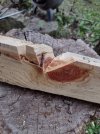
Too Acute
Too Acute

Jason B.
Knifemaker / Craftsman / Service Provider
- Joined
- Jun 13, 2007
- Messages
- 11,244
The apex is the only part that cuts, everything else is drag. So, going as low as possible is always best.
You will have limiting factors like blade geometry preventing you from going to lower angles but getting down to 15° per side is doable on most any knife. Steel hardness can also play a factor. Some knives are much softer than most think and as you get down to low angles you end up with a lot of deformation, rolling/folding and denting. Not very common, but clone knives and cheap kitchen knives tend to have this problem.
Im typically in the 15°-17° range on folders and fixed blades, and 10°-12° on mid to high end kitchen knives.
You will have limiting factors like blade geometry preventing you from going to lower angles but getting down to 15° per side is doable on most any knife. Steel hardness can also play a factor. Some knives are much softer than most think and as you get down to low angles you end up with a lot of deformation, rolling/folding and denting. Not very common, but clone knives and cheap kitchen knives tend to have this problem.
Im typically in the 15°-17° range on folders and fixed blades, and 10°-12° on mid to high end kitchen knives.
- Joined
- Apr 12, 2009
- Messages
- 13,669
Yes, back around year 2000, Buck adopted the new spec and dubbed it 'Edge 2000' (or 'Edge 2X').Thanks for the intel... did not know.
I've purchased several Bucks in the last 3 years or so and have really been impressed with the factory edges on their blades. Maybe the only brand that I haven't felt compelled to immediately reprofile as soon as I purchase them.
Last edited: