
Another first knife picture thread...

Joined
Sep 17, 2000
Messages
279
This forum has been beyond helpful with the making of this knife.

It has a million issues and, unfortunately, that's about all I see when I look at it, but I'm fairly proud of it just the same. The plunge line is horrible and the flat grind narrows at the tip.

I learned a ton working on it and hopefully the next one will be a bit better.


It's 1/4" Aldo's 1084 and was heat treated by me in a little two brick forge. It's a little thick for a blade this small.
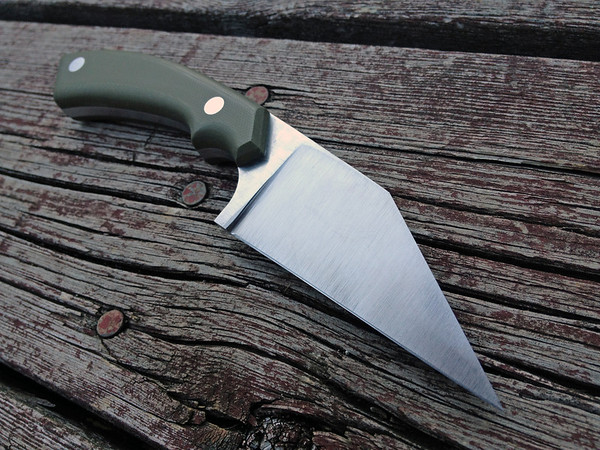
firstknife1-M.jpg


After a couple months of reading I jumped into this. It took forever and was a lot more work and lot more interesting and fun than I even thought it would be. When I see the blades posted on here I'm even in more awe at them than I was before.

Any critiques would be great.
 
Last edited:
Wow... Wish my first looked half as good as that! ;) really impressive. 1/4 is a little thick, but I did the same thing on my first knife, and so did a lot of people. Using 1/8 is a lot easier and gives better results. A hand-rubed finish will look good, and it can help a little with your plunges. Handles look great!
 
Thanks for the compliment.

I actually ordered 3/16, but was sent 1/4 and just used it. I have no complaints about that.
 
Heck looks better then my 3rd. The thinner stuff will be so much easier to work with.
 
The point looks very fragile to me. I'd suggest a curved drop instead of a straight angle.

Handle is nice... certainly less blocky and crude than most first knives I see.

Well done, sir.
 
Looks really good.

As Greg pointed out, the point is going to break in use, sooner or later. Don't get upset when it happens, just round it up as a little curved drop.

Design pointers:
The handle is superb. It has flow and a secure grip. There is no sharp corner on the blade right at the finger - Kudos!

The blade is angular. It has a straight spine with a straight drop angle. The edge is totally straight. While not unattractive, it is very different from the handle.

A blade with an upswept edge would cut better, as the knife will only cut at the tip as it is now ( Hold it in your hand and try and cut a piece of cardboard that is laying flat on a cutting board).
The spine and drop can be lived with, but the super straight edge is going to be very hard to maintain. Sharpening it and keeping it flat will be difficult. After sharpening, the unsharpened part beyond the plunge will prevent the edge from contacting the cutting surface anywhere but the tip. The unsharpened area should be a small curve upward, called a choil. That can be added with a 1" small wheel in a Dremel either now, or after sharpening the knife a time or two.

For these reasons, a blade edge with a slight upward curve would have solved all these issues. It would still have a sharp tip, but the tip would be thicker. This blade could be re-shaped into this, but it is probably best to just leave that for the next knife.....which I am sure will be a stunning job.
 
Thanks for the replies.

The tip is really thin and fragile, something I didn't really take into consideration with this shape until I started grinding and saw what was happening. I kept going anyway figuring the worst that could happen is it would end up scrap that would be a test mule for heat treating.

I agree that the angles on the blade kind of clash with the curves on the handle. I tried to offset that by leaving the sharp edges at the pommel (although I'm not convinced it was enough), but then ended up rounding them off slightly due to a mistake I made.

I also see how the rear portion of the cutting edge becomes pretty unusable due to the ricasso extending all the way down to the cutting edge (I believe that's what you were saying).

I have two more blanks cut out this same shape. I may not grind as high on them to see if the tip is a big more rigid (or I'll take your advice and sweep the cutting edge upward a bit)...or they might just get shelved for something else that doesn't have that issue.
 
Back
Top