Another Potential Testing Aid

Rick Marchand

Donkey on the Edge
Moderator
Joined
Jan 6, 2005
Messages
9,680
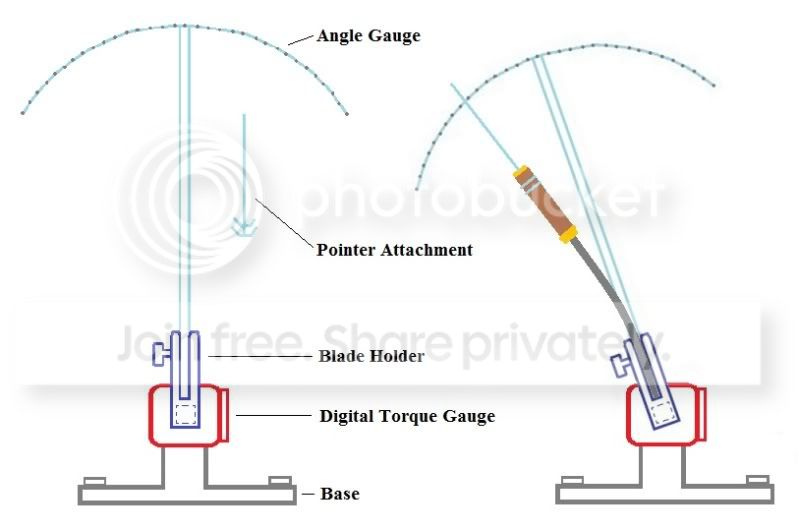
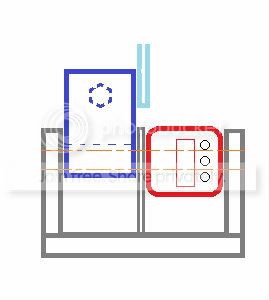
I am in the process of building a contraption to measure a more realistic ft/lbs torque of resistance a blade generates while being laterally flexed. It might be able to give a more accurate angle of deflection as well. I've opted for the cheaper/more work route, rather than paying $1500 for a torque meter that is basically ready to go. AC Delco has a fairly cheap Digital Torque Guage that ranges up to 150 ft/lbs. (Should be sufficient for most knives) Here is my idea....

torque2.jpg

torque1-1.jpg


$(KGrHqZ,!g4E7P1Vu3(2BO7!ggu6Sg~~60_35.JPG


What are your thoughts/ideas/critiques? I am gathering parts right now.


Rick
 
Last edited:
Excellent engineering. The depth of insertion of the blade tip, and the center of rotation and torque are fixed parameters . That way the device will alway read force the same.

Remember that the results will only be equivalent for blades of the exact same shape, thickness, and length. Otherwise , you are comparing apples and oranges.
 
Thanks.

I realize that the blades are the variable in this device. It would be good for testing like bars of steel while experimenting with heat treat. The Guage has a "peak" mode that records the highest reading. That would be good for destruction testing. I hope 150lbs is sufficient for most blades. That's the largest they offer, right now.
 
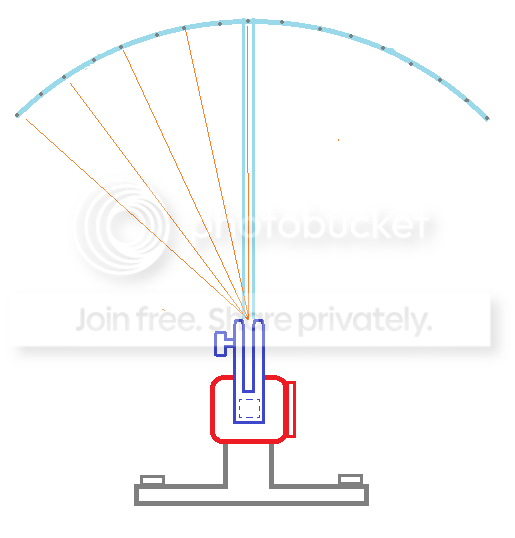
Stacy.... Should the center point of the angle guage be at the mouth of the blade holder? I would tend to think so..... Technically, it is somewhere along the curve of the blade but practically speaking, where would you put it?
 
Pretty cool Rick!

I bet you could market those to the crowbar industry. :)
 
Rick,
If you want the closest reading to the actual force needed to bend "X" inches of steel "Y" degrees, the attachment of the meter should be at the mouth of the clamp, not the end as drawn. This is the end of the flexed portion of the blade. The part in the clamp can not flex, so it merely adds to the length, without adding to the flex.

Where the center of rotation is will change the amount of leverage applied to the torque meter, and thus vary the force needed.

The blade is the lever, and the pivot point is the fulcrum.
If the fulcrum is exactly at the point where the blade begins to bend, it measures the amount of force needed to bend the blade. If it is at the end of the rigid fixture, the measurement is different, because you have a longer lever.

It really won't matter, as the measurement numbers are merely a reference number for comparison between similar blades. If the pivot point is the same each time, the readings will be comparative.

If you go with the blade mount in the drawing, I would put the pivot as drawn, because it will be much easier to weld up the socket to the slit bar. This will also keep the plane of the blade closer to the plane of the meter shaft, which will remove another variable - vectors

A alternative blade mount that will be really easy to make, and work better, would be to slot a spark plug socket with two slots that will allow the blade tip to be inserted and the tip will stick out the bottom. Then drill and tap it from the sides for two thumb stud bolts. Take a piece of round UHMW or Micarta that will fit loosely in the socket and cut it in half lengthwise. Slip the blade between the plastic/Micarta to the point where you want it to start the flex, and tighten the bolts to lock in the blade. Basically you build a tiny Moran knife vise with a top and bottom slot.

With the blade locked between the jaws, and the socket snapped on the gauge, it will read a pretty accurate force measurement. Let me know the shaft size of the gauge, and I'll put one together for you. I have everything I need on hand in the shop.

 
Last edited:
Thanks Stacy... I was thinking to make the center point of the angle gauge at the top(mouth) of the clamp as well.

torque3.png


That socket clamp sounds pretty snazzy... I know how it should be done, but really, I am not set up for it. If you are up for fabricating one, I would appreciate it greatly. The gauge has a 1/2" drive..... and seriously, let me know how I can compensate you for your trouble.
 
Back
Top