another s90v question thread....

Joined
Oct 29, 2005
Messages
19,834
alright, so ive been carrying my s90 millie a couple weeks. it was with str for a spell getting tapped for tip up.

it has been my duty knife regularly since i got it. i have also replaced my d2 millie at the range with this one. so its been cutting stuff, mainly cardboard and other soft media.

but im certain i will have to at least touch it up at some point.

i reread some other threads where i had asked some questions, but im still a little unclear.

1. there was mention of carbides falling out.
-what does this mean?
-can i see this happen?
-how does missing carbides affect the edge?
2. sal said he just uses the fine or ultra fine sharpmaker stones.
-have his carbides fallen out?
3. will the edge pro be a good tool to use?

4. what is the rockwell hardness on the s90v?
-it "feels" harder, if that makes any sense, than even my d2.

i can get diamond stones if absolutely necessary, but would prefer to use what i already have.

haze?
 
What some of us were worried about is that the references I have been able to find show vanadium carbide (which S90V has a lot of) to be harder than aluminum oxide (which the SharpMaker ceramics are made of). The concern was that the ceramics would abrade away the steel matrix without being able to cut the harder vanadium carbides. This would leave the carbides unsupported, allowing them to break out during use, leaving behind craters where they used to be. Even large vanadium carbides are still very small, so I doubt you could see this without a microscope, but the net result would be rapid edge dulling, or at least coarsening (loss of smooth polish), a.k.a. microchipping.

Sal says this doesn't happen. I don't have an electron microscope to prove it or disprove it. Sal says he sharpens his on the SharpMaker with no problem. I sharpen mine the same way I do any other steel...on diamond hones. I haven't had any problems either.

The hardness on S90V from Spyderco is Rc 60-61.
 
what kind of spyder is that in your avatar?


would i be better off not using the edge pro then?
 
I'm pretty sure it was shown that the sharpmaker rods are harder than the Vanaduim carbides, by quite a bit. No worries there.

I'm pretty sure your regular hardware store benchstones will do the job too, it'll just take a lot longer.
Softer media can erode harder material with enough wear, I get to see all sorts of parts on machinery worn down from moving grain. I doubt wheat seeds would facor very high on the Rc scale, but they sure can eat metal if you run enough of them across one part.
 
I'm pretty sure that sapphires (which are aluminum oxide) are the second hardest material on earth (just behind diamonds). I might be wrong, but I know they are over a 9 on the moh scale (diamonds being a 10) and I doubt Vanadium carbides are harder. Keep in mind, I could very well be wrong.

That having been said, diamonds (being the hardest material on earth) will have no problem honing vanadium carbides.
 
Last edited:
Blah, blah, blah spyderco ceramics work just fine with S90V. Not sure of the other stones but the UF ceramic is rated 9.2 on the moh scale so I don't see why anyone thinks it won't work.

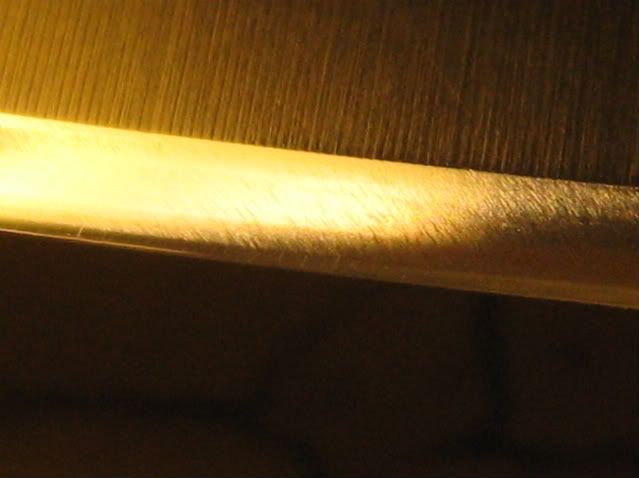
S90V millie and UF ceramic, looks like its working to me.
Picture310.jpg
 
What some of us were worried about is that the references I have been able to find show vanadium carbide (which S90V has a lot of) to be harder than aluminum oxide (which the SharpMaker ceramics are made of). The concern was that the ceramics would abrade away the steel matrix without being able to cut the harder vanadium carbides. This would leave the carbides unsupported, allowing them to break out during use, leaving behind craters where they used to be. Even large vanadium carbides are still very small, so I doubt you could see this without a microscope, but the net result would be rapid edge dulling, or at least coarsening (loss of smooth polish), a.k.a. microchipping.

Sal says this doesn't happen. I don't have an electron microscope to prove it or disprove it. Sal says he sharpens his on the SharpMaker with no problem. I sharpen mine the same way I do any other steel...on diamond hones. I haven't had any problems either.

The hardness on S90V from Spyderco is Rc 60-61.

It's been a decade or two, but I can attest that vanadium carbides are 'harder' than aluminum oxides, though not by much. The carbides I was working with were thin films, rather than bulk material ... so my conclusions should be looked at with suspicion (the processes to create the carbides for thin films are quite different than those employed in bulk materials).

Vanadium carbides, in thin film form, did not support or sustain cracks as easily as aluminum oxides. It is possible to accidentally create small agglomerations of carbides and oxides in thin films -- these are small-scale accidents, essentially. Oddly enough, the vanadium carbide agglomerations tended to fall apart into smaller pieces much more easily than the oxides.

Not sure how this little 'nugget' of information transfers to concerns about edge sharpening and edge retention, but it's lonely 'out here,' so I thought I'd toss the tidbit in.

Howdy, Morimotom. Hope life (and the citizens) is treating you well.:thumbup:
 
What some of us were worried about is that the references I have been able to find show vanadium carbide (which S90V has a lot of) to be harder than aluminum oxide (which the SharpMaker ceramics are made of). The concern was that the ceramics would abrade away the steel matrix without being able to cut the harder vanadium carbides. This would leave the carbides unsupported, allowing them to break out during use, leaving behind craters where they used to be. Even large vanadium carbides are still very small, so I doubt you could see this without a microscope, but the net result would be rapid edge dulling, or at least coarsening (loss of smooth polish), a.k.a. microchipping.

Sal says this doesn't happen. I don't have an electron microscope to prove it or disprove it. Sal says he sharpens his on the SharpMaker with no problem. I sharpen mine the same way I do any other steel...on diamond hones. I haven't had any problems either.

The hardness on S90V from Spyderco is Rc 60-61.

No way. Spyderco's S90V only has a Rc of 60-61? Some of BM's D2 is harder than that. That's intresting. Maybe that's one of the keys to it. Hard, but not ridiculous like 110V, allthough I personally like the ridiculousness. :D
 
It's been a decade or two, but I can attest that vanadium carbides are 'harder' than aluminum oxides, though not by much. The carbides I was working with were thin films, rather than bulk material ... so my conclusions should be looked at with suspicion (the processes to create the carbides for thin films are quite different than those employed in bulk materials).

Vanadium carbides, in thin film form, did not support or sustain cracks as easily as aluminum oxides. It is possible to accidentally create small agglomerations of carbides and oxides in thin films -- these are small-scale accidents, essentially. Oddly enough, the vanadium carbide agglomerations tended to fall apart into smaller pieces much more easily than the oxides.

Not sure how this little 'nugget' of information transfers to concerns about edge sharpening and edge retention, but it's lonely 'out here,' so I thought I'd toss the tidbit in.

Howdy, Morimotom. Hope life (and the citizens) is treating you well.:thumbup:

i have no idea what i just read, save the highlighted portions. :p


hey op, doing fine!!
 
Those ceramic sticks rate a 9 on the Mohs scale. They're harder then those carbides.

I sharpen my S90V Mule and Military no problem on my fine (stock white) Sharpmaker sticks.

Use it an love it, but you won't have to sharpen often. :D
 
Have you ever tried finding relative hardness values for abrasive materials? Part of the problem is that hardness scales are either non-linear (such as Moh's scale) or they are too narrow to compare the different materials effectively. As nearly as I have been able to translate from scale to scale, on Moh's scale the steel matrix (what you actually test during Rockwell hardness testing) is about 6, quartz (sand) is about 7, the ceramic used on Spyderco's sharpening products would be about 9.2 , and the forms of vanadium carbide I was finding in references would measure about 9.4 on the same scale. Are those the same forms of vanadium carbide present in the steel? I don't know, and I haven't been able to find out from any of references available locally. Maybe someone close to a major university or a better library can find out and shut me up permanently on the subject.

I switched to diamond hones over twenty years ago, and I'm not going back.
 
I reprofiled my S90V Millie to 15 degrees per side, (30 included) and sharpen it to straight razor+ sharpness, and mirror polish it on the Edge-Pro. It holds that edge practically forever.

I wish Sal would offer a lot more models, especially the Native, in S90V.
 
MORIMOTOM,
I don't know if this will be of any help, but I used the edge pro to put a new angle on my S90V Mule. Under the loop the edge looks just fine, and I didn't get any dishing or excessive wear on the edge pro stones.
 
MORIMOTOM,
I don't know if this will be of any help, but I used the edge pro to put a new angle on my S90V Mule. Under the loop the edge looks just fine, and I didn't get any dishing or excessive wear on the edge pro stones.

good enough for me, thx!
 
so, new problem. sort of.

ive got a small ding or chip near the belly. i ran the fine stones away from the edge hoping it would fix itself, as ive done with other damaged blades.

i dont know if its a chip or roll, so dont know if i was helping or not.

what do you guys think? ill try and take a pic.


bah! doesnt show up in pics. under the loupe it looks like a chip.
 
Use the fine or UF ceramic untill the whole bevel has a even scratch pattern. Work the edge for a few extra minutes then re-strop, the small chip should be gone after that.
 
I have owned a few S90V blades and sharpened them just fine on the Spyderco system. No scientific data, just personal experience. Excellent blade steel for knives, BTW.
 
My experience has always been that it's a pain in the butt to grind anything unless you start with the most aggressive thing you have and work up from there. The fine rods are made for polishing metal, not removing any significant amount. If it's a really small chip it may only take a few strokes on a coarse stone to get rid of.
Unless the edge were just rolled a little I would go ahead and do a full re-sharpening. That's usually what ends up happening anyway.
 
Last edited:
Back
Top