anvil base

J.McDonald Knives

Basic Member
Joined
Jan 28, 2007
Messages
2,021
what position does your arm have to be when your hammer comes to rest on the anvil? im working on putting together my anvil base out of 2x4's and i also have a 2x12 board im using for the top and bottom. im using 2.5" screws and wood glue. im not shying on the wood glue. my anvil base is going to be 10.5" wide and about 18" long. my anvil is 7.5" tall. just started about 45mins ago so i still have time to wait for replies. HEHEHEHE!!!!
 
Top of anvil should be at the same height as you knuckles when you make a fist. Do that while standing up and your arm by you side.
 
ive heard people saying thats too short. i wasnt sure. someone else said to have it where your arm is next to your side and your forearm is at a 90 degree bend from your arm.
 
Ray's right on with the general rule. Everybody will have their own "comfort zone" for the work they do though. The extension of the general rule is that you want the anvil lower if you're doing heavy work, and higher if you're doing very fine, light detail work.

My advice would be to start w/ Ray's suggestion and see how it works. If you find that your back is hurting because you're leaning over the anvil all the time, raise it a bit. It's easier to go up than down, especially if you're gluing each course.

-d
 
I've got to source an anvil stand now, but a few blocks away the council have felled a tree on the roadside, looks to be 2' 6" in diameter, some might say a bit overkill for any application...just how I want it:D

I was tempted to try laminating smaller sections, somewhat like a giant jenga tower too, but after seeing old postcards depicting the log/iron staples style, I am romanced to steer that way, but I'll look forward to seeing your results, I may compromise :)
 
The knuckle is a rule of thumb, but it is about comfort. A lot of guys go with it being about wrist-high.
 
well majority rules. im still working on it as we speak. i still have 48' left and are just over half way there. since my anvil doesnt have any holes for mounting it what can i use? i have alot pipe strap and will have plenty of screws left over. will that work? if not i can run to the hardware store to get what i need. im also going to use the belt that came with my 2x42 and do most of the refacing of my anvil. ill also use of the rest of my 4" grinding wheels i have. ill use them first and then use the 2x42 afterwards. im having to use a sawzall to cut the 2x4's but its all i have and its getting the job done. doesnt look pretty but i will work. im also going to get some sealer once i finish so i can keep the 2x4's in good shape since its going to be in the weather all the time.
 
I used pipe strapping to hold my anvil in place as a temp measure. Thought that I would replace it when it rusted through or broke. It's been 15 years now, pipe strap still holding.
 
Construction adhesive works better than anything else plus it kills the ring. Just make sure you have it positioned right before you do it. The only thing holding my demo anvil down is the adhesive and its been that way for two years now.
 
...... im also going to get some sealer once i finish so i can keep the 2x4's in good shape since its going to be in the weather all the time.

Heh, Outdoors too eh?
Don't get creosote near your eyes

I've got to decide what my smithy will look like, salvaged bricks, leaded window,ledger door and and, what what what! is this I see?!?!...
humbler.jpg

Aaaahhhh, pure inspiration, Though I wouldn't mind having a deep porch, bashing hot metal in a calm wind has an appeal all to its self, hair flying around catching sparks and the smell of charcoal smoke being lifted from your tired clothes...mmmm

To hell with the Moderns , lol
And besides, behind walls, how can you be sure the steel does ''glow like a morning sun'' ? :cool:
 
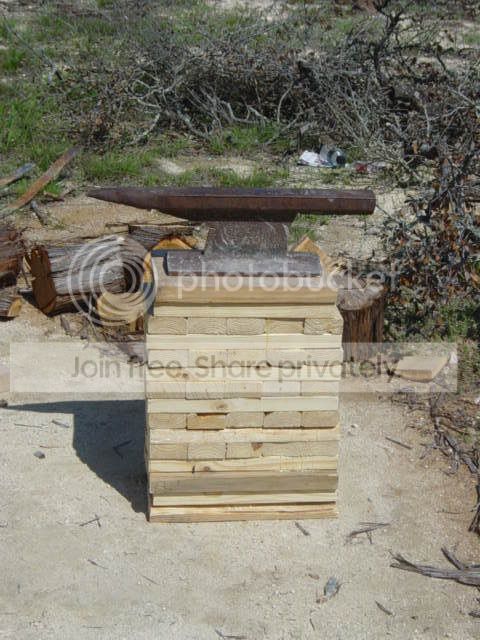
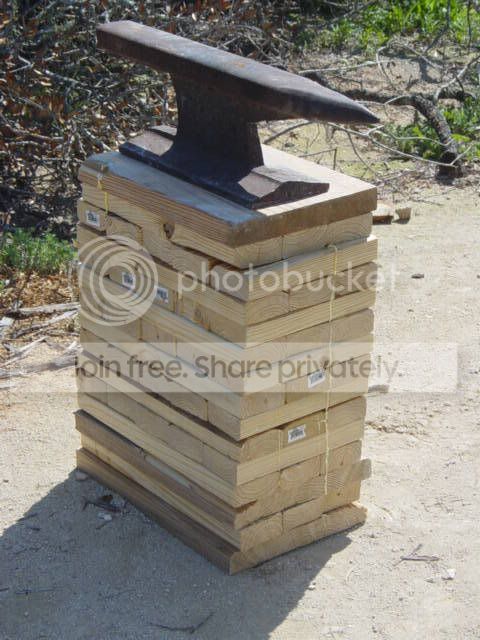
ok its finished. heres the pics. i know it looks like crap and i got a string of glue running down the side under the horn. i went thru 2 boxes of 2 1/2" screws. i hope i put enough in it and enough glue. HEHEHEHE!!!!

Anvilbase1.jpg

Anvilbase2.jpg


watcha think?
 
That's turned out nice, I might well do mine the same.
Are you going to add a few hooks/loops to hang tools from?
 
My anvil support. Very primitive, but also mobile. I move mine in and out and only forge in good weather. I keep the anvil in the shop to protect it from the weather and I role the support around to the side of the house when they are not being used. The log wasn't high enough, so I screwed some supports onto the top and also screwed heavy plywood onto it to make a wall to keep the anvil in one place. Since I have to take the anvil off and on all the time, I don't fasten it down. It doesn't ring loud, and doesn't move, so I'm happy with it.
 
i might take some of my rebar and forge a few hammer holders. ive decided to use the construction adhesive and pipe strap. i just applied the water sealer to my base. made sure i got it really good and coated, especially the ends. those soaked up alot of the sealer so i made sure to apply extra. i might put a second coat on after it dries just to make sure this thing lasts a long time. when i build my shop im going to have a tree trunk cemented into the ground and use this anvil base and anvil if i go somewhere or for friends who want to learn or already know how and just feel like hammering on some hot steel.
 
mine makes my anvil come up just past my knuckles. should be right on the money once i reface it to make it flat. thanks again for yalls help.
 
I agree in general with the "knuckles height". This has always been considered the best overall height for an anvil. It allows you to hit something about as hard as you can and still not be out of position.

If you are doing knife work and are forging from barstock or something similar, this is what I would use.

If you are doing something that is light or does not require a lot of full power forging strokes, you can put the face of the anvil a little higher. This will allow you to tap without having to bend quite as much. I do this for anvils that I use when I travel and do demo work. I only do light stuff and after 12 hours of work, it helps not to have to bend quite so much. A change as small as 1 to 1 1/2 inches makes a big difference. It goes without saying that if you end up trying to do something that requires regular forging, your wrist will not be in the optimum position.

I am not sure what size anvil you are anchoring but if you build the stand to the knuckles height, you can always slide a piece of 1/2 or 3/4 inch plywood under the base and see how you like the elevated platform. Assuming that you anvil is not a 15 pounder, you can just make two pieces of wood that fit inside the feet on the front (the side toward you) and back. If you fit these carefully, they will hold an anvil in place against any forward/backward or side to side motion. If you are bending heavy stuff in the hardy or pritchel hole, they don't hold that too well. The nice thing about these quarter moon shaped pieces is that they are easy and can be attached with a couple of screws to the base. If you want to try something a little higher, just take out the screws, insert the new base piece and screw them back down, simple. The anvil that I finish knives on is 1 inch higher than knuckle height. I don't do any heavy stuff on this and it is long and flat (homebuilt). I like it even though it is pretty non traditional.

Good Luck,
don't be afraid to experiment but remember that a formula that has worked for a long time has earned its place.
Jack

 
Screw down a 2X4 on each side of the anvil. It will keep the anvil from hopping around.
Stacy
 
im actually seriously thinking about going to the metal place around the corner from me and getting a piece big enough for my anvil and flip it over and have it welded to the top of the railrod track so i can just use the bottom of it. basically do it the way IG did his. save me from having to grind off about 1/4" of the top the whole length of the anvil. afterwards ill just bolt it to the base. also going to chop off some of the top and have it welded to the plate and anvil so it makes it heavier and not as long. later on i can just find small chunks of steel and just keep welding it to the base so that it gets even heavier.
 
Back
Top