Anybody have a Becker Companion?

Razorback - Knives said:
Here is a pic of the knife. I used black canvas micarta and left the pommel exposed. Still have to make a sheath. With the edge reprofiled, it sharpens up nicely.
Scott QUOTE]

Damn, does that ever look excellent. How about doing that to a BK7?

A little comparison photo but couldn't get my 'rotate by degrees' to work:

untitled.jpg


Doc
 
Doc, I'm not sure, but I think the Camillus Beckers are hollow ground. I can't convex the primary grind if it's a hollow grind, only the edge. The knife I did looked to have been started as a flat grind then switched to a convex. Hard to explain. The primary grind stopped about 1/4" from the spine. I just reground it to a full convex, from spine to edge.
Scott
 
Razorback - Knives said:
Doc, I'm not sure, but I think the Camillus Beckers are hollow ground. I can't convex the primary grind if it's a hollow grind, only the edge. The knife I did looked to have been started as a flat grind then switched to a convex. Hard to explain. The primary grind stopped about 1/4" from the spine. I just reground it to a full convex, from spine to edge.
Scott

I know very little about the different kinds of grinds. Also I read about people reprofiling their knives for better performance, and it's something I want to know more about. I haven't seen 'Knife bevels for Dummies' at Chapters :( so is there somewhere you can direct me, so I am not such an ignoramus on this subject?

Doc
 
Razorback - Knives said:
I can't convex the primary grind if it's a hollow grind ...

People do this all the time, the reverse as well. Of course if the hollow is really deep and you flatten the grind the blade will be very thin. The same would be true of a flat grind as well. If you applied a fully convex grind to a SAK for example there isn't much left to the blade, in those cases you are usually better going hollow to apply a relief.

-Cliff
 
Razorback

That companion turned out great, the Beckers are real sleepers

Most are a handle away from being top shelf, atleast per dollars spent

thanks for the photos.
 
Razorback

one other feature about your handle design,

when being used in a camp/kithen capacity, the elimination of fastener

cavities is nice in that food stuffs( food, blood, dirt etc.) will not collect in

the cavities eliminating the possibility of food poisoning(perfect for the

bk-7)

or getting a blister/cut infected, also would like to see that one with a

choil and a nice tactical sawback:D
 
Cliff Stamp said:
People do this all the time, the reverse as well. Of course if the hollow is really deep and you flatten the grind the blade will be very thin. The same would be true of a flat grind as well. If you applied a fully convex grind to a SAK for example there isn't much left to the blade, in those cases you are usually better going hollow to apply a relief.

-Cliff
Cliff, a hollow grind is the direct opposite of a convex grind. You can't convex what isn't there. Show me a pic of one that has been done. Then I'll believe it.
Scott
 
scfishr said:
the elimination of fastener

cavities is nice in that food stuffs( food, blood, dirt etc.) will not collect in

the cavities eliminating the possibility of food poisoning(perfect for the

bk-7) or getting a blister/cut infected,

Good point, and an often overlooked one! :thumbup:
 
Razorback - Knives said:
You can't convex what isn't there.

Take a hollow grind, now grind it flat, now grind it convex. The middle part isn't necessary, it just makes it obvious you can go from the first part to the latter part. People have done this with hollow ground Spyderco's and described the results on the forums. It is commonly done on khukuris with hollow ground edges to change the bevel from hollow to convex. I do it on cheap hollow ground kitchen knives all the time. I can grind one tomorrow and show a before/after picture if you want as I have to sharpen a dozen of them. All of my hollow grind knives end up going flat and then convex as I sharpen them flat to the stone, and eventually you remove the hollow, you are then supposed to get them hollowed back out so they cut well again.

-Cliff
 
Cliff Stamp said:
Take a hollow grind, now grind it flat, now grind it convex. The middle part isn't necessary, it just makes it obvious you can go from the first part to the latter part. People have done this with hollow ground Spyderco's and described the results on the forums. It is commonly done on khukuris with hollow ground edges to change the bevel from hollow to convex. I do it on cheap hollow ground kitchen knives all the time. I can grind one tomorrow and show a before/after picture if you want as I have to sharpen a dozen of them. All of my hollow grind knives end up going flat and then convex as I sharpen them flat to the stone, and eventually you remove the hollow, you are then supposed to get them hollowed back out so they cut well again.

-Cliff
Please do Cliff, I'd like to see what you mean. In the last sentence of your quote, "you are then supposed to get them hollowed back out so they cut well again" if you hollow it back out, what the purpose of even trying to convex a hollow grind in the first place? I convex the "edges" on any grind, whether it be hollow, flat or convex. The best primary grind for a convex edge is a true convex that is done from the beginning. You can start out doing a flat grind then before the edge is to thin, switch to a slack belt and convex. This is how Bark River knives are made. With the rotary platen I have, I can achieve flatter convex grinds then a standard slack belt attachment would give me. Bark River gets their flatter convex grinds from doing it they way I described. The link that Thomas Linton provided is one of the best explanations about the convex grind and edge that I have ever read.
Scott
 
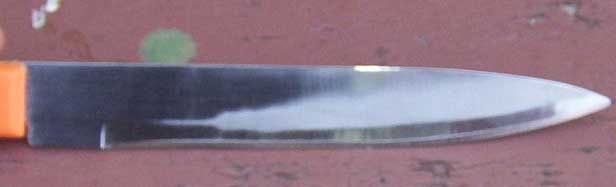
Here is a cheap kitchen knife with a typical low hollow grind. This is the same type of grind found on scandinavian knives, this one just has a really obtuse secondary bevel.


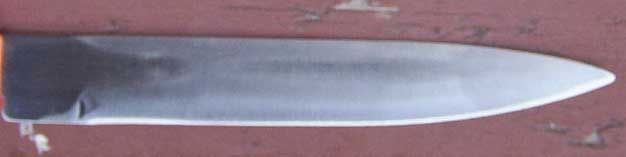
This is what it looks like after one minute of grinding on a slack belt. It is actually difficult to grind this knife because since it is so thin (1/16") it heats up with just one pass on the belt unless really light force is used :


The hollow grind has been removed and the secondary bevel very reduced. The primary grind is now convex and is coming down from the spine and up from the edge. With more work these will intersect and the blade will go from sabre/hollow to full convex like an opinel.

Razorback - Knives said:
if you hollow it back out, what the purpose of even trying to convex a hollow grind in the first place?

When I sharpen my Jess Horn flat to the stone I am not doing it to try and create a convex primary grind. I am doing it because I want the edge sharpened at about 7/8 degrees per side and that is how low I need to go to get that angle. Now as I sharpen the edge will widen and the shoulder of the grind starts to flatten and eventually they will meet as the bevel went from hollow to flat. This isn't a good thing because now I am sharpening a huge bevel which is over a cm wide. Thus I get it hollowed back out again and now the edge is again only a fraction of a mm wide.

With the rotary platen I have, I can achieve flatter convex grinds then a standard slack belt attachment would give me.

The amount of curvature induced will be dependent on the pressure and the tension in the belt. You can even grind them on a flat platen by rotating the knife. I have knives with primary convex grinds which were even ground on an angle grinder. Many traditional makers grind them with wheels and files. You can go very thin or thick or vary the curvature simply by how the blade is presented to the abrasive.

-Cliff
 
Thanks for setting me straight with that Cliff. For the life of me, I don't know why you don't become a knifemaker yourself. You seem to know it all. ;)
Scott
 
Razorback - Knives said:
I don't know why you don't become a knifemaker yourself.

Because there are other things I enjoy doing far more than grinding steel. The above commentary on hollow grinding comes from Alvin Johnston who is a knifemaker. He is also the guy who made a convex ground knife on an angle grinder. He also starts out his hollow grinds the same way. There is a lot of hollow -> convex described in detail on the HI forum, complete with far better pictures than in the above.

-Cliff
 
Here is an examples of such a grind, hollow to convex (a very flat convex, taper is less than 1-2 degrees from shoulder to apex) :


I have been doing a lot of work with this recently and you can see the edge has widened and actually intersected with the primary grind in the middle of the blade.

This isn't a good thing because now when I sharpen I have to remove more metal to restore the edge. This should be restored to a hollow grind on a wheel. Krein does this really well.

-Cliff
 
Back
Top
