hi i'm a brand new member and this is my first post. i don't know if this is the right category to put this in so don't stone me to hard lol. i'm just getting into knife making and doing more and more knifes and see those big 72 inch grinders and look like they work really really well. but i don't have the cash for one right now. i see some people make their own is this something that's easy, hard? is it going to take me a month to build? i have a background in machining and fabrication. just looking for some wisdom to help steer me the right way thanks, zach

-
The BladeForums.com 2024 Traditional Knife is available! Price is $250 ea (shipped within CONUS).
Order here: https://www.bladeforums.com/help/2024-traditional/
You are using an out of date browser. It may not display this or other websites correctly.
You should upgrade or use an alternative browser.
You should upgrade or use an alternative browser.
anyone made their own grinder???
- Thread starter corkyzach
- Start date

Stacy E. Apelt - Bladesmith
ilmarinen - MODERATOR
Moderator
Knifemaker / Craftsman / Service Provider
- Joined
- Aug 20, 2004
- Messages
- 38,235
Welcome to Shop Talk. Fill out your profile so we know where you are and some things about you.
There are many threads on grinder builds. Use the search engine in the stickys to pull them up. One of the simpler ways to build a grinder is with one of the kits, usually called a GIB ( grinder in a box). Polar Bear Forge sells the most popular one.
There are many threads on grinder builds. Use the search engine in the stickys to pull them up. One of the simpler ways to build a grinder is with one of the kits, usually called a GIB ( grinder in a box). Polar Bear Forge sells the most popular one.
- Joined
- Aug 11, 2016
- Messages
- 251
I just gave up and ordered a grinder. The difference between the cost of buying and building was way too small. I already had the motor and VFD, so all I needed to get started were a drive wheel, chassis, and tool rest.
The wheel I ordered cost $40. That's about what I would pay for a 3" slice of 5.25" aluminum round rod, which is the smallest amount I'd feel comfortable trying to machine for myself. I could have saved money on the chassis, but I would have to cut and weld it, and then I would have to add bearings and idler wheels and make sure everything was aligned...it just seemed like a bad idea.
Ebay can save you a ton on a motor. If you can't find a new or nearly new American 2-HP motor for under $150, you're just not trying.
The wheel I ordered cost $40. That's about what I would pay for a 3" slice of 5.25" aluminum round rod, which is the smallest amount I'd feel comfortable trying to machine for myself. I could have saved money on the chassis, but I would have to cut and weld it, and then I would have to add bearings and idler wheels and make sure everything was aligned...it just seemed like a bad idea.
Ebay can save you a ton on a motor. If you can't find a new or nearly new American 2-HP motor for under $150, you're just not trying.
Last edited:
thank you for all the feedback!!! its all a big help i was so indecisive about the route i wanted to take and apprehensive about posting for the first time but all is well thanks again. ken i'm drooling over that grinder i think i'm going to emulate it some how just with steel instead of aluminum. thanks again

- Joined
- Jan 9, 2011
- Messages
- 16,397
It's a buyers market for grinders right now... they are extremely expensive to build and to me the tiny difference is not really worth it.
take a look at the polar bear forge frame kits I built the combo sling for just around 300.00 and it works great.i have 3 working 2x72 and a 1x42, I added a tilt base myself. I already had a 3 hp motor and a vfd. the kit was 115, the contact wheels were 99 and the drive and tracking 45 plus about 3.00 for bolts and nuts.


- Joined
- Oct 17, 2007
- Messages
- 4,266
I've built both of my 2x72 grinders. The first was a gradual build of the NWGS using plans developed by Tracy Mickley of USAKnifeMaker and the Knife Dogs Forum. The reason I originally went with the NWGS, was because at the time there really weren't nearly as many options for 2x72 grinders, much less kits and DIY setups. What was also really nice was that you could piece it together a little at a time, and pay for upgrades and attachments as you could afford them.
For the majority of the build, I used scrap/drops from a local fab shop, found a used motor, and then pieced the rest of it together as funds came in. Now, at the time, I went with Beumont Metal Works wheels (they make the KMG) for the 8" contact, drive, tracking and idler wheels, and that added up to about half of the cost of the machine right there. Now days, there are much more economical wheel options, and some of them are arguably as good, if not a little bit nicer in quality (I recommend VWJackStraw on ebay).
Full disclosure: I have made a number of modifications to the original plans to suit my needs a little bit more, but as the plans currently sit, it's still a pretty nice machine, and a flat platen setup can be pieced together for probably less than $300 if you shop around for parts and pieces, and you still have an expandable machine that can be upgraded or added to as you go.
The next best option after that would probably be a GIB or one of the other Polar Bear Forge kits, but you'll probably end up needing to spend a little bit more, although it will be a much more professional looking machine (arguably) when finished.
Now, my second and most recent grinder I designed and built from scratch, using 3D CAD software and having a majority of the pieces cut via waterjet. When it was all said and done, I could have probably purchased a number of single machines for about the same price (if not a little bit cheaper in some cases), but IMO they wouldn't have been nearly as versatile, well made, or have nearly exactly what I wanted in a machine. Granted, I had been making knives for several years by this point and had done about as much research as one can do on what was out there and available, so I had a very good idea of what I wanted, needed, and could accomplish.
 Untitled by AR Custom Knives (Andrew Riley), on Flickr
As for time frames, the actual assembly isn't super long or involved for most kits. It really depends on what kind of tools you have at your disposal, as well as how long it takes to source parts and pieces.
My Riley Grinder took more time to design and get the parts ordered in that it probably did to put together. It took a few days to do some final machining on some parts hear and there, but overall it was a "relatively" quick and easy build. I know a lot of guys get a little hung up on the build times, but unless you're getting paid by the hour in your shop, I don't think it needs to be a huge consideration, especially considering it's a one time investment, and if done well and properly should give you decades of use (with regular maintenance of course).
For the majority of the build, I used scrap/drops from a local fab shop, found a used motor, and then pieced the rest of it together as funds came in. Now, at the time, I went with Beumont Metal Works wheels (they make the KMG) for the 8" contact, drive, tracking and idler wheels, and that added up to about half of the cost of the machine right there. Now days, there are much more economical wheel options, and some of them are arguably as good, if not a little bit nicer in quality (I recommend VWJackStraw on ebay).
Full disclosure: I have made a number of modifications to the original plans to suit my needs a little bit more, but as the plans currently sit, it's still a pretty nice machine, and a flat platen setup can be pieced together for probably less than $300 if you shop around for parts and pieces, and you still have an expandable machine that can be upgraded or added to as you go.
The next best option after that would probably be a GIB or one of the other Polar Bear Forge kits, but you'll probably end up needing to spend a little bit more, although it will be a much more professional looking machine (arguably) when finished.
Now, my second and most recent grinder I designed and built from scratch, using 3D CAD software and having a majority of the pieces cut via waterjet. When it was all said and done, I could have probably purchased a number of single machines for about the same price (if not a little bit cheaper in some cases), but IMO they wouldn't have been nearly as versatile, well made, or have nearly exactly what I wanted in a machine. Granted, I had been making knives for several years by this point and had done about as much research as one can do on what was out there and available, so I had a very good idea of what I wanted, needed, and could accomplish.
Untitled by AR Custom Knives (Andrew Riley), on FlickrAs for time frames, the actual assembly isn't super long or involved for most kits. It really depends on what kind of tools you have at your disposal, as well as how long it takes to source parts and pieces.
My Riley Grinder took more time to design and get the parts ordered in that it probably did to put together. It took a few days to do some final machining on some parts hear and there, but overall it was a "relatively" quick and easy build. I know a lot of guys get a little hung up on the build times, but unless you're getting paid by the hour in your shop, I don't think it needs to be a huge consideration, especially considering it's a one time investment, and if done well and properly should give you decades of use (with regular maintenance of course).


- Joined
- Sep 12, 2002
- Messages
- 84
Hey Corkyzach. I am in the process of making me a new one. I am pretty busy right now, but pm me and maybe we can get together and you can get ideas off of mine.
thanks for all the feedback guys!! here's another question since iv'e never used a 2x72 belt grinder i have nothing to compare it to. is it worth it? is there any other grinder setups people like to use? i'm to the point now that i'm getting the basics down i'm making more and more knifes but i want that professional look with minor imperfections is this the grinder for me? and i think i'm going to make my own. i have the steel in my shop cause like i said i do fabrication so that's covered but the tension system is the only thing that i'm kinda confused about iv'e never built something like this. thanks again, zach

- Joined
- Feb 2, 2003
- Messages
- 2,261
I made my own grinders since its difficult and expensive to import grinders to England and I wanted a grinder that could use different length belts because you can get odd size belts cheap on ebay. I pay an average of around a $1 a belt or less.
My friend did the machining on the contact wheel, tracking wheel, pulleys and the motor and controller and I designed and built the grinder. I think the total cost was around $600. I'll try and get a pic tomorrow when I am back in the workshop.
My friend did the machining on the contact wheel, tracking wheel, pulleys and the motor and controller and I designed and built the grinder. I think the total cost was around $600. I'll try and get a pic tomorrow when I am back in the workshop.
ok thanks a bunch shing i really appreciate it!! how did you set up the tension system? is there a certain amount of pressure that needs to be on the belt? what about the spring is it like a one size fits all? again thanks a lot for all the info guys it means alot!

kuraki
Fimbulvetr Knifeworks
- Joined
- Jun 17, 2016
- Messages
- 4,679
As for time frames, the actual assembly isn't super long or involved for most kits. It really depends on what kind of tools you have at your disposal, as well as how long it takes to source parts and pieces.
My Riley Grinder took more time to design and get the parts ordered in that it probably did to put together. It took a few days to do some final machining on some parts hear and there, but overall it was a "relatively" quick and easy build. I know a lot of guys get a little hung up on the build times, but unless you're getting paid by the hour in your shop, I don't think it needs to be a huge consideration, especially considering it's a one time investment, and if done well and properly should give you decades of use (with regular maintenance of course).
I like that design. I've been looking to build a second grinder and it looks very similar to that in the design stage.
Question on positioning of the tracking wheel relative to the drive wheel. Yours is located further back than mine. Is there a reason related to tracking that you chose to position yours where it is? How much force is your gas spring rated for? Do you have a mechanism for changing tension?
- Joined
- Oct 17, 2007
- Messages
- 4,266
I like that design. I've been looking to build a second grinder and it looks very similar to that in the design stage.
Question on positioning of the tracking wheel relative to the drive wheel. Yours is located further back than mine. Is there a reason related to tracking that you chose to position yours where it is? How much force is your gas spring rated for? Do you have a mechanism for changing tension?
I think the tracking arm length and wheel position mostly ended up like it was as a result of how I was able to lay out the material, as well as not wanting a great deal of overhang past the spring pivot to "counter balance" the spring. It seems to work just fine as is, though I'm tempted to try a slightly longer one to see if it makes any difference with reverse tracking which seems to drift off the side of the platen about 1/4" in reverse.
My spring is 100lbs.
Sent from my iPhone using Tapatalk
I am just about done building one like this. Dan has an easy to follow set of plans. http://dcknives.blogspot.ca/p/2-x-72-belt-grinder.html
I have done tons of woodwork and am a diy work on my own vehicles person, but had no experience welding. Got to my brother in laws place in Edmonton and went for it. It was quite easy. I bought a second hand vfd and motor. Wheels off ebay. I am just waiting for my buddy to put 240 into my garage and I will start it all up. Cost me waaaaay less than buying one made already.
If I didn't have access to a welder I would have gone with the grinder in a box or the combo sling grinder mentioned above. Problem with the sling grinder is it needs a specific motor frame and when you are looking for second hand that cuts down the possibilities for a deal.
I have done tons of woodwork and am a diy work on my own vehicles person, but had no experience welding. Got to my brother in laws place in Edmonton and went for it. It was quite easy. I bought a second hand vfd and motor. Wheels off ebay. I am just waiting for my buddy to put 240 into my garage and I will start it all up. Cost me waaaaay less than buying one made already.
If I didn't have access to a welder I would have gone with the grinder in a box or the combo sling grinder mentioned above. Problem with the sling grinder is it needs a specific motor frame and when you are looking for second hand that cuts down the possibilities for a deal.
That is a great resource page and what I also used to get my ideas from http://dcknives.blogspot.ca/p/2-x-72-belt-grinder.html
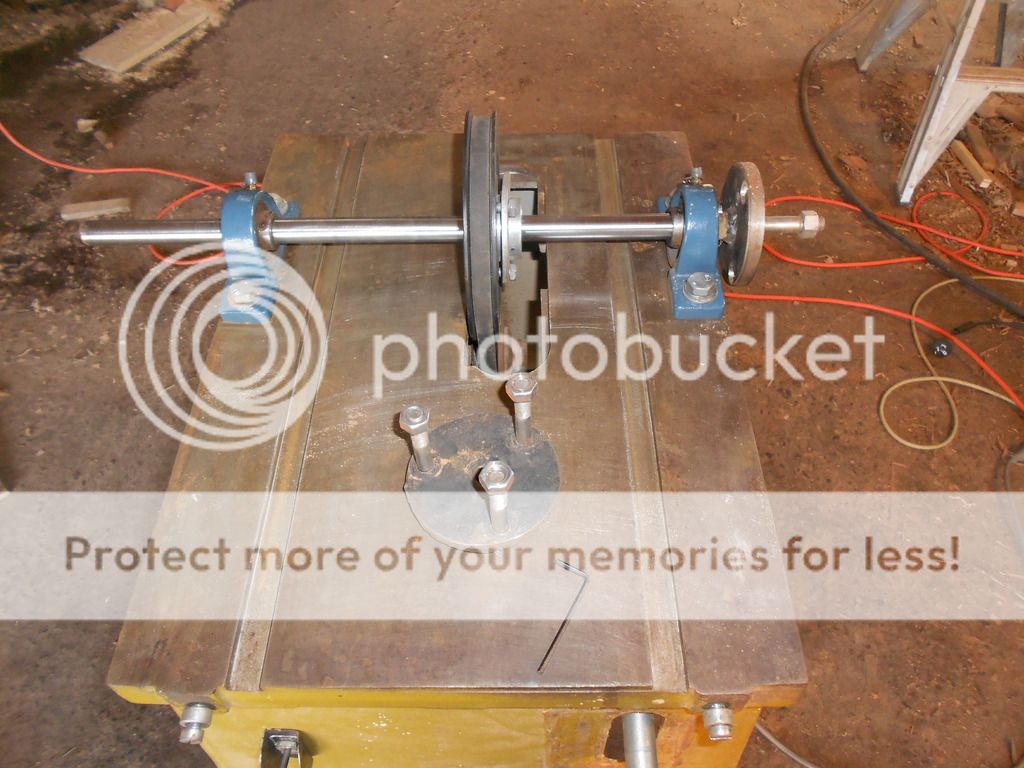
I used an old saw bench as the base to make mine from

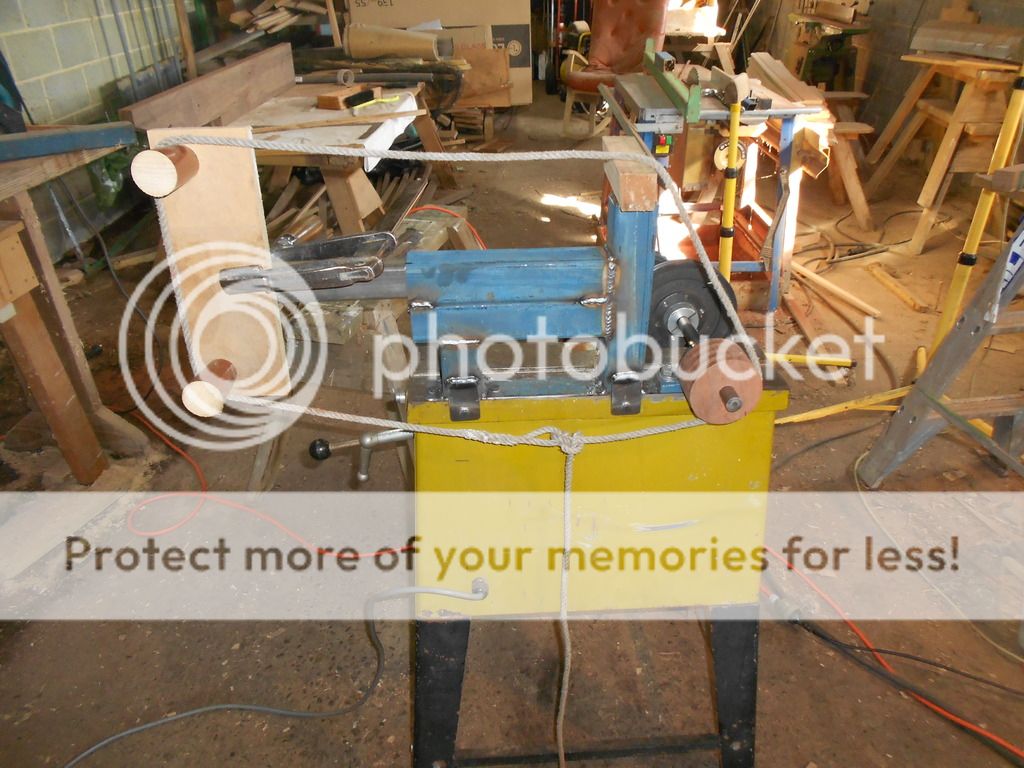
After a good look in my shed I found some 2x2 box steel that would work for the main stands and with trip to the garrage for some welding was able to do a mock-up . A length of cord tied off at 72 inches gave me an idea of finished composition
I used an old saw bench as the base to make mine from


After a good look in my shed I found some 2x2 box steel that would work for the main stands and with trip to the garrage for some welding was able to do a mock-up . A length of cord tied off at 72 inches gave me an idea of finished composition
