
-
The BladeForums.com 2024 Traditional Knife is available! Price is $250 ea (shipped within CONUS).
Order here: https://www.bladeforums.com/help/2024-traditional/
You are using an out of date browser. It may not display this or other websites correctly.
You should upgrade or use an alternative browser.
You should upgrade or use an alternative browser.
Anyone still "weld" ina coal fire?
- Thread starter Kentucky
- Start date

- Joined
- Dec 13, 2008
- Messages
- 2,986
We have gas but still weld mostly in a coal fire. Im stubborn I suppose, thats how I learned to weld. Lisa dosnt use the coal, she uses a two burner diamondback forge. Living where we do there is an abundance of high quaility coal at super cheap prices too  Then some of our customers demand traditional construction and wont have a hawk unless its welded in coal. Your right though, if you dont know what your doing and watch real close you'll burn up high carbon stuff in a heartbeat with coal.
Then some of our customers demand traditional construction and wont have a hawk unless its welded in coal. Your right though, if you dont know what your doing and watch real close you'll burn up high carbon stuff in a heartbeat with coal.
- Joined
- Jul 23, 1999
- Messages
- 1,409
I read your other post too......I started out doing Blacksmith/Farrier work, and in coal too! As I became more interested in knives, I gravitated in that direction, and along the way I switched from coal to gas forges. It just makes much better sense to use a gas fired forge when working with blade steels.
I personally think coal is the way to go if your doing ornamental ironwork...which is usually created with "mild" steel. However, when dealing with the alloys present in steels used for blades, coal is very much a handicap when compared to gas forges.
Although I learned to forge weld in a coal forge, and even made my first billets of damascus with that same forge, when I switched to gas, all I could think was..."why didn't I do this long ago!?" There are so many benefits to gas over coal for bladesmithing that I can't begin to list them here.... better overall control, better welds, no inclusions, and on and on.
Although most of my forging is directed towards blades, I still sometimes use ornamental works as my "therapy".....where bladesmithing requires that your attention is focused 100% on the task at hand, and that everything be precisely forged, ornamental work requires less precision, and in most cases, the more "forged" (beat up and full of hammer marks) the end product appears, the better customers like it.
I personally think coal is the way to go if your doing ornamental ironwork...which is usually created with "mild" steel. However, when dealing with the alloys present in steels used for blades, coal is very much a handicap when compared to gas forges.
Although I learned to forge weld in a coal forge, and even made my first billets of damascus with that same forge, when I switched to gas, all I could think was..."why didn't I do this long ago!?" There are so many benefits to gas over coal for bladesmithing that I can't begin to list them here.... better overall control, better welds, no inclusions, and on and on.
Although most of my forging is directed towards blades, I still sometimes use ornamental works as my "therapy".....where bladesmithing requires that your attention is focused 100% on the task at hand, and that everything be precisely forged, ornamental work requires less precision, and in most cases, the more "forged" (beat up and full of hammer marks) the end product appears, the better customers like it.
Last edited:
- Joined
- Dec 13, 2008
- Messages
- 2,986
I personally think coal is the way to go if your doing ornamental ironwork...
Thats another reason. We still do a lot of ornamental blacksmithing. Lisa hits the fall craft fairs and such every year. I also feel coal is the best way to go there. You can work mild steel so much faster and easier in coal. Not to mention that many gas forged wont even get hot enought to weld mild steel. Our gasser will weld mild but it eats a lot of gas in the process. Coal is just plain hotter and faster in that regard.
......Your right though, gassers are easier and cleaner for blade steels. No doubt about it. Its a lot easier to see your work piece than to judge by fire color and time.
I have to say though, after doing regular blacksmith welding for several years before trying damascus I thought damascus was the easiest welding Id ever done. Sticking layers of high carbon stuff together was so easy after doing lap welds and jump welds out of a coal fire..

- Joined
- Oct 2, 2006
- Messages
- 3,238
the first time you have a blade that you have put a lot of time into go red short because you hit a sulfur inclusion in a piece of coal (or one of several other contaminants that sometimes piggyback in the coal) you will never willingly do a blade in coal. That is why I switched to gas in 1992. Coal is great for big heat for moving big pieces of mild, but for blades, blown gas is the only way to go
-Page
-Page

- Joined
- Nov 20, 2008
- Messages
- 10,188
I don't use coal, but I've used charcoal for the past six years with no problems. After awhile, I believe I can sense just how hot it is, and adjust accordingly. In any case, I've been able to successfully forge out a large number of knives.
Cheers!
Dave
Cheers!
Dave
- Joined
- Dec 13, 2008
- Messages
- 2,986
After you forge with solid fuel so long you get that "inside eye" so to speak as to the temp down in the fire.I don't use coal, but I've used charcoal for the past six years with no problems. After awhile, I believe I can sense just how hot it is, and adjust accordingly. In any case, I've been able to successfully forge out a large number of knives.
Cheers!
Dave
Im not trying to argue the merits of one of the other for bladesmithing. Theres no doubt gas is cleaner, easier and less accident prone. Just curious as to anyone that still uses coal for a welding source. Around here I can buy a ton of good crushed washed high grade coal for under $100 so its actually cheaper than gas. Our traditional customers demand traditional methods so solid fuel is what we have to use for them.
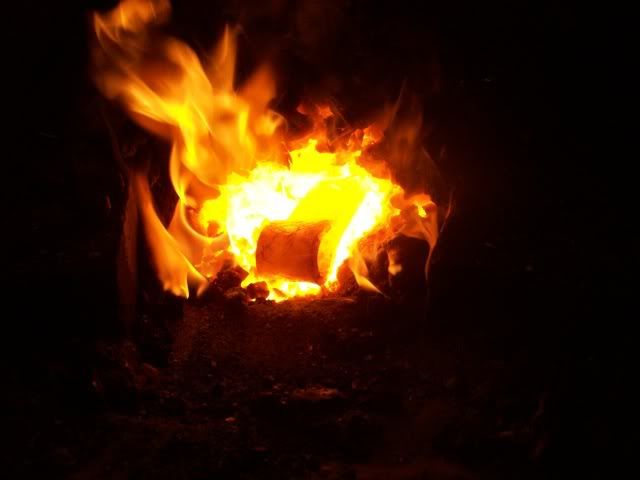
Heres a pic of a wrap & weld hawk head in a beehive coal fire..If you have good coal and know how to make one a coal fire like this one it is similar to using a gas forge, but have to be more careful and work the fire like a tool instead of just a heat source.
Last edited:
- Joined
- Nov 20, 2008
- Messages
- 10,188
Kentucky, lookin good there.
Dave
Dave

- Joined
- Nov 6, 2006
- Messages
- 1,011
Gas is cleaner, I have 3 gasser's. 1 blown that welds very well and 2 atmospheric. I just can't get used to using the gas. Always end up back at the coal forge to weld my hawks. There's just something about the smell of coal smoke. I guess it's the blacksmith in me.
I guess it's the blacksmith in me.- Joined
- Dec 20, 2008
- Messages
- 1,937
I exclusively use a coal forge. For everything! blade and black, as it's the only forge I have! lol Could we talk about the contaminants for a moment? How bad are we talking about contaminating the work... are we gonna raise it by several tenth's or a few hundredths of a point? I'm using Pocahontas Slack forging coal. so it's low sulfur but what other contaminates should I be worried about?
Jason
Could we talk about the contaminants for a moment? How bad are we talking about contaminating the work... are we gonna raise it by several tenth's or a few hundredths of a point? I'm using Pocahontas Slack forging coal. so it's low sulfur but what other contaminates should I be worried about? Jason
- Joined
- Nov 20, 2008
- Messages
- 10,188
Kentucky,
My land is very heavily forested with hardwoods. Every spring, I pile up huge piles of deadwood, drench it in keroscene, fire up, and when it cools gather up the charcoal. It burns long and holds a steady temp. It can also generate an incredible amount of heat, I've accidentily melted steel in such a fire. I've thought of using coal, but never found a local source of good pea coal.
Dave
My land is very heavily forested with hardwoods. Every spring, I pile up huge piles of deadwood, drench it in keroscene, fire up, and when it cools gather up the charcoal. It burns long and holds a steady temp. It can also generate an incredible amount of heat, I've accidentily melted steel in such a fire. I've thought of using coal, but never found a local source of good pea coal.
Dave

- Joined
- Nov 26, 2001
- Messages
- 1,375
Well, I understand perfectly well the advantages of gas.
BUT
I don't believe that "gas is the only way to go"...
From a historical point of view, coal has been used for welding for thousands of years with great success. Most blades in human history have been forged on coal.
Many of the best and more elaborate blades, like japanese swords, are still forged on coal fires.
Aldo Conto, one of the best italian damascus smiths, does his remarkable mosaic damascus in a coal forge.
Using coke helps a lot, as it doesn't contains impurities.
BUT
I don't believe that "gas is the only way to go"...
From a historical point of view, coal has been used for welding for thousands of years with great success. Most blades in human history have been forged on coal.
Many of the best and more elaborate blades, like japanese swords, are still forged on coal fires.
Aldo Conto, one of the best italian damascus smiths, does his remarkable mosaic damascus in a coal forge.
Using coke helps a lot, as it doesn't contains impurities.
- Joined
- Nov 20, 2008
- Messages
- 10,188
I believe I've read/heard Tai Goo say he uses wood.
Dave
Dave

Tai Goo
BANNED
- Joined
- Apr 7, 2006
- Messages
- 3,806
I use wood for welding "a few welds here and there", but for pattern welding or anytime I really need to maintain a welding heat for extended periods of time, ... I use charcoal. With wood, it needs to convert to charcoal in the ducks nest at a rate equal to it's consumption. It's kind of the same with coal...
I've used “coal” for pattern welding damascus in the past, with good results, but you do have to be careful with the sulfur impurities in it. You want to weld with "coke" and steer clear of the "green coal" as much as possible. You can pack green coal around the fire, (as long as there's a good amount of coke inside the ducks nest), and let it convert to coke as you go,… Keep the billet out of, off of and away from the green coal when it‘s hot.
I've used “coal” for pattern welding damascus in the past, with good results, but you do have to be careful with the sulfur impurities in it. You want to weld with "coke" and steer clear of the "green coal" as much as possible. You can pack green coal around the fire, (as long as there's a good amount of coke inside the ducks nest), and let it convert to coke as you go,… Keep the billet out of, off of and away from the green coal when it‘s hot.
- Joined
- Nov 26, 2001
- Messages
- 1,375
traditional nihonto makers use charcoal, not coal
Yes, I know. But it's still called a "coal forge".
As I said, what you burn in it makes a big difference.
I usually burn coke, and have used charcoal (which is damn expensive, especially because you need 3 pounds of charcoal to do what you do with 1 pound of coke).
There are many qualities of coal, and while you can "coke" it, it remains an erratic and delicate process, much of which depends upon which quality of coal you got in the first place.
Good coal and bad coal can make a huge difference.
Already made coke is much more dependable, having been distilled in a standardized and highly reliable process.
But it's hard to find.
Here near Alessandria, not too far from Genova, it's pretty easy to come by right now, but with the closure of many of the old Genovese ironworks, i wonder how long this availability will last...
Aldo Conto uses coke as well, big, lumpy coke (but, well, he also uses a big, lumpy hammer and he's a big, lumpy guy, so I believe it's all right
)