
-
The BladeForums.com 2024 Traditional Knife is available! Price is $250 ea (shipped within CONUS).
Order here: https://www.bladeforums.com/help/2024-traditional/
You are using an out of date browser. It may not display this or other websites correctly.
You should upgrade or use an alternative browser.
You should upgrade or use an alternative browser.
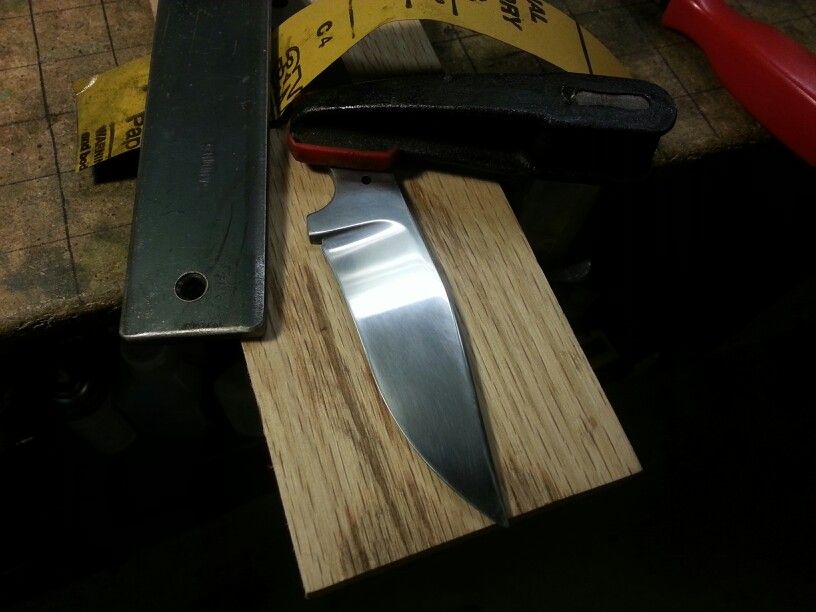
anything i should change before heat treat.
- Thread starter crank78
- Start date


- Joined
- May 2, 2013
- Messages
- 1,711
How thick is your steel? Your bevels look way to short. In other words your flats are too steep. Makes for a rough cutter... trying to push too much steel through behind the edge.
Peronally I would go for a high flat grind...
This is 5/32" and about .020 at the leading edge prior to putting the cutting edge on it. The higher grind means a narrower angle passing through the material the edge cuts. Slices better and is plenty tough with a good HT.
Are you sending it out?
Peronally I would go for a high flat grind...
This is 5/32" and about .020 at the leading edge prior to putting the cutting edge on it. The higher grind means a narrower angle passing through the material the edge cuts. Slices better and is plenty tough with a good HT.
Are you sending it out?

Stacy E. Apelt - Bladesmith
ilmarinen - MODERATOR
Moderator
Knifemaker / Craftsman / Service Provider
- Joined
- Aug 20, 2004
- Messages
- 38,514
It looks like you still have a lot of sanding to do before HT. I would take it to 400 grit and have all scratches out before HT.
Are the pin holes their final size? They should be about 50% larger than the pins you will use.... e.g. for 1/8" pins, drill 3/16" holes in the tang.
I also agree that the bevel should be much higher. I prefer full flat grinds, where the bevel goes all the way ( or nearly all the way) to the spine.
For future knives:
This one looks "stiff". It is a straight bar of steel with a knife shape filed into it. Making it from a slightly wider bar and putting in some curve will make a much nicer knife. A good knife has what is called "flow". That is when the features work together and smoothly flow into each other. Such a knife not only looks better, but works better.
Look at the photo LucyCustomKnives posted and see how much difference there is between his and yours. Looking at some of the knives in magazines and The Gallery will give you many ideas on adding "flow" to your knives.
Are the pin holes their final size? They should be about 50% larger than the pins you will use.... e.g. for 1/8" pins, drill 3/16" holes in the tang.
I also agree that the bevel should be much higher. I prefer full flat grinds, where the bevel goes all the way ( or nearly all the way) to the spine.
For future knives:
This one looks "stiff". It is a straight bar of steel with a knife shape filed into it. Making it from a slightly wider bar and putting in some curve will make a much nicer knife. A good knife has what is called "flow". That is when the features work together and smoothly flow into each other. Such a knife not only looks better, but works better.
Look at the photo LucyCustomKnives posted and see how much difference there is between his and yours. Looking at some of the knives in magazines and The Gallery will give you many ideas on adding "flow" to your knives.

Yes, there are changes that need to be made.
The grind needs to come up higher like LucyCustomKnives and Bladsmth both stated, at least another 1/8", but 1/4" would look better, it would then be closer to a full flat grind (FFG) like Stacy prefers.
The handle needs more holes drilled in it for weight distribution, a blade heavy knife is usually more comfortable to hold and use (just my opinion there). The epoxy will also have more surface area to grip and will create hidden epoxy pins by filling the holes.
Like Tryppyr pointed out, you don't need that many pins, two or three will look best and "flow" better. Just make sure they're evenly laid out.
You do need to remove the machine marks. A 400-600grit hand-rubbed satin finish would look very nice, all of the scratch lines need to be running the same direction without any fish-hook scratches. This needs to be done prior to HT so you won't have as much sanding to do post-HT. Sanding hardened steel is a major PITA.
The grind needs to come up higher like LucyCustomKnives and Bladsmth both stated, at least another 1/8", but 1/4" would look better, it would then be closer to a full flat grind (FFG) like Stacy prefers.
The handle needs more holes drilled in it for weight distribution, a blade heavy knife is usually more comfortable to hold and use (just my opinion there). The epoxy will also have more surface area to grip and will create hidden epoxy pins by filling the holes.
Like Tryppyr pointed out, you don't need that many pins, two or three will look best and "flow" better. Just make sure they're evenly laid out.
You do need to remove the machine marks. A 400-600grit hand-rubbed satin finish would look very nice, all of the scratch lines need to be running the same direction without any fish-hook scratches. This needs to be done prior to HT so you won't have as much sanding to do post-HT. Sanding hardened steel is a major PITA.
ty everyone. im doing ht myself. it is approximately 1/8 thick.
ty everyone going back to the shop to do some more work on it. bringing the bevel up much higher, drilling bigger and more holes. im only using three of the holes others are just going to be for weight reduction.
ty everyone going back to the shop to do some more work on it. bringing the bevel up much higher, drilling bigger and more holes. im only using three of the holes others are just going to be for weight reduction.

- Joined
- Dec 5, 2013
- Messages
- 1,180
Are the pin holes their final size? They should be about 50% larger than the pins you will use.... e.g. for 1/8" pins, drill 3/16" holes in the tang.
Why is this? I am completely new to knifemaking and don't understand why you would do this.
Bob
- Joined
- Dec 4, 2013
- Messages
- 891
Why is this? I am completely new to knifemaking and don't understand why you would do this.
Bob
I was thinking the same thing hope someone answers. Is it due to expansion of the metal during the heat treat?
Have the same question here.
From what I have heard/read is that you should drill the holes slightly smaller than the pins are. Due the HT they deform/become bigger, right?
In my (first) knife I have drilled 2 holes of 3.8/3.9mm for 4mm pins.
Haven't done HT yet.
From what I have heard/read is that you should drill the holes slightly smaller than the pins are. Due the HT they deform/become bigger, right?
In my (first) knife I have drilled 2 holes of 3.8/3.9mm for 4mm pins.
Haven't done HT yet.

Stacy E. Apelt - Bladesmith
ilmarinen - MODERATOR
Moderator
Knifemaker / Craftsman / Service Provider
- Joined
- Aug 20, 2004
- Messages
- 38,514
The tang holes should have a bit of clearance all the way around the pin. If the pin was a snug fit and you peened the pin, it may spread at the tang as well as the end and raise the scale up off the tang. Also, aligning pins through three holes through two scales an a tang is dang near impossible unless there is some slop in the tang holes.
Drill tang holes 50% larger than the pin/rivet. For an 1/8" - .125" pin that is 3/16"- .185". That will allow a clearance of only three one-hundredths of an inch around the pin. take a calipe and open it to 3/100" and see how thin that actually is. For 1/4" pins, the clearance is only 6/100".
Drill tang holes 50% larger than the pin/rivet. For an 1/8" - .125" pin that is 3/16"- .185". That will allow a clearance of only three one-hundredths of an inch around the pin. take a calipe and open it to 3/100" and see how thin that actually is. For 1/4" pins, the clearance is only 6/100".
- Joined
- May 2, 2013
- Messages
- 1,711
For mine, I drill the holes the exact size of my pins. Drill a hole, pin that one, then the next, etc. I do each side with temporary pins (that is lightly sand and then polish so they slide out a little easier) and shape my handles to final shape. Then I drive out the temp pins, finish the blade and tang. I don't peen radically with the final pins, just a light tap before smoothing them to size. That is done as part of my final glue up and finishing.
There is nothing wrong with the bigger holes, the epoxy will take care of the space. I just like my handles to basically be affixed to the point epoxy would probably not be necessary. There is nothing wrong with finishing your handles with the knife. For some projects I finish then this way. I etch a lot my blades though, and have had the FeCl color light spacers faintly in the past. So now I finish the blade with scales separate. It also allows me to cerakote or blue the knife without the chemicals getting on the scales. It also allows me to pin just the scales together to ensure they are exact copies of each other... Works well for bookmatching spalted scales and such also. Always finish the leading edge of the scale to final finish before its on the knife, then you don't have an issue of working against the blade.
I also try for either a blade heavy or dead neutral balance. I also like as few pins as possible and may only expose one or two, and use stubby thread rod for the others. For that I undercut the drilled holes in the scales slightly to create a ledge of sorts for the epoxy. With this method, I have driven a stake with the handle of my knife before and had no issues... With modern epoxies, only a couple of pins are necessary. They basically retard lateral movement saving the epoxy bond... For a small project I have gone with no pins at all... just texture and a couple if small holes to hold the scales. It was a personal project and I'm waiting to see how it holds up. I use G Flex BTW.
I also go to at least 600-800 grit prior to HT. That plus atmosphere control equal very little scale. Reducing scale saves time and belts...
Cheers... good luck.
There is nothing wrong with the bigger holes, the epoxy will take care of the space. I just like my handles to basically be affixed to the point epoxy would probably not be necessary. There is nothing wrong with finishing your handles with the knife. For some projects I finish then this way. I etch a lot my blades though, and have had the FeCl color light spacers faintly in the past. So now I finish the blade with scales separate. It also allows me to cerakote or blue the knife without the chemicals getting on the scales. It also allows me to pin just the scales together to ensure they are exact copies of each other... Works well for bookmatching spalted scales and such also. Always finish the leading edge of the scale to final finish before its on the knife, then you don't have an issue of working against the blade.
I also try for either a blade heavy or dead neutral balance. I also like as few pins as possible and may only expose one or two, and use stubby thread rod for the others. For that I undercut the drilled holes in the scales slightly to create a ledge of sorts for the epoxy. With this method, I have driven a stake with the handle of my knife before and had no issues... With modern epoxies, only a couple of pins are necessary. They basically retard lateral movement saving the epoxy bond... For a small project I have gone with no pins at all... just texture and a couple if small holes to hold the scales. It was a personal project and I'm waiting to see how it holds up. I use G Flex BTW.
I also go to at least 600-800 grit prior to HT. That plus atmosphere control equal very little scale. Reducing scale saves time and belts...
Cheers... good luck.
Last edited:
Where I live we use the metric system so I had te recalculate it to understand it.
.125" is 3.175 mm
.185" is 4.699 mm
So 4.699-3.175 = 1.524mm, that means all the way around the pin there is 0.762 mm of clearance.
To me that sounds a lot!
You where talking about peening the pins but does it also count if you just epoxy the pins in place? 'not peened'.
.125" is 3.175 mm
.185" is 4.699 mm
So 4.699-3.175 = 1.524mm, that means all the way around the pin there is 0.762 mm of clearance.
To me that sounds a lot!
You where talking about peening the pins but does it also count if you just epoxy the pins in place? 'not peened'.
Stacy E. Apelt - Bladesmith
ilmarinen - MODERATOR
Moderator
Knifemaker / Craftsman / Service Provider
- Joined
- Aug 20, 2004
- Messages
- 38,514
I work in millimeters normally, too.
.7mm is about the thickness one high bond weight or two cheap weight business cards.
In a folder pivot, that would be a huge gap. In a rivet/pin hole in a knife tang, that is just right.
The epoxy will fill the space and add a shock absorber effect to the handle. This gives more shear resistance to the pins.
.7mm is about the thickness one high bond weight or two cheap weight business cards.
In a folder pivot, that would be a huge gap. In a rivet/pin hole in a knife tang, that is just right.
The epoxy will fill the space and add a shock absorber effect to the handle. This gives more shear resistance to the pins.

- Joined
- Apr 19, 2012
- Messages
- 212
It's looking good. Do yourself a favor and get as close to the finished "smoothness" before heat treat. After heat treat you may have to go back a grit or two but there will be less steel to remove, and that's work after heat treat. If you're drilling holes for weight reduction, you need many more, or larger diameter.