
Are liner locks easy to use / safe?

Status
Not open for further replies.
Pitch angle. Nice phrase to describe the intersection of the blade and liner.

I have had liner locks fail, they were from large American manufacturers. And the pitch angle was certainly a lot steeper on them than others. Including the warranty replacement.

I'd add that the length of the active liner lock section has some affect on pitch angle because of the location of the virtual axis. They don't all exactly pivot at the end of the cutout, and don't really rotate there like a hinge, anyway. Short liner leafs seem to have steeper pitch angles, just because of the arc they travel.

Yeah I see a lot less problems in shorther less leveraged liner locks than I do the longer ones with a lot more leverage and the same thickness liners on them.

Pitch angle is just my own description that seems to help non knife people associate with the contact interface. To create a contact on a knife I'm making I set my table to the angle I need on my KMG belt grinder. I use a pitch angle locator to find that degree of angle. Then once I know its at 7 or 9 degrees I can then lay my blade flat on the table and using a 10" wheel make my contact so its slightly concave.

I would recommend testing the locks you use and looking over any frequently used locking folders often for debris, damage, blade play, and more on a regular basis. I do this each time I sharpen or touch up my own. Post number two in that tips and tricks link I gave above is a good simple test you can do yourself even sitting down.

STR
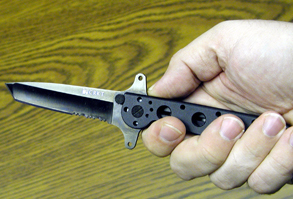
 
I rarely buy liner-lock knives and, as a matter of policy, do not recommend liner-lock knives to friends.

Too many failures, overall.

Beware of some frame-locks, also. I've got a Ti framelock that is no longer a pilar of reliability.


Try an Axis-lock or arc-lock or perhaps even one of the Mircrotech "liner-lock"s (I don't consider the bar design of Microtech a liner-lock).

STR is right on the money, IMO. It is an issue of geometry. STR's testing protical appears valid, so if you buy a liner-lock follow it, regularly.

I do still own some Benchmade 800 liner-lock knives and test the carry ones regularly.
 
Too many failures, overall.

Beware of some frame-locks, also. I've got a Ti framelock that is no longer a pilar of reliability.

This is a good point and worth covering. Frame locks are not as problematic in general due to the fact that you can physically secure the lock and even shock absorb for it to some extent in a grip. But I have had some mailed to me that were problems for their owners.

In my experience with most modern frame locks you have a two fold issue that can take place to make them problems for you. The Strider PT, and SnG are exempt from this as is the Hinderer frame locks but all others seem to fall into a catch 22.

What can happen is this and I base this on feedback from end line users.

First the maker or manufacturer will take the 'lock cut' to bend the lock to spring it down so thin that it is less thickness than even most gents liner lock folders at this cut. I have measured heavy duty hard use folders that were frame locks with .033 lock cuts. That is a .033 thickness where the lock is sprung and everywhere else the lock thickness is .125 or thicker, sometimes .100 but you get the point the lock cut is thin. One reason many take them so thin is so the action is similar to the liner lock and the locks don't have such spring that they off center your blade when its in the closed position. This is fine in most cases but it can come back to haunt you too.

Now combine this with the fact that a lot of folks don't like pocket clips. They read a lot about how reliable and great frame locks are but are not aware that on most modern frame locks the pocket clip does more than just allow you to carry it conveniently. It also doubles as a lock stabalizer to keep you from hyper extending the lock when you release it to close your blade. Since many don't like clips they take them off and you end up with a hyper extended lock with no or very little spring left in it to secure your blade open as it should.

Hyper extension is when you push the lock to release it and accidentally take the lock and push it way out against the direction the spring tension had been adjusted for. What this does is it removes the springiness and you lose the locks ability to move in behind the blade properly or not as far as it once did.

People have no idea how easy this is to do when the lock cuts are so thin but its so easy in fact that it often times occurs without the owenr of the knife even being aware that he did it. I've had them mailed to me to respring them and I've heard all the horror stories of how they cut themselves when the blade didn't lock as well. Its easy to hyper extend a lock out the wrong way in a heated moment like an adrenaline rush in an emergency say after you just had to cut out a seat belt to save someone from a burning car or something and while still pumped up you over extend the lock when closing the blade and don't know it.

STR
 
I've seen framelocks that hyperextend. My CRKT KISSes are prone to it. I believe it's because they don't have enough interference angle to prevent it, i.e., the two angles don't intersect somewhere in the locking plane of the ramp, so the leaf can just slide right on by, especially when the blade is cocked against the pivot.

I'm reminded that engine valves and seats have an interference fit, 45 to 44 degrees, to ensure tight sealing. I see this as an additional point - the pitch angles may not necessarily be best if they are identical. I notice the cut on my SnG blade is concave, but the leaf is flat ground, which creates an interference fit. Not the fine fit and finish some demand in expensive custom folders, but it seems to work well.

What kind of lockup does the Sebenza have?
 
I like the Sebenza lock contact and base my own on that one. It appears to be a flat grind contact but many times it is hard to tell its really concave if its a big wheel used. I use a 10" but some use a 14". I've done them concave with liner locks when I still made them. A lot of frame locks are flat grind contacts but some do still get made with a wheel instead of the flat platten too. I noted on my new Tyrade that it had a concave contact. I see that on several production frame locks also. I do mine flat on occasion but either way its always at about 9 to 10 degrees and no more on frame locks. On liner locks when I still made them I used my 10" wheel and a 7 degree angle for the contact.

What I see is that the guys making them 12 to 15 degrees do it to increase the life of the lock to keep it from moving in across the back of the blade interface slower. To me its a toss up because the sharp angle makes it easier to defeat the lock in my experience and to me that is not necessarily the way to go. I find the 10 degree holds up to stress tests quite well right up there with the 7 degree angle toe to toe and feel its also allowing the middle of the road area to not let the lock skip across the tang too early so it wears in normally but I will be the first to agree it will probably move in faster the flatter the contact is but on a thicker frame lock big deal. Let it move in. Let it get behind the blade to its sweet spot and its then reliable and strong like it should be idealy.

I also think when you have the combination of a 'sticky lock' that is hard to release to close your blade speaking of a frame lock that removing the pocket clip can be a recipe for hyper extension due to that added ummph you need to close the blade. This added push you have to put behind the lock to close it makes it snap out farther than needed without the clip there to act as a stop for that momentum and you end up easily hyper extending it without the clip there to keep that from happening. I just forgot to mention that above with the rest of my last post. I have had several smaller frame locks like the Mayos, the Emerson HD7s and others sent to me from gents doing this with their knives unknowing until they either got cut or nearly did. All from taking the clips off. So I'd suggest looking at ones like the AG Russell SeaMaster with physical lock stops built in if you go clipless.

STR
 
This is my opinion only, but linerlocks are at the bottom of the lock chain. Yes, there are good ones and bad ones and any lock can fail, but a good frame lock is better than a good linerlock, and a good lock back is better than a good frame lock. In like manner, a good axis lock is better than a good lock back, and all are better than good slip joints.

Opinions may vary. One thing that's good about linerlocks is that if you have something you can jam in between the lock and the blade, it will be exceptionally strong until you can dig it out and close it again. It's also easy to clean. But there's a reason most cheap locking knives are linerlocks. They're cheap to produce. The Lake and Walker Knife Safety (LAWKS), in conjunction with a linerlock, is better than a frame lock IMO.

I prefer to keep my fingers on my hand, and think most people would agree, so any lock should be thoroughly tested before being relied upon for heavy use.


m16sf-thumb.jpg


A linerlock with LAWKS and full hilts is about
as safe as one can get. Blade quality is
something else entirely.
 
I have only gotten to extensively handle and operate two Buck liner locks, A folding Alpha I gifted away last Christmas, and a Folding Kalinga I am putting through a shake down.

Both locks are/were well designed and well executed in my view. By this, I mean both were/are rock solid upon opening, no play in any direction. I still prefer lock backs because they seem beefier, but my Kalinga's liner engagement inspires confidence and I use it without a second thought after the blade glides through its arc and clicks in.

My issue with liner locks is wear, and the routine inspection for any such issue is my job. Since the mating surfaces deteriorate over time, liners bear more close attention to unacceptable wear developing than do more "robust" locking systems.

Should it come to pass, I'm certain Buck would hook me up with a new liner down the road a long spell.

In the meanwhile, I will use my 419 like I stole it.:D
 
Status
Not open for further replies.
Back
Top