Are there any particular steel types that can handle subzero temperatures better

I doubt it makes a difference,
what job you are doing with the knives and the moisture/marine salt level are probably more important to make your choice.

Where are you headed etc..?
 
I have a trip to Alaska planned. I am hoping that all the knives I bring along are going to work well for wood processing when the temperature drops below zero. I have heard that subzero temperatures can really test a knife's strength. The trip would be inland but I am not sure how much moisture to expect.
 
Years ago there was a guy that tested his H-1 steel in a freezer. It performed well.

Further more I have seen Victorinox kitchen knives used as igloo building knives and used in arctic explorations by Mike Horn.

Carbon steel axes are used constantly is Sweden to process wood.

There was a memeber here that used his ESSEE Junglas on a survival training camp in snowy weather without issue.

At the end I think a good quality product will serve you well rather than a specific steel.
 
Wow. My only hope is that any knife I have will not crack at 20 below from use in an emergency. I have several 1095 knives and wasn't sure if 3V or other super steels would ensure any better performance. It sounds like it will not really matter.
 
I've heard good things about 5CoRP10N's resistance to sub zero. Also, there's a guy in Japan named Liu Kang who seems to have come up with a winning formula.


:D
 
Wow. My only hope is that any knife I have will not crack at 20 below from use in an emergency. I have several 1095 knives and wasn't sure if 3V or other super steels would ensure any better performance. It sounds like it will not really matter.

No it won't make a difference. Buy quality!
I've heard good things about 5CoRP10N's resistance to sub zero. Also, there's a guy in Japan named Liu Kang who seems to have come up with a winning formula

:D

Ya right! Thats all marketing BS, It would have to colder than a human could stand before the steel would be effected. Try well over a 150-200 degree's below Zero. Even then I doubt it would make difference wether it was carbon or Stainless.
 
I've heard good things about 5CoRP10N's resistance to sub zero. Also, there's a guy in Japan named Liu Kang who seems to have come up with a winning formula.


:D


Hold on there. If we are going to speculate in MK Steels, the most adaptable one is 5Han9-T5un9 tournament steel.
 
Subzero temperatures that humans can bear are not of great concern to knife steel.

Take 1095 for example...while the martensite 90% point may be around 200F the martensite finish point is at around-100F... For 108X steel it is around -50.... as the blades approach these temperatures the retained austentite in the blade is converted to martensite, which may add maybe a point or two to the blade... if it's a blade that is already 62RC this isn't a good thing... but if it's 58RC or so you aren't getting to dangerously brittle.

So it's not that one steel is better or worse in sub temps... but a steel with higher carbon content takes colder temps to induce a phase change but even the lower carbon steels with Mf temps around -30F (107x steels) still have to get pretty deep sub zero to be seriously affected by the cold...

I would recommend for sub zero temps the safest bet is just to not take a knife that is already on the upper end of desirable hardness scale, but maybe something in the 55-58RC range so even if it freezes at negative double digits you won't gain enough hardness to make the knife dangerously hard.
 
The Inuit used simple carbon steels forever. Local museum has knives that look similar to my 60 year old Old Hickory knife except the steel is even thinner on the museum's examples. Don't over think it.
 
Of course steel type plays large role in subzero temperature behaviour.

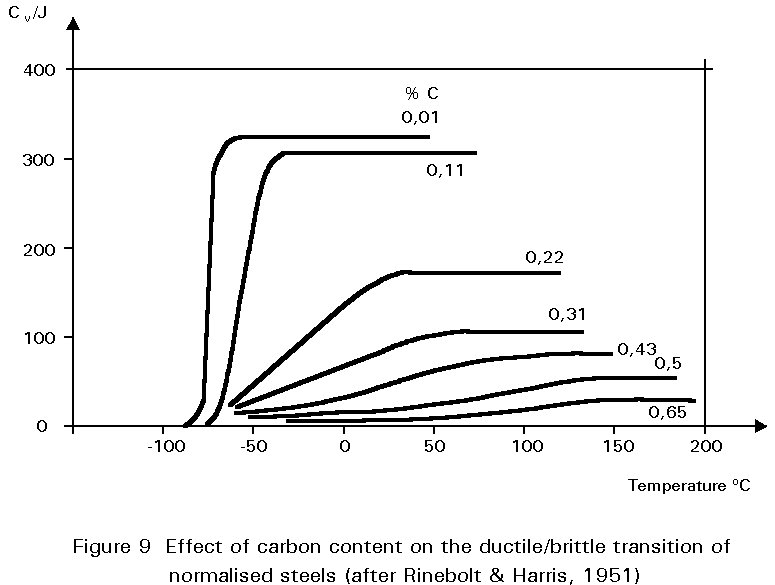
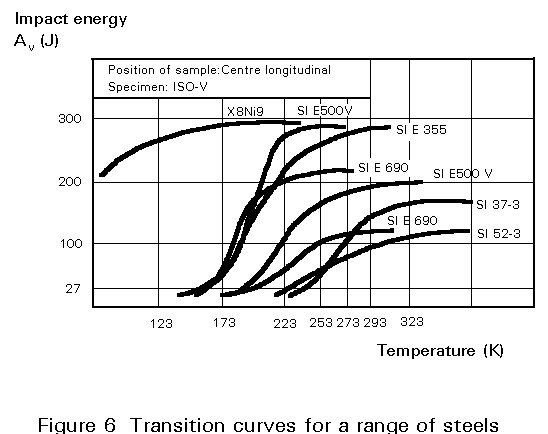
Steel composition, used elements and their quantity is crucial for temperature where such steel moves from ductile fracture to brittle fracture.
Here is for normalized steel and Carbon content
f0100009.jpg

or some wider range of steels
f0320006.jpg


How it applies to knives and knife steels?

It is quite simple.
You do not want stainless (i mean 13%+ Cr)
You want AS LITTLE carbon as possible (lets say 0,4-0,5%)
You want nickel - that is crucial element for cold temperature.
And you want secondary hardening steel - coz martensite is then much more temperer - and more ductile therefore.
 
Of course steel type plays large role in subzero temperature behaviour.

Steel composition, used elements and their quantity is crucial for temperature where such steel moves from ductile fracture to brittle fracture.
Here is for normalized steel and Carbon content
f0100009.jpg

or some wider range of steels
f0320006.jpg


How it applies to knives and knife steels?

It is quite simple.
You do not want stainless (i mean 13%+ Cr)
You want AS LITTLE carbon as possible (lets say 0,4-0,5%)
You want nickel - that is crucial element for cold temperature.
And you want secondary hardening steel - coz martensite is then much more temperer - and more ductile therefore.

I been looking at steel composition charts for about an hour. That looks like a specialty steel that is hard to match with most knife steels.
 
Somebody above said "don't overthink it." He was right.
If it's that cold, you don't wanna be there anyway.
 
In structural engineering it is said that steels have less toughness at low temperatures. Samples of the hull plating from the Titanic have been brought up and tested, supposedly the steel used was somewhat brittle and would have been even worse at the low temperatures of the north Atlantic. I.e. the hull may have been less resistant to iceburg impacts than it should have been.
 
I can't make sense of those graphs but I have heard L6 recommended for cold weather. It's got the things you want. Not too high carbon. Nickel content. Moderate working hardness. It's pretty well known for being a basic, fairly tough steel. Easy enough to find and not real expensive. There is a very similar swedish steel but I can't recall now the name. It's commonly used for home made Damascus because of the Nickel content. 15N20 Maybe?

Even if the steel doesn't become brittle low temps sure make things like wood tough unless the wood is dry. I'm talking -10F and below BTW. I used to love splitting wood when frozen but that was with a maul, not a high hardness thin bladed knife.

Joe
 
I don't live in Alaska, but I've used just about everything here in MT as low as -30*. The knives more or less performed the same. The problem will be that your hand dexterity is going to be the limiting factor. Trust me on this one!
 
Back
Top