Are translucent Arksansas stones finer than hard black?

Joined
Jan 23, 2017
Messages
987
I've read conflicting accounts on this matter, some people claim that translucent novaculite is a finer stone than the hard black novaculite. I can see how people might have assumed just because the stone looks different.
So does anybody have direct experience with this? I've recently gotten back into Arkansas stones for some steels.
Thanks in advance.
 
Yes. Err, no. Ummm... maybe so. :D

These stones are effectively finer when they are denser and more tightly bound so that particles don't come loose. This can happen with either variety of Arkansas - both Black and Translucent. So the denser the stone, the finer it will act. They actually grade the stones by "specific gravity" but this is - for all practical purposes - equal to density in this case. In practice, I've found the finer examples of these two types of stone that I've owned and used to be fairly equivalent.
 
The black hard Arkansas I have is finer than the translucent I have. It's quicker to glaze than the translucent as well; so at times, it's that much more 'fine' in it's ability to cut (less aggressive) or polish (more so) the steel being sharpened.

They're natural stones, made in the earth in a natural process with no defined 'specs' or controls. So I'm sure there's some natural variation in them as well, in terms of grain size, hardness and/or density. Surface finishing from the stone's vendors can make a difference, at least initially. But not many stones, either natural or man-made, retain their factory surface finish for very long, if they're used at all.
 
Last edited:
In my experience it is stone dependent and that is why there is so much contradiction out there when looking for this answer. This translucent stone can be finer than that black one but that black is finer than this translucent and so on.

Wasn't it old Dan from Dan's Whetstones that said no one truly understands the difference between the two stones? Maybe I'm not remembering that right but it is rattling around in my melon as I type this...
 
The black hard Arkansas I have is finer than the translucent I have. It's quicker to glaze than the translucent as well; so at times, it's that much more 'fine' in it's ability to cut or polish the steel being sharpened.

They're natural stones, made in the earth in a natural process with no defined 'specs' or controls. So I'm sure there's some natural variation in them as well, in terms of grain size, hardness and/or density. Surface finishing from the stone's vendors can make a difference, at least initially. But not many stones, either natural or man-made, retain their factory surface finish for very long, if they're used at all.

Not knowing much about rock finishing beyond wet-saw cutting, I've sometimes wondered if the final finish of a stone lends to different experiences? At least early on. For example, if Company A sands/grinds/unicorn wishes the surface of their stones to be much finer than Company B, will Company A's black appear finer than Company B's translucent?

I reckon it would be a moot point if they both came from the same company. Maybe they don't do any kind of "finishing" either and it is just the stone's natural surface (density) that we feel?
 
Not knowing much about rock finishing beyond wet-saw cutting, I've sometimes wondered if the final finish of a stone lends to different experiences? At least early on. For example, if Company A sands/grinds/unicorn wishes the surface of their stones to be much finer than Company B, will Company A's black appear finer than Company B's translucent?

I reckon it would be a moot point if they both came from the same company. Maybe they don't do any kind of "finishing" either and it is just the stone's natural surface (density) that we feel?

I think it's almost a given that the stone's finish will usually be 'different' in the near-term when a stone is new, or almost so. Whether it's starting out finer or coarser is a toss-up. As the stone wears, it's 'real' character comes out, dictated by the nature of the grit itself (hardness, friability, shape, etc) after the factory's original finish is worn away. Also depends on what steels are sharpened on it. Very wear-resistant steels will tend to glaze some stones much faster, and so the stone's performance will trend toward 'finer' as a result, unless or until the stone is resurfaced again (and that'll change it's working character either way too, at least temporarily, depending on how it's done).

Being that the stones are artificially cut to shape & size from original production, even the nature of the methods used to do that (how is it sawn or cut, and with what tools or saw blade types, etc?) could make a difference in how coarse or fine it starts out, until the last remaining traits of it's factory processing are erased from the stone's surface, after some use.
 
Since these particular stones don't give up much in the way of abrasive particles, the finish level of the surface plays a very large role in the perceived "fineness." With use, the stones glaze/dull further and further - so get finer and finer. Most users of these stones for straight razor work purposely smooth/glaze the surface in advance prior to use. This is probably a very large part of why there is so much confusion in terms of which are finer.

Also - if you actually call Dan's and speak to him, he'll tell you - the black stone from his mine is a bit finer than the translucent from his mine. Other sources can be different - and they may be identical after they are smoothed - Dan's does not finish the surface of the stone to a high level, and neither do any other sellers as far as I'm aware. The stones are normally cut on a saw, then flattened on a large rotating disc which is supplied with lubricant (usually water) and sand or some other grit. Different vendors do a better or worse job of getting the stones flat - Dan's does relatively well.
 
I have called him and talked to him and his wording during the conversation was more general, 'that the black is finer'. Still, I can see what
your saying about the abrasive particles and agree. I have all of the Arkansas grades and when I finish my straight razor on the Translucent or Black it is difficult to determine which is finer. DM
 
The guys at the Blade Show selling Arkansas stones (from their backyard) claim that the grit size is similar between 2 different grades, say medium and hard, but the particles are packed closer together in a stone that yields a finer scratch pattern. So I have some stones that look identical, but the only way to distinguish between them, is to measure the Specific Gravity of each. Denser stones are “finer”.
This done by weighing the stone under water and comparing that with the dry weight.
 
About the stones getting finer as used, that seems to concur with my experience. I have 2 "new" translucent stones from Dan's, and an old highly used translucent from my grandfather. The old stone is MUCH MUCH finer than my new stones. It is immediately noticeable by touch. Feels like a sheet of glass. I have seen it advertised that the translucent stones are finer than the black, but also vice versa. Depends on stone, and how used it is, I would think.
 
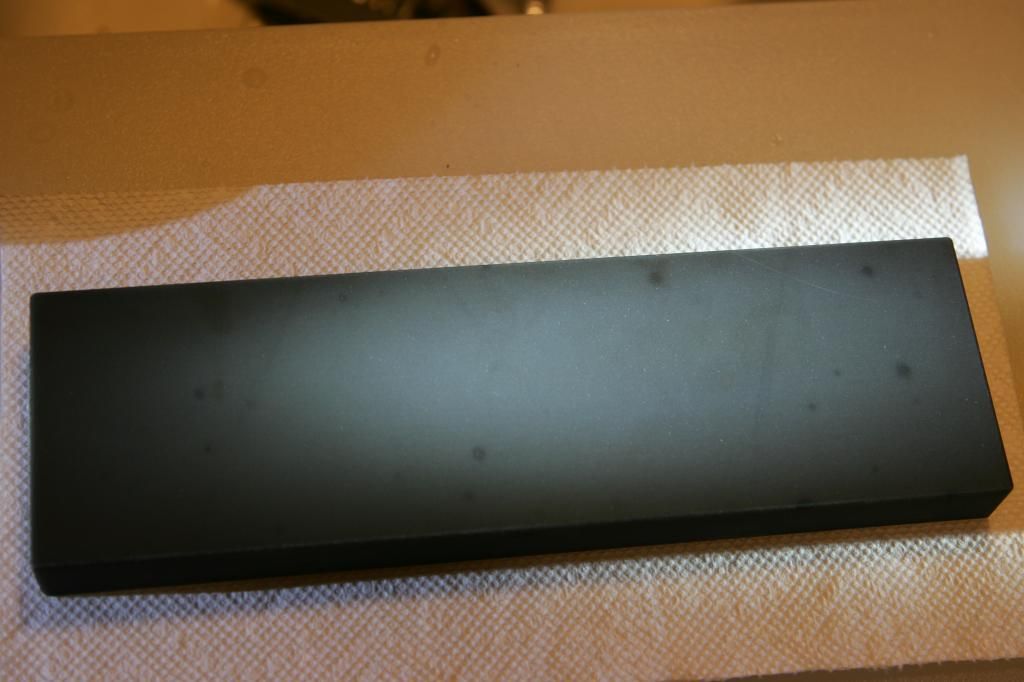
Just to give you an idea, here is one of the Arks I use for finishing razors and sometimes chisels. It is a translucent black stone. The surface is cleaned with acetone and dry, no oil or water present. This is a fairly new stone and was conditioned specifically for final finishing of razor edges. It does NOT feel abrasive to the touch in the slightest.

IMG_20140914_013053.jpg
 
My black if from Norton in the 70's and does not look like that. Mine is more jet black. DM
 
My translucent is almost twice as thick (3/4x2x6 vs 7/16x2x6 both are perfect sizes) as my black and finer. The translucent has a small chip on one corner and is glass smooth. Black has a little grit to the feel. Ive had them for about 25 years and use them constantly, with no signs of wear other than glazing which gets cleaned off after using.
 
My black if from Norton in the 70's and does not look like that. Mine is more jet black. DM

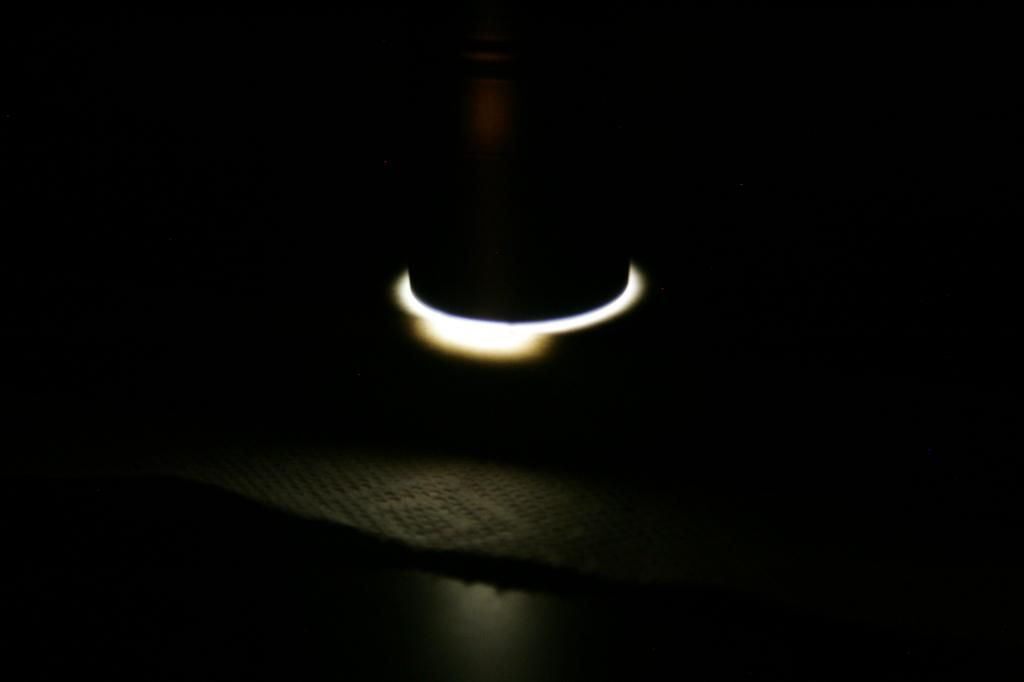
Yours isn't translucent. I have about 6 or 8 Arks, including several plain black. That one in the photo transmits just enough light to be called translucent. You can't see light all the way fhrough the stone but if you turn on a flashlight and place it on the surface near the side so that the stone still blocks the entire lens, you can see light penetrating about 1/4" into the stone. It also has small black dots and lines as you can see in this photo:

KJ2T6149.jpg
 
Here is a photo I just dug up of the translucence. The rim of the flashlight is inside the edge of the stone, and on a surface that isn't translucent, no light escapes.

KJ2T6158.jpg
 
Back
Top