At Home Cryo?

great thread. I just got a 22" evenheat oven and haven't even wired it in yet, but these are the questions i am looking into for when it's time to HT my own blades.... so far Rob and Peter have done great jobs so I'm hoping my HT quality stays consistent once i get into it.

Thanks for the tip on checking chucks page Stacy... that can't hurt as a place to start at least.
 
You'll have to let me know if they get back to you! I'm running dangerously low on blade steel. I've been holding off my order as I am going to pick up some stainless also. Just need to figure out what I will be capable of working with, WITHOUT having to send blades out anywhere.

I had a long conversation with Bob (the metallurgist at Crucible) this morning and he stated that they used a mixture of alcohol and dry ice in their testing/data sheets and he sees no benefit of using liquid nitrogen in the cooling process. He stated that 30 minutes would be sufficient for a knife sized piece of steel with the dry ice slurry. The only benefit he could see with LN would be the quicker cooling time with steels thicker than 1/4". He stated the most crucial part of the process was the initial quench out of the oven and that it should be as rapid as possible to handling temperature. He also stated the there is no practice difference having your quench plates in the freezer prior to the quench or at room temperature. The biggest problem associated with steel quality would be from cooking it too long. He has no problem answering questions regarding knife making as long as people are using their product.
 
That agrees with what I have heard from other metallurgists.

The biggest thing you have control over that can give you good results is the austenitization temp and soak....and the quench curve. It should be a Continuous Curve from A3 to Mf. No long rests or rises. 1950F to -95F within 30 minutes should make almost any stainless steel as good as it will get for a knife ..... as far as HT goes.
 
He did say that he recommended a temper prior to the cooling for S30 and S35VN which were the two main steels we discussed.
 
He did say that he recommended a temper prior to the cooling for S30 and S35VN which were the two main steels we discussed.

Interesting, so am I understanding correct, he is recommending a temper cycle before the sub-zero cycle? Seems like that would interrupt the quench curve Stacy was talking about. Also thank you for passing along the information from your conversation with Bob, very help, just what this thread needed.
 
Last edited:
Many go with a short snap temper before the sub-zero/cryo. This is mostly to prevent distortion/warp/cracks. In blade thicknesses, I don't consider it an issue or necessary. It won't make all that much difference, but technically, a continuous cooling curve is better.
 
I had a long conversation with Bob (the metallurgist at Crucible) this morning and he stated that they used a mixture of alcohol and dry ice in their testing/data sheets and he sees no benefit of using liquid nitrogen in the cooling process. He stated that 30 minutes would be sufficient for a knife sized piece of steel with the dry ice slurry. The only benefit he could see with LN would be the quicker cooling time with steels thicker than 1/4". He stated the most crucial part of the process was the initial quench out of the oven and that it should be as rapid as possible to handling temperature. He also stated the there is no practice difference having your quench plates in the freezer prior to the quench or at room temperature. The biggest problem associated with steel quality would be from cooking it too long. He has no problem answering questions regarding knife making as long as people are using their product.

That goes against what I have always heard about the difference between Dry ice slurries and LN. Dry ice being enough to finish martensite transformation, but not cold enough for transition carbides (eta carbides or whatever you call them), which add cohesion to the martensite matrix, something that dry ice cannot do. disclaimer....not a metallurgist...just repeating what I have heard from the knife making world.
 
I haven't been around as long as you or others in the knife making world and I realize it also goes against what could be considered common knowledge. I asked Bob about the formation of eta carbides and he had an explanation for it that I can't remember all the terms used. Basically says there is no real difference, but it sounds good. I know it's a contentious issue so I would recommend people call him for themselves.
 
It took me a very long time to find out the facts about what happens with cryo ! That was a few years of reading technical papers word by word ! Yet many metallurgists ,including some in the ASM cryo committee could not give me an explaiation of what happens .More than one steel maker had either no explaination or an incorrect one ! Much of cryo performers were selling misinformation [fraud ! ].
What does happen with cryo [assuming appropriate alloys ] is the formation of eta carbides and the accompaning cohesion. It must be done as part of the HT process not an add-on. It involves the tweeking of the matrix to permit room for the formation of small carbides upon tempering. This is not the martensite transformation of additional RA to martensite. Rather it is a diffusion type reaction ,first to tweek the matrix , then to precipitate eta carbides through tempering.
Snap tempering is not needed if things are done properly and if done wrong may prohibit the proper HT.Snap tempering should be done to reduce cracking but only at 250F but certainly not higher than 300F.
If you check through the forum to see comments of those who do it right ,they will tell you that they get 1-2 HRc points .The cohesion is the same type cohesion as you get in secondary hardening. It strains the matrix to add to the strength.
 
We got the 1-2 extra points of hardness on AEB-L with dry/ice acetone mix.(appx -106°) Also on 154cm..Not saying its as good as LN and I know there is no eta carbide formation but we got the extra hardness regardless.
 
There's no mention whatsoever in Crucible's documentation that states that -112 F is Mf. What they state is that is the temperature required to achieve the transformation. I find it odd that somehow this can be translated into ANY other close number. If it wasn't that important, why would the engineers and metallurgists have specified -112, do you think? Doesn't it seem as if it would have been easier to say -110, or even state to "approximately -112"?


It's a moving target and there are no absolutes. You're not reaching 100% martensite at -112. And you won't at absolute zero either.

My guess is some engineer said, "yeah, -80 C seems to be a pretty good temperature" and someone converted that into F at -112F and that's where that number came from.

-80 C converts to -112 F

But -70c is good and so is -90C. As Stacy said, it isn't some trip point, it's an arbitrary point of diminishing return for some set of circumstances.
 
Just repeating what I have heard and gathered on this great forums, you have sub zero (dry ice at -112f), and then you have cryo (LN temps of -300F or whatever I dont recall).

I would like to post a question, first a preface: I have heard that sub zero dry ice can help transform RA to untempered martensite, not a cut off temp, but like Stacy brought up, a sort of point of diminishing returns. Not likely to ever reach 0 RA, even at absolute zero like Nathan mentioned.

I have heard that cryo LN can help transform RA to untempered martensite as well, in addition......a "tightening" of the martensite matrix for more cohesion (I take that to mean with carbides in structure)....AND precipitation of ultra small carbides upon tempering.

So, does sub zero dry ice slurry, in addition to RA minimization, help in "cohesion", and does it precipitate ultra small "eta" carbides as well? Thanks for any thoughts.
 
I found discussion in section 4. sounds reasonable. Keep in mind: 1. the Author's guessed/conjectured on Fe atomic (and perhaps implicitly rhombic structure dimensional flux) radius-flux cause n-carbide transformation. 2. Fairly high alloy steel.

http://www.industrialheating.com/ext/resources/IH/Home/Files/PDFs/Role of Eta-Carbide-Meng.pdf

Just repeating what I have heard and gathered on this great forums, you have sub zero (dry ice at -112f), and then you have cryo (LN temps of -300F or whatever I dont recall).

I would like to post a question, first a preface: I have heard that sub zero dry ice can help transform RA to untempered martensite, not a cut off temp, but like Stacy brought up, a sort of point of diminishing returns. Not likely to ever reach 0 RA, even at absolute zero like Nathan mentioned.

I have heard that cryo LN can help transform RA to untempered martensite as well, in addition......a "tightening" of the martensite matrix for more cohesion (I take that to mean with carbides in structure)....AND precipitation of ultra small carbides upon tempering.

So, does sub zero dry ice slurry, in addition to RA minimization, help in "cohesion", and does it precipitate ultra small "eta" carbides as well? Thanks for any thoughts.
 
After reading the document, I suppose the answer to my question is, "No". Thank you for re posting that link. I meant to say as well that my concern is with carbon steels like W2, 52100, CFV. The general consensus is that dry ice and cryo will not help much at all with steels like that, especially if aust range is below 1500F. My concern was with a possible added cohesion with the carbon steel matrix, but if carbon low alloy steels CAN benefit from cohesion, then LN is probably going to be necessary. I see a lot of write ups on cryo and sub zero for SS, but not much for more simple carbon steels. I simply want to make the best heat treat I can, and if that means adding LN to my set up, I will. I guess I am actually SEARCHING for someone to tell me, "Yes it helps tremendously" instead of what I should be doing....let the evidence speak for itself.
 
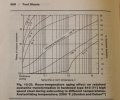
This chart is for high speed steel but will apply to other steels also.

Note that there is some benefit from temps higher than you'ld expect if you quench down to such temps within a certain amount of time.

All good stuff, some steels respond better than others to sub zero quenching.

Hoss
 

Attachments

  • 001.jpg
    001.jpg
    61.9 KB · Views: 17
After reading the document, I suppose the answer to my question is, "No". Thank you for re posting that link. I meant to say as well that my concern is with carbon steels like W2, 52100, CFV. The general consensus is that dry ice and cryo will not help much at all with steels like that, especially if aust range is below 1500F. My concern was with a possible added cohesion with the carbon steel matrix, but if carbon low alloy steels CAN benefit from cohesion, then LN is probably going to be necessary. I see a lot of write ups on cryo and sub zero for SS, but not much for more simple carbon steels. I simply want to make the best heat treat I can, and if that means adding LN to my set up, I will. I guess I am actually SEARCHING for someone to tell me, "Yes it helps tremendously" instead of what I should be doing....let the evidence speak for itself.

For low Cr high carbon steels (such as w2/52100...). From metal viewpoint -> Translate thermal into kinetic into aust crystal population lead to dislocation. 1500F + less than 20 minutes soak = low kinetic + aust matrix is not excessively carbon rich, hence fairly low dislocation. IMO, Mf should be above 70F for this case. If more carbon in solution along with higher kinetic, RA will be there at room temp. Subzero would help reduce RA% but plate martensite fraction will be higher in this case. Aha, this could be a case of loss in impact-toughness from 2 factors (plate martensite and RA). Include the word 'impact' so I can throw in RA :cool:

High alloy steels (i.e. lower Fe% balance) have much higher lattice & grain dislocation/strain. Easy to make this connection when looking at simple alloy such as aebl, even only 0.45%C in solution, RA will be high. Even after subzero or cryo, RA% still around 3-7%. Um ever wonder why stainless has low charpy-c values.

otoh, please beware of my rapid hand-waving metallurgy :foot:
 
Back
Top