At what point does "traditional" become "silhouette" class?

Great thread and very interesting opinions all around. I'm in the "it just feels traditional" camp. It's a combination of pattern, materials, and overall "feel" of the knife. I've seen a few barlows in the Custom forum that, while using traditional materials, are heavily embellished which in my eyes make them not a "traditional" knife. It's strange this is a topic I've never really thought about in depth, and now that I am I find it hard to put my finger on. Is it possible to add a poll to an existing thread? I'd be interesting in seeing people's opinions mapped out :thumbup:

WHATEVER BLUES SAYS!...(snip respecfully)...I really want one, but just because of the green micarta scales, it does not fit my interpretation of a traditional knife. If you took black paper micarta and slapped that on the knife, it would probably be traditional in my eye. If you took the G10 scale off of a Strider SMF and put a jigged bone scale in its place, I would not consider the SMF traditional, however...

I'm just curious as to why the color of the micarta would determine whether or not the knife is "traditional" in your eyes? Was black micarta used long before colored? Again just curious, thanks.

Nathan
 
I think that folks should take a few moments and read this thread as an adjunct to provide additional and supplementary perspective. ;)
 
ndeezl, just my opinion. I guess it looks more like black delrin to me, on the custom slipjoints I have seen with black paper micarta. Looks a little more traditional than green canvas micarta.
 
All of this hurts my head a bit. Some thoughts; you don't have to agree.
A stockman pattern is traditional whether it is CV with yeller handles or VG-10 and micarta.
You can put stag or jigged bone on a Spyderco, but it still isn't going to be a "traditional"
That's kind of the ends of the gray spectrum for me. When I move away from the middle toward the Spyderco, I have to ask Gus and Elliott what they think.
Ed J
 
All of this hurts my head a bit. Some thoughts; you don't have to agree.
A stockman pattern is traditional whether it is CV with yeller handles or VG-10 and micarta.
You can put stag or jigged bone on a Spyderco, but it still isn't going to be a "traditional"
That's kind of the ends of the gray spectrum for me. When I move away from the middle toward the Spyderco, I have to ask Gus and Elliott what they think.
Ed J

And therein lies the danger... :eek:

;)
 
Interesting thread.

I seem to have a few in the grey area....


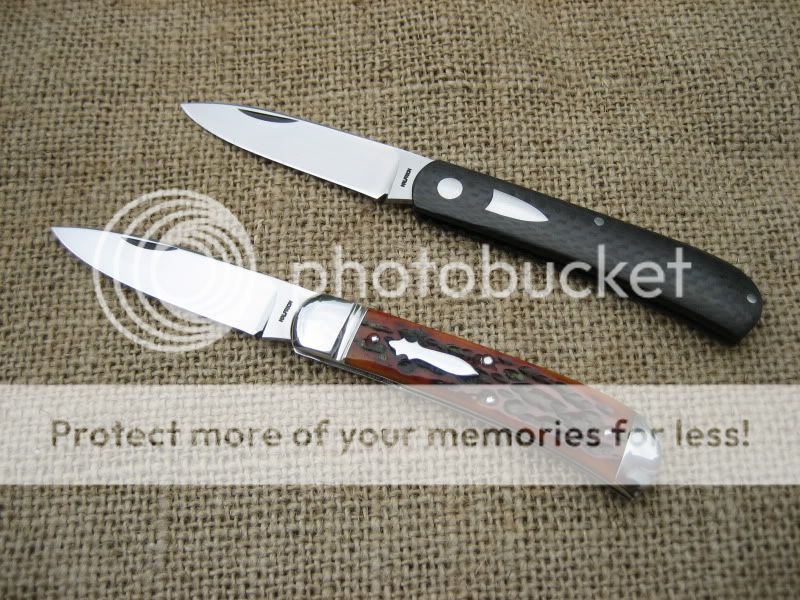
Same maker, same pattern, same steel.

IMG_2463.jpg


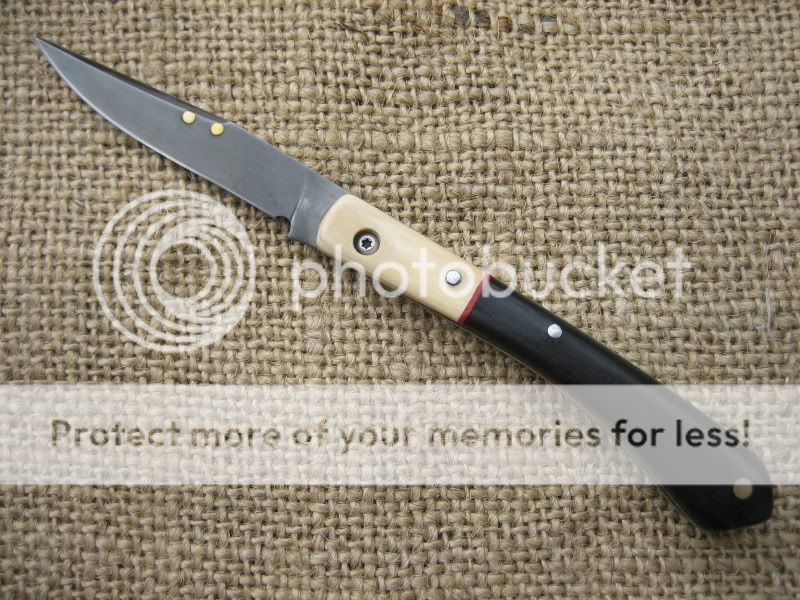
O1 Steel, Ebony and Ivory....Titanium liners, s/s spring, screwed pivot.

IMG_2299-1.jpg


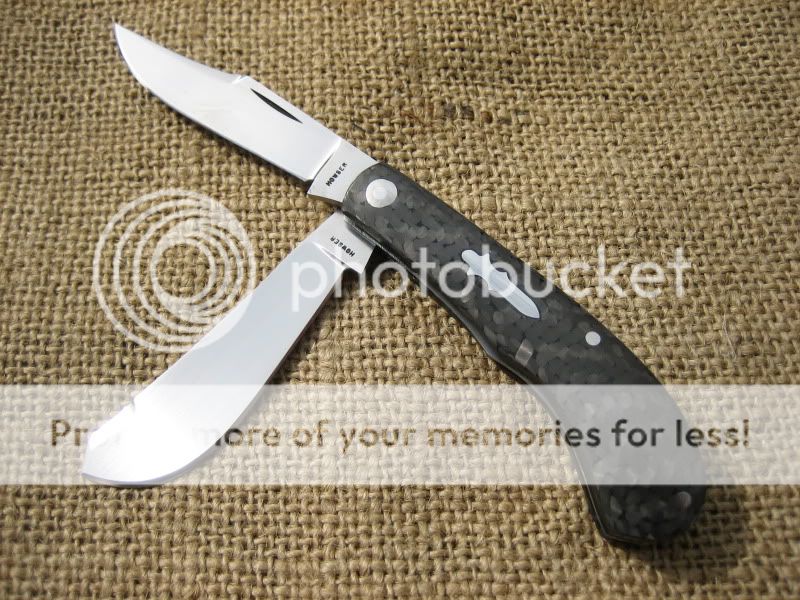
What about this Ultralight Saddlehorn?

IMG_2308-1.jpg


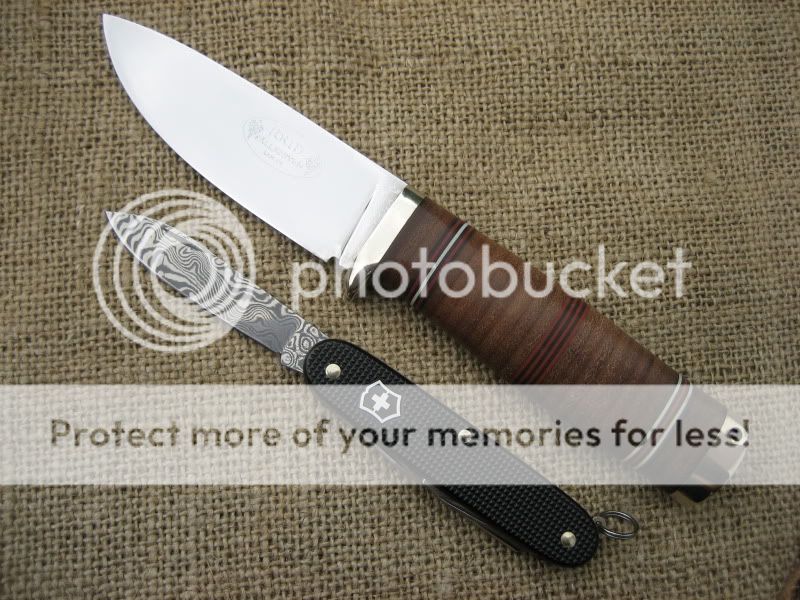
Does the steel really make a difference? The Idun is Cowry X damascus (The etch has rubbed off with use) and the Pioneer is Damasteel.


IMG_2462.jpg


Slip joint, Integral Ti liners bolsters and caps with damasteel blade.

IMG_2428.jpg


I'll get me coat. lol! (English joke)


Neil
 
Last edited:
I agree that old time knifemakers would have used 'super steels' if they had been available then, and the same applies to scale materials.
I do however, disagree strongly with the assumption that they would have used screw-type fasteners instead of rivets.

Another interest of mine is pocket watches.
I have an Elgin watch from the late 1800's, I think about 1880-1890.
I dismantle the movement (the mechanism) of this watch occasionally for routine maintenance and cleaning, and if you saw the intricacy of the components, you'd quickly realise that the technology to use small screws to build a knife would have been child's play well over a century ago.
There are tiny jewels with even tinier holes, screws so small I had to make my own screwdrivers to turn them, and had to use a loupe to see what I was doing, and shafts that are of diameters approaching that of a human hair.

All of these components were mass produced by American watch companies on automated machinery, to tolerances so tight that the parts were interchangeable with no hand fitting needed.

Knifemakers didn't bang knives together with hammers because they were too primitive to use finely machined components, they did it because rivets are better than screws in the context of a 'slipjoint' type knife.

One of the advantages of rivets over screws in the context of building a knife is that they are more capable of withstanding shear-type forces. Another is that rivets don't unscrew themselves :D
 
Thanks for all the views people!

Interesting comment re screws versus rivets, but it makes sense.

If you look at the outer doors on 17th century houses (think Plymouth Plantation), the doors are nailed through then the nails are "clenched" or "made dead" (hence the term "dead as a door nail"). Essentially, the nails served the same function as rivets. A door needed to withstand large, relatively isolated impacts--as would a knife, but not the long-term repetitive stress of a watch movement.

In the golden age of cutlery, knives were working tools, which would have been repaired as often as possible...usually "on-site:" Much easier to re-peen (or replace) a rivet than to repair (or re-machine) a screw.

Door nails and knife rivets could be re-peened or re-clenched more easily given the larger cross-section of the fastener. For the miniature scale of watch movements, screw were the better solution.

[For those of you interested in the history of technology, here's a great book: "One Good Turn: A Natural History of the Screwdriver and the Screw" byWitold Rybczynski.]
 
Last edited:
Back
Top