Atrocious edge

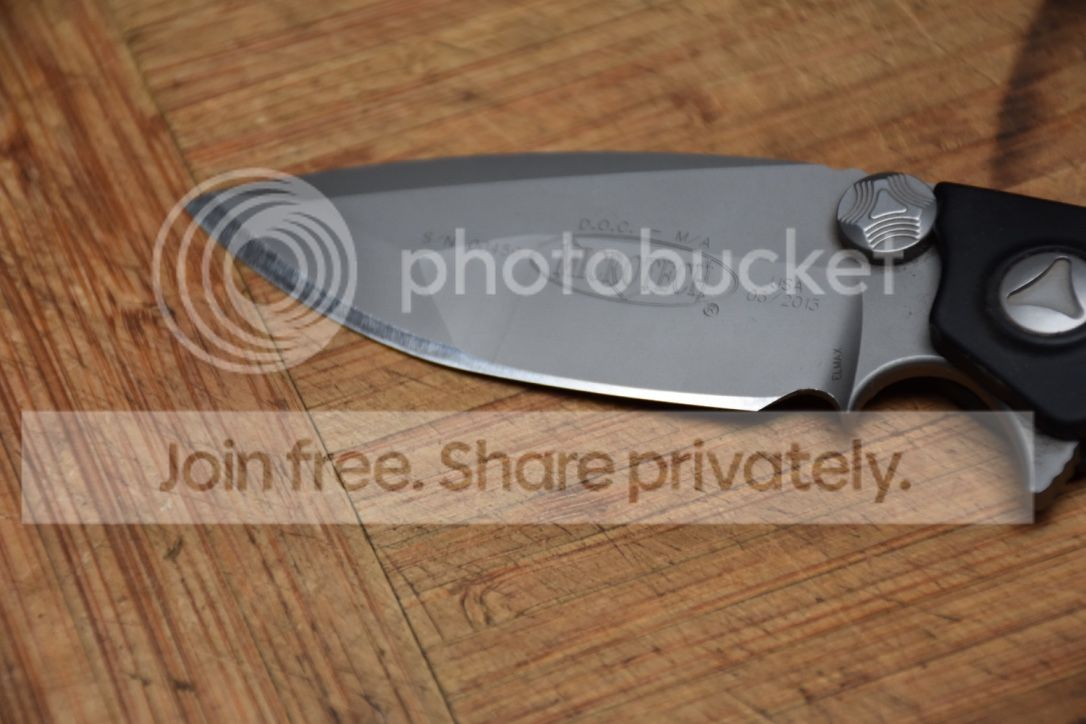
Here is a proper sharpening coil — right before the ricasso. The regular choil is behind it, allowing you to choke up on the blade to get more control in certain cutting tasks.
thumb_DSC_0136_1024_zpstbhrsg9m.jpg


The sharpening choil allows you to sharpen the edge evenly without getting your stone caught up in the ricasso.

The OP’s knife is a faulty execution of a sharpening choil. It looks like that knife has a high sabre flat grind that wasn’t finished at the ricasso, as it should have been. Instead, the edge ramps up to the ricasso, so the rear most portion of the edge is much thicker than the rest of the edge. You can’t get a good, clean edge that way. What was left was a groove directly before the ricasso. Every part of the edge in front of that groove should be a constant thickness.

The DOC in the photo also has a ramp up to the ricasso, but it doesn’t affect the edge or the sharpening process because the sharpening choil makes sure the edge is well in front of the ramp up, making the entire edge a constant thickness that is easy to sharpen.
 
Are you referring to the ricasso or the plunge line? I'm confused:confused:

I think I understand what you're talking about, and I agree that the sharpening choil should be cut out after the plunge line, not with it.

The ricasso is the entire unsharpened part between the the handle and the start of the edge and many knives can have a ricasso without a sharpening choil.
 
Yes, the ricasso is the flat portion between the handle and the blade proper.


thumb_DSC_0138_1024_zpstitza0wi.jpg


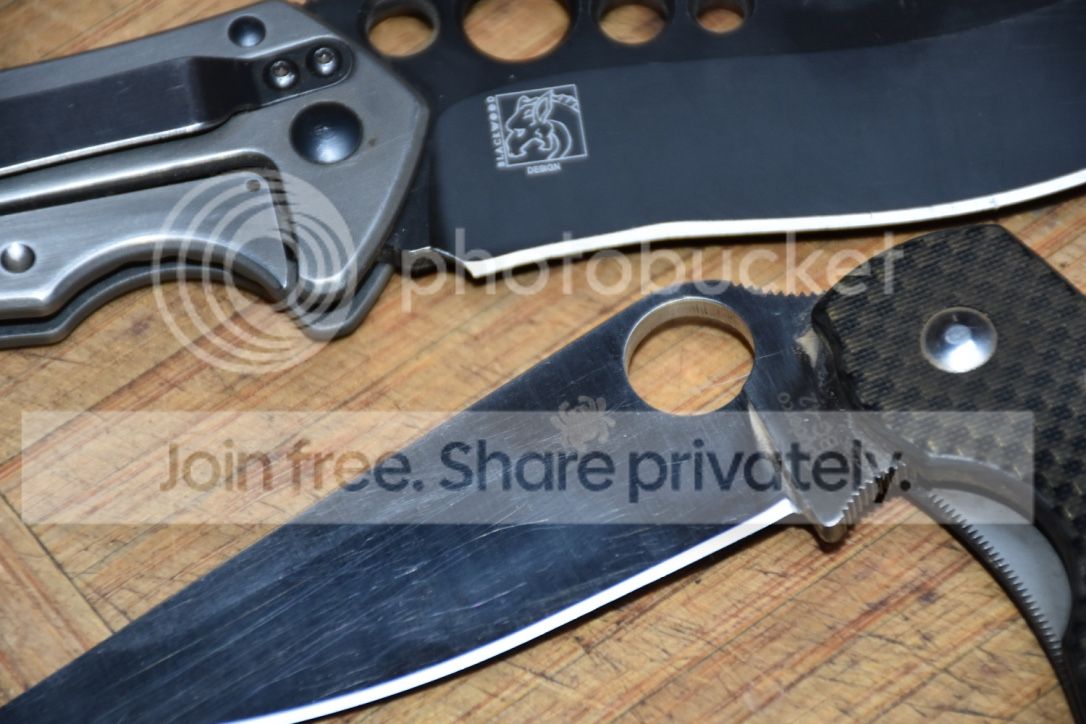
Here’s another example of a proper sharpening choil — the one on the Benchmade Skirmish. The Spyderco Military doesn’t have a sharpening choil and you can see that the edge doesn’t finish cleanly because the stone has to butt up against the ricasso.

There is a second advantage to the sharpening choil: it eliminates a stress riser. On the Military, the sharp grind line where the blade meets the ricasso, is a stress riser.

On the Skirmish, the blade gradually ramps up to the ricasso, eliminating the stress riser.

It’s difficult to tell on the OP’s knife if there was even supposed to be a sharpening choil. It looks like the blade didn’t get finished. In any event, a sharpening choil is supposed to allow for a clean finish to the edge, something that the faulty grind of the OP’s knife doesn’t allow.
 
I get what you're saying, and I agree. But to clarify; on the military, the stone would butt up against the plunge line. Maybe I'm getting too technical, but post #21 was a little confusing:D:p
 
Also to defend the manufacturer, the knife in the op seems different than their normal offerings. Who knows if it was resharpened and is a used knife or not? The secondary bevel seems like it was ground too high to take advantage of the "choil", but I still think this thread it being picky.

8157A325-861F-4543-A5D4-59F505F7C6E4_zps0ay2o6sr.jpg
 
I get what you're saying, and I agree. But to clarify; on the military, the stone would butt up against the plunge line. Maybe I'm getting too technical, but post #21 was a little confusing:D:p


That's correct, but the plunge line is the forward edge of the ricasso.

Anatomy-of-a-blade-illo_03.jpg
 
Also to defend the manufacturer, the knife in the op seems different than their normal offerings. Who knows if it was resharpened and is a used knife or not? The secondary bevel seems like it was ground too high to take advantage of the "choil", but I still think this thread it being picky.

8157A325-861F-4543-A5D4-59F505F7C6E4_zps0ay2o6sr.jpg

That's definitely a sharpening choil. Still, the grind lines are poorly executed, and it looks as though the ramp up to the ricasso (the blending plunge line) didn't quite get clear of the sharpening choil.
 
I was online shopping knives and I came across this edge atrocity. I'll get bashed for this and might be labeled as a troll but in reality I'm tired of seeing these type of edges on quality materials and they call it "quality made" product.

For those people who wonders what I'm talking about. It's the grind on base of the secondary bevel.


Yes you will and have!
 
Are you talking about the area of the sharpening notch? I'm not familiar with that knife but it would make sense to me if it was deliberate; it would help stop things like cord and cloth catching on the sharpening notch during cutting.

The sharpening notch is usually there for more that just ease of sharpening. It is there because the main grind coming up into the ricasso makes a thicker piece in one small part. You dont want an uneven edge at one small part because it screws up your ability to put a fine edge on your entire blade. also it does not make your sharpening system happy.
spyderco doesnt put them on because they have a sharp angle from the ricasso into the main grind, as to not create that thicker piece that makes a notch nessecary.

I might have just answered the wrong question, but nobody really does what is demonstrated in the picture on purpose.
 
Twindog, thanks for further clarifying my post.

Maybe this is just a "picky" thread and I've always lamented on knife makers that can't do a properly made choil and grinds and calls it "high quality" or lack thereof.

I've also seen inives w/o a sharpening choil that has a very consistent edge all the way to the heel.

I can tell you a bunch of production, semi-production and custom knifemakers that considers that type of grind either a scrap or factory 2nd.

I'll take the bashes and the negativity as long as I get this type of information across.
 
I'm glad to read some real knowledge about proper knife making, thanks to Twindog. ;)
that choil is a mess, anyone who knows the basics would agree.
 
It's for "Rapunzel-ing" from high rises when on covert missions.

:D:D

Sweet! A new term to add to my repertoire. :D "Yeah, man! We were on the 3rd floor and our enemies were making their way up the stairs, so I had no choice but to unwrap the paracord handle on my knife and Rapunzel out the back window to make my getaway!" :thumbup:
 
Sweet! A new term to add to my repertoire. :D "Yeah, man! We were on the 3rd floor and our enemies were making their way up the stairs, so I had no choice but to unwrap the paracord handle on my knife and Rapunzel out the back window to make my getaway!" :thumbup:

I was hoping someone would get a laugh outta that:D;)
 
Are you talking about the area of the sharpening notch? I'm not familiar with that knife but it would make sense to me if it was deliberate; it would help stop things like cord and cloth catching on the sharpening notch during cutting.

I agree 100%. The "sharpening choil" is a hindrance. It catches bundles of cordage or shrinkwrap, or feed bags when you're cutting a lot. something like the mora, with no notch at all, just cutting edge forward of the handle is perfect.
 
How can anyone tell anything about the edge from such a low resolution stock photo from a website? The choil looks a little weird but it's an $80 production knife not a $1000 custom! Maybe I'm just not picky enough?
 
That choil looks like it was designed more for function to minimize snagging when cutting. I would guess an $80 production knife is more designed for use than looking at, right? If that's the case, I reckon the maker succeeded.
 
You know, sometimes when I see a knife that I don't like... I just keep scrolling, right past it. Even go do a different dealer's site and see what they have.
 
Yes, the ricasso is the flat portion between the handle and the blade proper.


thumb_DSC_0138_1024_zpstitza0wi.jpg


Here’s another example of a proper sharpening choil — the one on the Benchmade Skirmish. The Spyderco Military doesn’t have a sharpening choil and you can see that the edge doesn’t finish cleanly because the stone has to butt up against the ricasso.

There is a second advantage to the sharpening choil: it eliminates a stress riser. On the Military, the sharp grind line where the blade meets the ricasso, is a stress riser.

On the Skirmish, the blade gradually ramps up to the ricasso, eliminating the stress riser.

It’s difficult to tell on the OP’s knife if there was even supposed to be a sharpening choil. It looks like the blade didn’t get finished. In any event, a sharpening choil is supposed to allow for a clean finish to the edge, something that the faulty grind of the OP’s knife doesn’t allow.


Stress risers, I understand that as a metallurgical term, and that may be true for the strength of a piece of steel, but if you use a knife as a knife, it won't matter. Having an unsharpened bit of blade right where I need an edge it is a pain. Spyderco does it right as a cutting tool.
 
Back
Top