Attaching slipjoint scales to liners

autogateman

Rod Braud
Joined
Jan 6, 2017
Messages
180
Hey Guys,
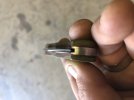
Ive taken a break from fixed blades and have been focusing on learning how to make slipjoints over the last couple months, and there is one thing I can not consistently get right. Im having problems with CA glue not firmly holding the SS liners to the scales. I can get them all glued up and it seems like any small amount of heat from sanding or just the impact from peening the pins makes them try to pop loose. All have been bolsterless so far. I have not had a single problem with G10 or micarta liners. Im roughing up the SS really well to give it something to bite to also. I tried the same epoxy as I use on my fixed blades and it did work better, but the CA glue is so much thinner it leaves a neater seam. Whats everyones method that yall find to work well for that?

Thanks in advance
Rod
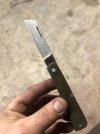
 
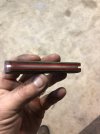
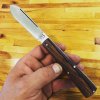
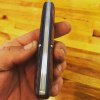
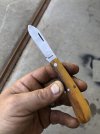
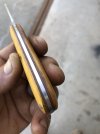
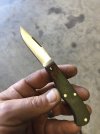
Here are the ones E8BAB971-53D3-4020-8ADC-43B6271761C1.jpeg 99C43634-84B2-47DD-82DD-6DAC0B9371C5.jpeg 073C688A-38E6-4163-AFEC-9228DFBF595D.jpeg 7137813C-765D-4DD7-BEDD-5A541B193EB6.jpeg 4947216A-5780-4E99-907C-8DE93FA5DD3E.jpeg F5119518-DE64-45B4-BA29-B44481CBC873.jpeg 81C26436-4E1D-4BEC-B580-7CC6C94B74CB.jpeg I’ve made so far.
 

Attachments

  • FA60BBE6-13B5-4F49-8122-AD16E352D524.jpeg
    FA60BBE6-13B5-4F49-8122-AD16E352D524.jpeg
    166 KB · Views: 28
Heat and glue dont mix very well. Once i glue the scales on it is very light work on the belt sander and the rest hand sanding.
 
standard CA glue is more sensitive to heat and impact than I'd be willing to tolerate for "final glue up" of scales. Plenty of great makers have and still do use it, and I guess if your process allows you to pin things together before everything else is finished, maybe it's ok as a water seal. I use CA glue all the time to "temp fixture" scales to finish with exotic materials like damascus or ti liners, where everything has to be individually finished before finally pinning the knife as the last step of assembly. I couldn't live without it for this, because of the characteristics mentioned with CA glue, I can heat it up real quick, and slap it on the bench, and the scale pops right off.


For actual permanent fixturing of the scales to liners, I'd recommend epoxy, or a structural acrylic adhesive like Loctite Speedbonder 324 or 326, which offers similar performance to high performance long cure epoxies, but with 1 or 5 minute fixture times, and anaerobic reaction, which keeps glue that squirts out from the seams, from curing (which makes it much easier to clean up than epoxy or ca glue). It's expensive, but it's great stuff. However, I recommend practicing with it a few times before using it, as you follow a little bit of a different process from epoxy, and I had some problems with the 1 min stuff setting up before I got everything completely clamped down, when I tried to use it the same way I was used to using epoxy.

Also, if you want it to really hold, it's advisable to rough up the inside of the liners and handle material in some way (off the edges, but close as you can get and still have room to clean up), and then gently lap off any raised edges or burrs, before clamping up. To get a really nice seam, you want a higher finish on the mating surfaces, than gives a good hold. The more aggressive the finish, the better the glue will hold in peel, but if it's rough at the edges of the mating joint, deep scratches will show, so you have to come up with a method to accommodate this.

FWIW, the Loctite stuff, has extremely high heat resistance, and a screwed up "gluing" can be a bitch to get apart, even worse than epoxy in my experience, I've ruined plenty of handle material trying to get a scale off that was glued with this stuff.
 
Those pins are there for a reason-to hold the scales on. There is no reason to glue scales on a slip joint-except for fixturing purposes.
 
Back
Top