- Joined
- Jan 5, 2007
- Messages
- 621
It is my priveledge to write a short account of Aurum Etchings and company that became well known throughout the 70s and 80s for the engraving fine artwork onto firearms and knives. It is also a short account of my personal friendship with Samuel R Shortes the Founder and President of Aurum Etchings who I have had almost daily contact with now for a number of years.
A number of years ago I first to contacted Samuel Shortes with some photos of my Aurum Etched knives, at that time I was fortunate that he did not have his current work commitments and we were able to form a business and personal relationship
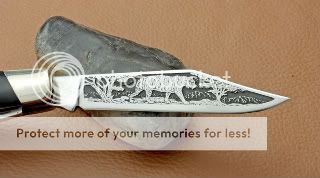
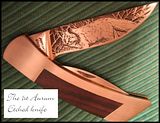
Subsequently my interest in Aurum Etchings grew and as my collection grew I was gradually able to gather more information about the company and it origins and what made Aurum Etchings unique. It also occurred to me that these same Aurum Etched knives would have cost me many thousand of dollars each if they had been individually engraved by hand but due to a process that Aurum Etchings had largely if not entirely revolutionised back in the early 70s the same could be had in some cases for even a few hundred dollars. In fact the very first Aurum knife produced by Aurum Etchings before they began the process is seen here below, it was done by Samuel Shortes on his kitchen table with the barest minimum of tools prior to setting up there facility, it was incredibly time consuming and not a cost effective method if these were to be had at price most could afford.
Click on image to enlarge
My own interest in collecting knives had started to decrease a little prior to collecting Aurum knives and I found that one could only collect so many variations before it was difficult to collect anything substantially different from what one already had. I was looking for some significant point of difference between what I had which was a number of models types and variations and yet although all different they were in many respects the same. That is where Aurum Etchings filled the void, my collecting surely would have declined after reaching what I considered enough variations had not Aurum Etchings produced knives embellished with some of the most fine artwork I had ever seem placed not on paper but on a canvas of steel, on knives and also firearms.
As a result of this new process Aurum etched knives represented an outstanding bargain and a price I was only too willing to pay. My collection soon started to take on a whole new dimension.
Aurum Etchings spanned a period of 17 years from 1974 to 1991 reaching its pinnacle in the late 70s early 80s. Most of Aurum Etchings work was confined firearms which makes the knives that were etched by Aurum of special interest to collectors as there were fewer of them and many of them are no longer in production today.
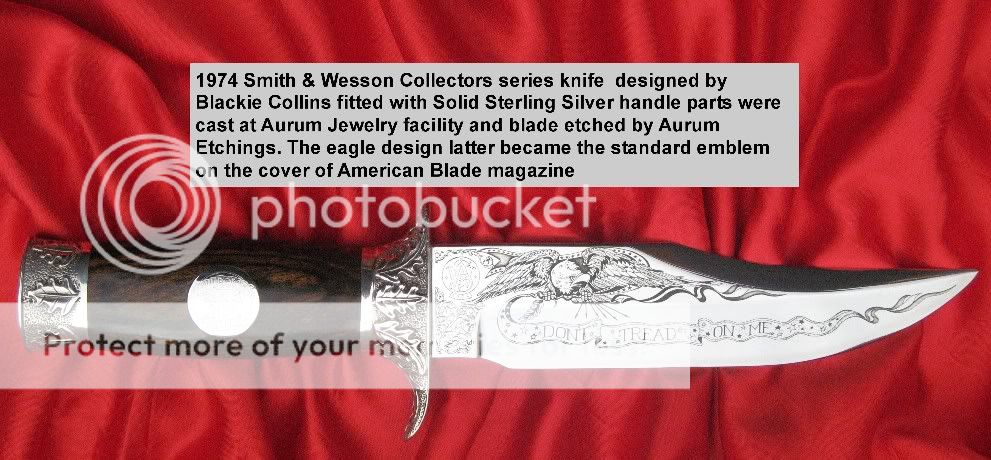
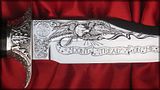
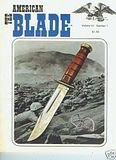
Samuel R Shortes had owned and operated his own Jewellery manufacturing company prior to setting up Aurum Etching in 1974; he was no stranger to fine and intricate work. In fact for some time the Jewellery Company continued to exist alongside the new Aurum facility and was used to cast the solid sterling silver handle parts of the very first knife (or knife in series) that Aurum Etchings ever produced, it was the Smith & Wesson 1974 collectors series bowie knife designed by Blackie Collins with the spread eagle which was latter seen on the covers of the American knives magazine for a few years after 1974. The knife retailed for $300 back in 1974 which is in todays money is approximately $1290. Here below is an example of my own which is one of the 4 in the series. (It should be noted that the 2nd knife in the series of 4 the S&W model 6020 was not etched by Aurum Etchings as the other 3 were and the etching is evidently of lesser quality and value.)
The blade etch was the finest level of detail that Aurum produced and the fact that these were actually SOLID sterling silver parts and that Aurum actually paid good money for the sterling silver (not to be confused with nickel silver) and that they were also the knife that inaugurated Aurum Etchings makes them highly collectable.
Click on images to enlarge
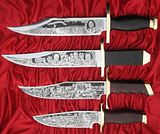
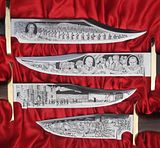
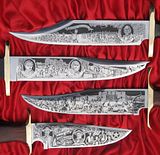
Later to follow was the famous Republic set aas seen here below. Introduced in 1976 it followed along the same lines as the Smith & Wesson collector series with the highest level of detail in the etch, The series of 4 knives the most famous of which was the Alamo were among the most highly detailed and intricately engraved (i.e. etched) knives ever produced.
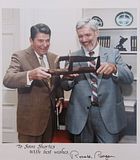
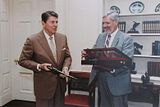
Here below Ronald Reagan is seen receiving one, I wrote a letter to Mrs Reagan about 12 months ago and was told that the knife in view is now held at the Ronald Reagan Presidential Library. There is also another Alamo displayed at the Alamo Museum (San Antonio, Texas).
Click on images to enlarge
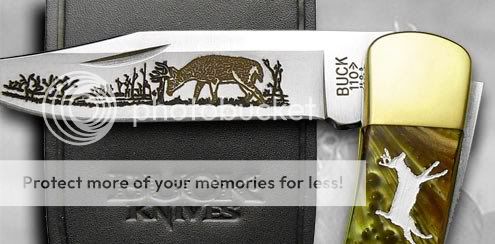
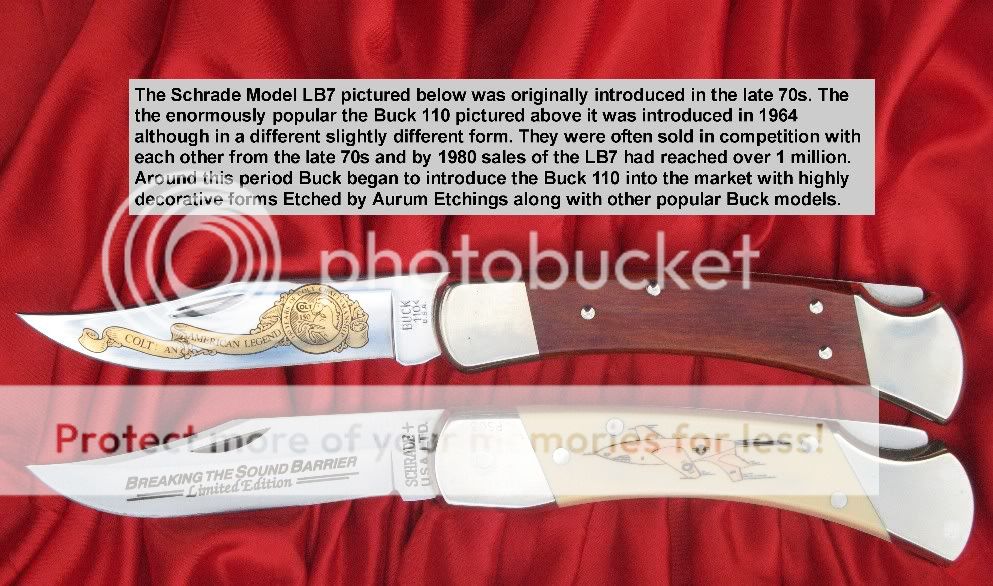
Into the 80s Aurum enjoyed a long standing relationship with Buck knives one of the biggest knife producers in the USA, it is a little known but significant fact that the sales success as a collectors item of what is often said to be the most popular folding knife design in the world http://webcache.googleusercontent.c...k+110+imitated+world&cd=1&hl=en&ct=clnk&gl=au
the Buck model 110 knife was in part largely due to Aurum Etchings.
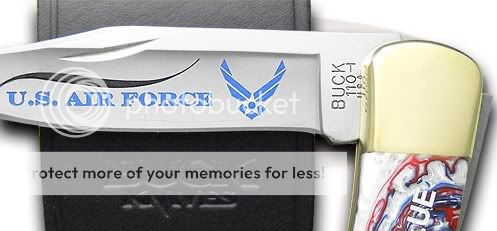
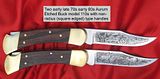
The famous model 110 previously had great success a utility/hunting knife but took the interest of collectors worldwide when many of these began to appear on the market Etched by Aurum Etchings back in the late 70s early 80s and continued through the 80s until 1991 when Samuel Shortes set up Buck knives own etching facility for them. It is difficult to estimate the enormous impact on interest from collectors that resulted from Aurum Etchings decorating the model 110 and many other knives from Buck through the eighties. There is currently still a cult like following among collectors for the humble buck model 110 due largely to the success Aurum Etchings had in introducing this knife in different highly decorative forms. One only needs to do a quick search on eBay to see masses of variations of this simple 110 model to appreciate the enormous collector interest that that was stimulated from those earlier years when a few highly decorative variations were first introduced into the market by Aurum Etchings. I presume that it is in part for that reason that Buck collectors will often pay a very high premium for an early 80s model 110 etched by Aurum Etchings.
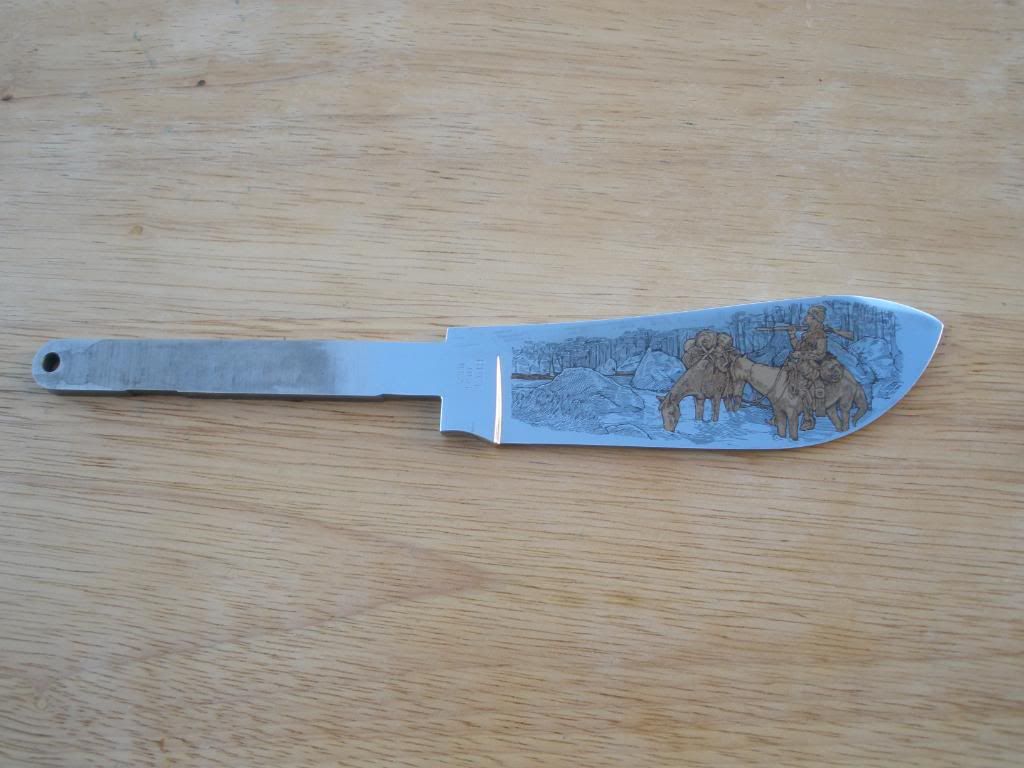
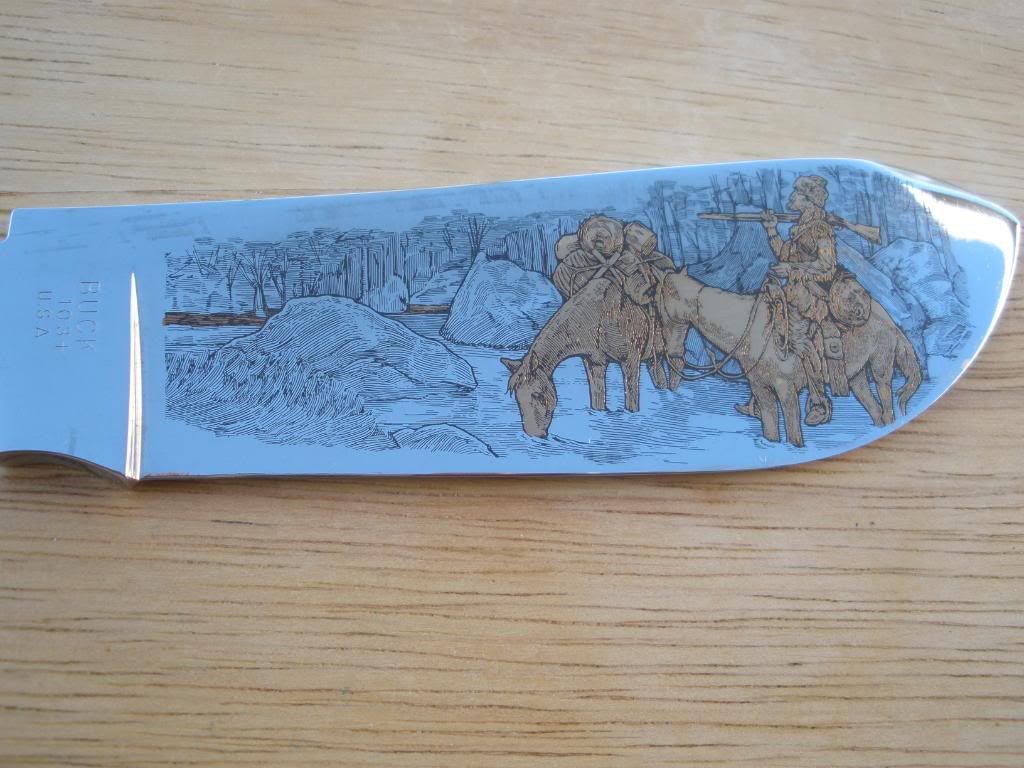
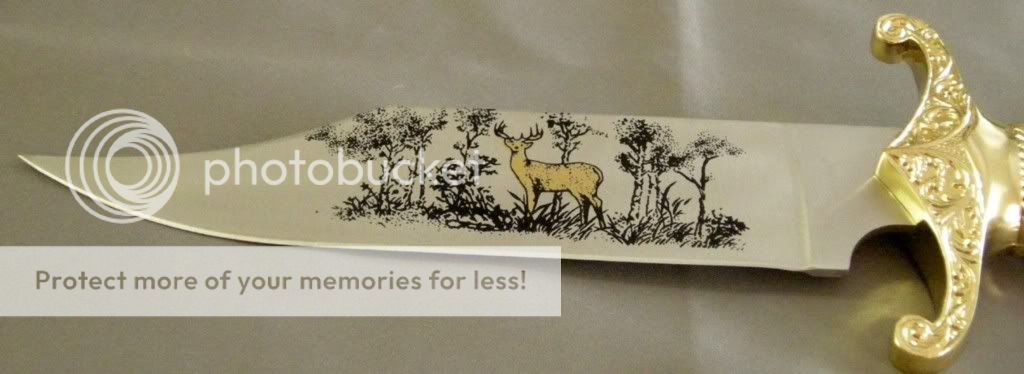
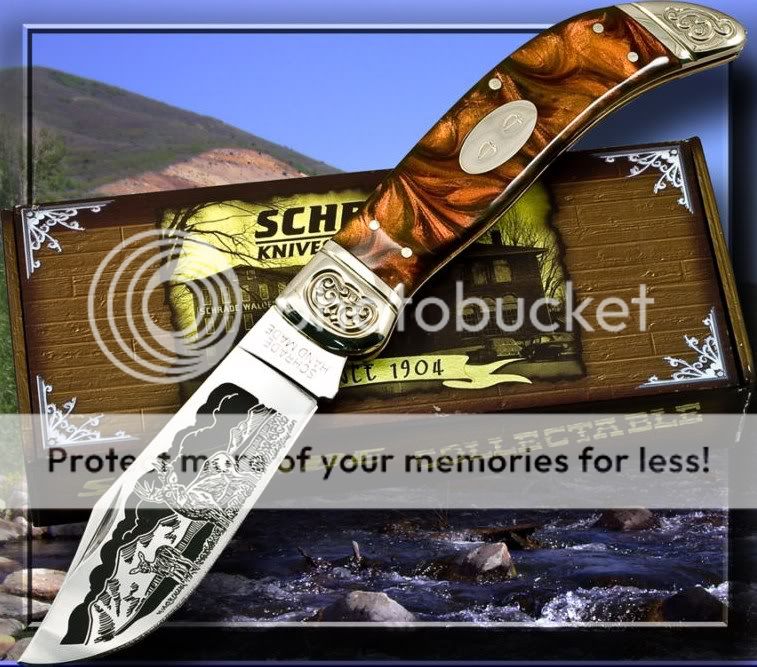
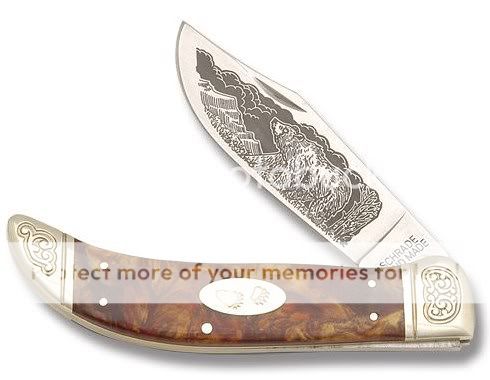
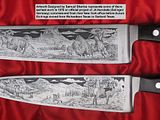
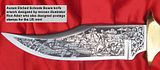
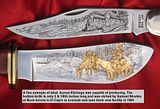
Aurum Etchings employed fine artists to do their work, Samuel Shortes was one of them and you can see the quality of some of his work below on the kitchen knives. Another famous artist employed by Aurum etchings was Ron Adair. Here below is an example of his work on the WW2 knife Schrade bowie, he also was commissioned to do work for the US mint.
Click to enlarge images
Aurum Etchings closed down in 1991 due to circumstances beyond its control.
Sam still enjoys a long standing relationship with Buck knives and often comments on the integrity that it operates with. Sam is currently in the process setting up Aurum Etchings again with newer high tech equipment. It will still be Aurum Etchings and will create new collector interest in both the old and new, the old Aurum Etchings belongs to the past separated by a period of approximately 20 years and significant increases in technology, The new Aurum Etchings will add a new dimension to the old, the old Aurum Etchings belongs to antiquity, the new to the future.
Regards Tim
A special note of thanks to Michael (Codger 64) from the Schrade Knives Collectors Forum for information on the numbers of Schrade lb7s produced around the early 80s.
A number of years ago I first to contacted Samuel Shortes with some photos of my Aurum Etched knives, at that time I was fortunate that he did not have his current work commitments and we were able to form a business and personal relationship
Subsequently my interest in Aurum Etchings grew and as my collection grew I was gradually able to gather more information about the company and it origins and what made Aurum Etchings unique. It also occurred to me that these same Aurum Etched knives would have cost me many thousand of dollars each if they had been individually engraved by hand but due to a process that Aurum Etchings had largely if not entirely revolutionised back in the early 70s the same could be had in some cases for even a few hundred dollars. In fact the very first Aurum knife produced by Aurum Etchings before they began the process is seen here below, it was done by Samuel Shortes on his kitchen table with the barest minimum of tools prior to setting up there facility, it was incredibly time consuming and not a cost effective method if these were to be had at price most could afford.
Click on image to enlarge

My own interest in collecting knives had started to decrease a little prior to collecting Aurum knives and I found that one could only collect so many variations before it was difficult to collect anything substantially different from what one already had. I was looking for some significant point of difference between what I had which was a number of models types and variations and yet although all different they were in many respects the same. That is where Aurum Etchings filled the void, my collecting surely would have declined after reaching what I considered enough variations had not Aurum Etchings produced knives embellished with some of the most fine artwork I had ever seem placed not on paper but on a canvas of steel, on knives and also firearms.
As a result of this new process Aurum etched knives represented an outstanding bargain and a price I was only too willing to pay. My collection soon started to take on a whole new dimension.
Aurum Etchings spanned a period of 17 years from 1974 to 1991 reaching its pinnacle in the late 70s early 80s. Most of Aurum Etchings work was confined firearms which makes the knives that were etched by Aurum of special interest to collectors as there were fewer of them and many of them are no longer in production today.
Samuel R Shortes had owned and operated his own Jewellery manufacturing company prior to setting up Aurum Etching in 1974; he was no stranger to fine and intricate work. In fact for some time the Jewellery Company continued to exist alongside the new Aurum facility and was used to cast the solid sterling silver handle parts of the very first knife (or knife in series) that Aurum Etchings ever produced, it was the Smith & Wesson 1974 collectors series bowie knife designed by Blackie Collins with the spread eagle which was latter seen on the covers of the American knives magazine for a few years after 1974. The knife retailed for $300 back in 1974 which is in todays money is approximately $1290. Here below is an example of my own which is one of the 4 in the series. (It should be noted that the 2nd knife in the series of 4 the S&W model 6020 was not etched by Aurum Etchings as the other 3 were and the etching is evidently of lesser quality and value.)
The blade etch was the finest level of detail that Aurum produced and the fact that these were actually SOLID sterling silver parts and that Aurum actually paid good money for the sterling silver (not to be confused with nickel silver) and that they were also the knife that inaugurated Aurum Etchings makes them highly collectable.
Click on images to enlarge


Later to follow was the famous Republic set aas seen here below. Introduced in 1976 it followed along the same lines as the Smith & Wesson collector series with the highest level of detail in the etch, The series of 4 knives the most famous of which was the Alamo were among the most highly detailed and intricately engraved (i.e. etched) knives ever produced.
Here below Ronald Reagan is seen receiving one, I wrote a letter to Mrs Reagan about 12 months ago and was told that the knife in view is now held at the Ronald Reagan Presidential Library. There is also another Alamo displayed at the Alamo Museum (San Antonio, Texas).
I personally delivered the Alamo knife and the Colt Walker to him at the Oval Office. Michael Wayne (John Wayne’s oldest son) bought two of the Alamo knives----one for himself and one for his father. Ronald Reagan began acquiring our work back when he was the Governor of California. Through Colt firearms and Winchester we engraved hundreds of firearms for the John Wayne Estate. I made multiple trips to Hollywood to talk to Michael regarding engraved gun projects with Colt and Winchester. I met with Patrick Wayne once. Michael was my main contact.
Samuel R Shortes
Click on images to enlarge


Into the 80s Aurum enjoyed a long standing relationship with Buck knives one of the biggest knife producers in the USA, it is a little known but significant fact that the sales success as a collectors item of what is often said to be the most popular folding knife design in the world http://webcache.googleusercontent.c...k+110+imitated+world&cd=1&hl=en&ct=clnk&gl=au
the Buck model 110 knife was in part largely due to Aurum Etchings.
The famous model 110 previously had great success a utility/hunting knife but took the interest of collectors worldwide when many of these began to appear on the market Etched by Aurum Etchings back in the late 70s early 80s and continued through the 80s until 1991 when Samuel Shortes set up Buck knives own etching facility for them. It is difficult to estimate the enormous impact on interest from collectors that resulted from Aurum Etchings decorating the model 110 and many other knives from Buck through the eighties. There is currently still a cult like following among collectors for the humble buck model 110 due largely to the success Aurum Etchings had in introducing this knife in different highly decorative forms. One only needs to do a quick search on eBay to see masses of variations of this simple 110 model to appreciate the enormous collector interest that that was stimulated from those earlier years when a few highly decorative variations were first introduced into the market by Aurum Etchings. I presume that it is in part for that reason that Buck collectors will often pay a very high premium for an early 80s model 110 etched by Aurum Etchings.
Aurum Etchings employed fine artists to do their work, Samuel Shortes was one of them and you can see the quality of some of his work below on the kitchen knives. Another famous artist employed by Aurum etchings was Ron Adair. Here below is an example of his work on the WW2 knife Schrade bowie, he also was commissioned to do work for the US mint.
Click to enlarge images


Aurum Etchings closed down in 1991 due to circumstances beyond its control.
Buck did not lose faith in our technology and they then hired me to install a complete etching facility at their El Cajon plant and then later a second plant in Idaho. Later A & A Engraving bought the Aurum process and I helped the install and start-up an engraving factory for guns in South Dakota.”
Samuel R Shortes
Publically, Aurum has been most commonly associated with the knife industry, and in particular, its work with Buck Knives. Buck was its primary knife customer throughout Aurum’s 15 year history from its very first year in 1975. Aurum went on to design and build Buck’s first knife etching facility/process In El Cajon, California. Decades later, an upgraded facility and process was built in Post Falls, Idaho. Buck and Aurum have enjoyed a long relationship that continues today.
What was not generally known was that almost 90% of Aurum’s services were to the firearms industry. Its primary customers were Colt Firearms, Winchester (U.S. Repeating Arms), Remington, Ithaca, Weatherby, and Smith & Wesson. Various firearm authors have collective works but usually do not identify engravers. (Ref. Winchester Commemoratives by Tom Trolard.) Ultimate customers were major police departments, U.S. military academies, military services, foundations as the John Wayne Foundation, and historical groups like the U. S. Historical Society.
Although the firearms industry might appear as a bedrock industry, it has a tumultuous history with a meltdown ever couple of decades. The last meltdown was at the end of the ‘80’s and beginning of the ‘90’s. U.S. Repeating Arms, Ithaca, and Colt Firearms declared bankruptcy and hundreds of their suppliers were drawn into the vortex. Aurum found itself holding over $ 500,000 of receivables from bankrupt clients. To preserve the technology it had developed over that 15 year period, Aurum made two critical moves. First, it sold its knife etching technology to Buck Knives and set it first facility in El Cajon. Secondly, it sold its firearms engraving technology to A & A Engraving in Rapid City, South Dakota. Both of these groups remain dominant contributors in their field.
Aurum's artistry and craftsmanship keeps it as one of the most desirable collectibles.
President & Founder Aurum Etchings
Samuel R Shortes
Sam still enjoys a long standing relationship with Buck knives and often comments on the integrity that it operates with. Sam is currently in the process setting up Aurum Etchings again with newer high tech equipment. It will still be Aurum Etchings and will create new collector interest in both the old and new, the old Aurum Etchings belongs to the past separated by a period of approximately 20 years and significant increases in technology, The new Aurum Etchings will add a new dimension to the old, the old Aurum Etchings belongs to antiquity, the new to the future.
Regards Tim
A special note of thanks to Michael (Codger 64) from the Schrade Knives Collectors Forum for information on the numbers of Schrade lb7s produced around the early 80s.
Last edited: