Bad steel or bad knifemaker?

Joined
Jul 19, 2008
Messages
199
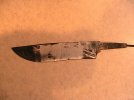
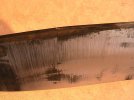
I tried to heat treat this blade today. It's a 10" blade of 1095 that I got from Admiral Steel. This is the first time I've used 1095 from Admiral. I normalized the blade at 1500 degrees three times, coated the blade with clay, heated the blade to 1475 degrees, then quenched in 150 degree Tough Quench. I then tempered twice for two hours at 450 degrees. When I started grinding off the scale, I found a very large crack in the spine of the blade. I have never had this happen before unless using a water quench and then the cracks were on the edge and not the spine. Could it be that there were some impurities in the steel , or is there something that I should do differently? The only thing that I did differently from normal is that it took about 20min to get the blade into the tempering oven.
IMG_0981.jpg

IMG_0982.jpg
 
wow, sorry to hear about that, i had that happen to me about a week ago, but in my case im sure its that im not that skilled at the heat treat yet... i know how it feels though.
 
What grit did you finish to before HT? I've had a blade pop from a deep 60x scratch, was pretty similar to this.
 
I feel your pain.

I have cracked the last 8 blades I have made from Admirals 1095 (3/32" x2"). I've used this size steel from Admiral in the past with no problems. Normalized 3 times held at 1500 for 5 min. into 130 deg. Parks #50.

I've heard the ping after the quench in my hand and while it was in the oil. I have tried 220 grit belt finish then heat treat, hand sanded everything up to 400 then heat treat. They have cracked on the spine and on the blade side.
At the same time I was doing these I also did 2 blades with 5/32" x 1.5" Admiral 1095, no problems.

After going through almost ten feet of this stuff I can only conclude I did not get 1095 or there is something else wrong with it.

I hope someday to find the answer.
 
I tend to agree with will. 40 grit can make one break. I always grind to 400 before HT. It could also be the steel, I had a ATS-34 blade break while peening a guard pin in.
Your process sounds good.
 
What grit did you finish to before HT? I've had a blade pop from a deep 60x scratch, was pretty similar to this.

I didn't even think of that and now that Will brings it up, I'm sure he's right. I only finished the blade to 60grit when I usually go to 220. Thanks for all the help. That's why I love this forum.
 
I have not had any problem with 1095 steel from Admiral in the 1.5" in several thicknesses. And being a newbie I have butchered some steel. No problem with the steel, just my grinding. Learning every day!:confused:
 
try lowering the temp of the quench to around 130 . Kevin says 1095 , the oil needs to be around 130
vern
 
You say you coated the blade with clay, was that just at the spine for a hamon or the entire blade as an attempt to limit decarb?

-Page
 
Just a note I found that finishing to 400 or even 220. and also have the grind on the edge and the spine run lengthway of the blade,from recasso to point. Just that alone stoped alot of cracking on my water quinched blades. So now I do it on both water and oil quinch. (I do realize you used oil,) I just learn't this lesson in water.
 
Thats a good point... if I'm reading you right. We usually grind the spine by holding the blade vertically against the grinder, but I also do the same to the edge to get the grinding grain running down the entire length of the edge as opposed to having a rough grain indusing a crack. Its tough to put this in words, if I was home i would post a pic.
 
You say you coated the blade with clay, was that just at the spine for a hamon or the entire blade as an attempt to limit decarb?

-Page
I only coated the blade up by the spine to go for a hamon, and the crack was in an area completely covered with clay. I have never prepared the blade with the grind running parallel to the edge prior to heat treat, but I will have to start doing that. I just feel silly for not grinding the blade more than just 60 grit. It's just that I'm almost out of belts, and wanted to save the ones I had left for finishing after heat treat. Thanks everyone for all of the great advice.
 
I only coated the blade up by the spine to go for a hamon, and the crack was in an area completely covered with clay. I have never prepared the blade with the grind running parallel to the edge prior to heat treat, but I will have to start doing that. I just feel silly for not grinding the blade more than just 60 grit. It's just that I'm almost out of belts, and wanted to save the ones I had left for finishing after heat treat. Thanks everyone for all of the great advice.

My perception of what may have happened is that the grind scratches running perpendicular to the cutting edge combined with the hard corners at the spine may well have given you a stress riser to start your catastrophy off, but the fact that your crack has pulled apart to reveal a gap at the spine indicates that the differential cooling of your edge hardening then your spine set up a tension that found a convenient release at your stress riser. First the edge hardens and contracts a little then the spine follows suit. If you have balanced everything out the spine contracting as it cools will bow your blade slightly (hence the curve in a Katana) but the edge will still be warm enough that it can adjust itself to the new dynamic without fighting back too hard. You may have set up too much of a differential (too much clay or some such) and then waited too long before tempering (if it hadn't already gone ping in the quench)

Just another theory. Don Fogg or or Don Hanson both work with clayed blades, maybe one of them will happen across this thread and shoot down my theory, but it is another thing to consider.

-Page
 
I agree with Page's Post except for one point. it has been found that water quenched blades will curve upward toward the spine and oil quenched blades curve toward the edge. This along with the coarse grind probably created the stress riser and the resultant crack. The only other possibility is forging too cold and creating the fracture with the hammer.
 
I agree with Page's Post except for one point. it has been found that water quenched blades will curve upward toward the spine and oil quenched blades curve toward the edge. This along with the coarse grind probably created the stress riser and the resultant crack. The only other possibility is forging too cold and creating the fracture with the hammer.

That certainly puts the explanation in a nice neat package! I was trying to model out how the spine contracting would cause that, it never occurred to me that oil would invert the bowing effect. now it all makes sense, The edge put the spine under tension. Thank you A.C.! I need to play with making hamon more.

-Page
 
Oh, well now I have to go and complicate things, if the tip dropped the spine would be under compression not tension. Sori is caused by the expansive effects of a BCC(pearlite) or BCT (martensite) structure vs FCC (austenite), the spine pushed the tip down with its expansion while the edge resisted since it had already got there. It is quite confusing for most people since we are led by popular conception to believe that hardening steel contracts. It only contracts from cooling to a point and then when actual transformation occurs it is accompanied by a massive expansion.

But then a technical argument could be made about the degrees of expansion and compression depending on where the transition line rests in the blade:confused:.
 
So much for nice neatly packaged explanations. I hadn't even though of the phase changes taking up different volumes! I thought it was just a simple thermal expansion thing.

more experimentation is definitely called for now!

-Page
 
Page,
It would be such a wonderful world if all it was, was a simple thermal expansion thing. The problems that arise in a blade that has different structures in it (differential quench, such as a clay coated blade) comes from the different sizes of the cubic arrangement of the atoms. In the FCC form, things are nice and tight, taking up less volume. The BCC form happens when the carbon leisurely shifts into the center of the cube, but only slightly increases the size of the cubes. When the FCC changes into BCT, the whole structure rearranges into nested tetragons,not stacked blocks. This happens all at once (Near the speed of sound IIRC), and there is an expansion of the volume.

A momentary digression:
The way the structures are arranged is what makes the steel harder, tougher, etc.
The cubes with carbon in the faces move very easily, and thus Austenite is rubbery ( think of stacked blocks with the faces greased). The cubes where the carbon is in the center have a very even arrangement, and can be moved left and right-up and down with little effort, thus Pearlite is soft ( stacked blocks with smooth sanded faces).
The arrangement where the tetragons (cubes sitting on the points) form is really locked together strongly, and does not move easily (Think of stacked egg crates). It will shear before disrupting. Thus Martensite is very hard and breaks easily under stress.

OK, Back to the blade:
When an uncoated 1095 (or W1-W2) blade is quenched ,the time needed for the Austenite to start its journey toward Martensite is very short...less than a second.It has to drop from 1350F to below 900F in that step. Once below 900F, the blade is still rubbery, and can be straightened or bent easily.Then ,as it crosses the Ms ,around 400F it rapidly converts to extremely brittle Martensite. The good thing is that all the blade is undergoing this drastic conversion at the same time. But,give it any place for all that sudden stress to concentrate - A deep scratch, sharp angle, thin section,etc. - and the structures will shear, creating a crack. Some of these cracks are microscopic, and some sever the blade in half. Uneven changes of thickness can cause warpage, too.
Now, coat part of the blade with clay to slow down the thicker spine's cooling, and the blade will form both BCC and BCT structures from the FCC austenite. The first thing that happens is the edge falls to below 900F and that part stays as FCC for the time being. While this is happening the spine changes to BCC. This slightly expands the spine, pushing the tip down a little. When the FCC edge reaches about 400F, the structure instantly converts to BCT Martensite. This happens fast and violently, while increasing in volume, too. If there is the softer pearlite already formed in the spine, it moves under the pressure, and the tip curves up - creating the sori. If the spine is too hard/thick it will resist the pressure, and the edge may shear itself in several places to release some of the stress.

If any parameter is altered in this process, bad things can happen.
A crack in the clay can create a tiny hard spot upon quench (which will break under the pressure).
Uneven or improper blade geometry can cause warp/twist/cracks.
Too high or too low austenitizing temperature ,or too short a soak....
Improper quench.
Gremlins ( This need much further study, but is the most common uncontrollable parameter. Kevin has tried for years, but has never got a good micrograph of one. I believe they will etch only with a pyridine-butyric acid mix.That is why he has not pursued this farther.)

Kevin will clean this up as needed if any of the process is not explained quite right.The above is a simplified technical explanation.

Stacy

 
Back
Top