Bark River Golok

All I can say after hours on the Internet, is that there is something called "Tempering Embrittlement," and it isn't good -- unless reversed.

University or industry sources refer to the range or temperature for "tempering embrittlement as : 1) 450-550C; 2) 250-450C; 500-700F; 205-400C; 400-750F; "350C"; and (your favorite, Cliff) "500F." That's a considerable range of ranges. :D

There are papers arguing that hydrogen embrittlement (avoided by "baking" the steel) somehow interacts with tempering embrittlement. They want $130.00 to send me a copy. Not THAT interested. :rolleyes:

Some Tempering Embrittlement is said to be reversed by a subsequent heating of the steel, although there seems no clear consensus (that my limited knowledge allows me to understand) on to what temperature or for how long.

Tempering embrittlment is said by some to be the result -- in part or entirely -- of impurities (e.g. phosphorus, arsenic, antimony, or tin) in the steel.

Lots of folks (Busse and Fowler for two) have supposedly made "high-performance" knives out of 52100 a simlar, non-tempering resistant steel, as Cliff notes, at 57-58 RC.

If you follow Crucible's recommendations, you get 58 RC either just out of, just inside, well below, or well inside the "Tempering Embrittlement zone, depending on the purity of the steel and whose number(s) you accept as to where that effect occurs.

Lots of comments on the issue are made with no specification of what steel(s) they are talking about.

Failing some flash of insight, I suppose we could wait and see (already a year into the process) how these knives perform.

Anyone had an edge shatter?

Still cannot find anyone selling this steel (50100B/0170-6) currently.
 
There are two main types of embrittlement; one step and two step embrittlement. One step embrittlement used to be called 500F embrittlement or blue embrittlment because that is the temperature and color of the steel for which it occurs in low alloy steels. It happens during tempering due to cementite lathing at grain boundries which is a form of secondary carbide precipitation.

Two step embrittlement happens to steels containing significant amounts of Ni, Mo, and Cr in the cooling after a much higher temper due to segregation of tramp elements in steels, which are not added intentionally but due to the manufacturing. It is mainly an issue for parts with a very high cross section. It isn't a factor for knives, for example you have to hold a piece at 550C for an hour to get two step embrittlement. A knife would have long cooled past that in air.

There is also an issue with a loss in toughness with secondary carbide precipitation in high alloy steels but this generally isn't refered to as a type of embrittlement. It is why you don't generally don't temper stainless steels in the region where chromium induces a strong secondary hardening because as the chromium carbides then the steel stops being stainless because the chromium isn't free to for passification.

-Cliff
 
But wasn't Liechtenauer a prelude to the eventual development and relatively widespread adoption of the rapier?

No. At least not in the sense you're talking about.


But I am wondering about the softer steel used in the core and back of katanas - was it of such poor quality that it could not be sufficiently hardened?

In the most common method of manufacture, a jacket of good steel was forged around an iron core. So no, the core was not heat treatable, and would remain dead soft. The sides above the hamon would more likely be fine pearlite, since this was still heat treatable steel; it just wasn't hardened fully. My great uncle happens to own a katana that several collectors have speculated could be over 600 years old. It has been used and repaired/polished so many times that the core metal is showing through the jacket steel in several places. Its luster and color is definitely different from the surrounding areas of jacket steel; it looks more like finely wrought iron.

attachment.php


[Stainless steel has] way less [impact resistance], the tougher tool steels are a order of magnitude tougher than the high carbon stainless. It would be like comparing the dynamic cutting ability of your large bowie to a Buck 110.

You've got me curious here Cliff. About the only numbers I've really seen are notched Charpy tests, and in those cases the high carbon stainless usually hovers somewhere in the 20-30 ft/lb range. Whereas L6 is in the 70's, and the shock steels are more like 130. I know Kevin Cashen has said he's gotten L6 beyond 240 ft/lbs with an un notched sample, but I have not seen such figures for the stainless. You got some data you could share or point me to?
 
*sticks to <4" folders*
:D

only significant damage I've done to a large knife was tearing the edge off of a long handle cane knife (Tramontina) while limbing some oak. It was more fun than using the axe.

My Martindale Golok blunts readily, I do wish is was just a little bit harder. Edge cleans up quickly with a file, but I have to break out the file often. Maybe it's just cause I suck at swinging big blades.

How is W2 in a large blade? Got a ~12" blade from a file I might mess around with.
 
You got some data you could share or point me to?

D2, which is comparable in toughness to the high carbon stainless, has an unnotched Izod of about 50-55 ft.lbs where it is usually hardened for cutlery steels from 59-61 HRC (Timken). A2 goes off scale at above 120 ft.lbs at the same hardness (Allegheny Ludlum). A2 is actually brittle compared to the upper toughness tool steels.

I have cracked many high carbon stainless blades with just a light hit from a hammer and seen it done similar even on steels like S30V which were promoted as being extremely tough for that class. I have seen other steels, which were not even the tougher tool steels take many to one greater impacts (I calibrated the impact energies off of weight drops) with no harm.

-Cliff
 
Here's my Martindale golok, whole lot cheaper that the Barkie. I just cut up some okra plants for my dad. They were 6-8 feet high, the older stalks are very fibrous. Near the root, they get to be 3-4" in diameter. Took a couple whacks to get through at that point, or one fairly speedy one. Cutting them up into bits about 6" on average, probably did close to 300 swings, half landed the blade 2/3rds into the dirt (just tilled last week, rains almost daily) which is where the staining comes from. Lot of shells in the dirt, used to be the driveway material which is close to the rows. You can see what it does to the edge before I filed. Files very quickly, just knocked off most of it before I typed this sentence :) But the chips/dents were deep, would need to grind it down to even the edge again. And I need to cut a new tip.
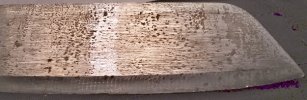
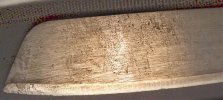
 

Attachments

  • 000_0008.jpg
    000_0008.jpg
    34.5 KB · Views: 22
  • 000_0009.jpg
    000_0009.jpg
    64.1 KB · Views: 21
  • 000_0012.jpg
    000_0012.jpg
    22.4 KB · Views: 26
The initial edges on these are hollow ground, this is problematic for a number of reasons. The performance tends to increase dramatically when you resharpen them. The angle also changes along the edge and gets much more acute through the tip. This is often not the best choice for large blades.

-Cliff
 
Yeah, I just flattened out about 8" of blade on one side(gotta love that D8XX) The tip on mine actually wasn't acute-it hadn't been ground. Neither is the last 1.5" near the handle. It's like whoever ground this one eased into the grinder while moving the blade laterally, and eased right back off it before reaching the tip.

I prefer to have steel deform rather than chip, but this thing is like working butter.
 
The choil area is unsharpened intentionally as a sort of guard/grip. On mine though the tip was sharpened.

-Cliff
 
I might not have explained that right. The grind just ahead of the 2" long ricasso area doesn't thin the metal to a cutting edge for about the first 1.5" It's ground, but only down to about 1/16" thick immeadiately ahead of the ricasso, and thinning dow to an actual edge for the rest of the blade-after I used the file to put an edge on at the tip, which was about 1/32" thick when I got it.
 
I picked up what was represented as a UK MILSUP golok of the same outline. (It has a broad arrow, but no other markings.) It had a super thick convexed edge and was very hard. A new file just slid off it with no effect. Even the diamond sharpening gear took a long time to improve the terrible edge. It seemed far too hard for practical use in the field, and I have only tried it on cordwood with disappointing results (more metal removal required). I suppose I'll have to see what happens to it when it gets "woopsed."
 
Well, I received my BR Golok yesterday, and I'm positively impressed, though I have yet to take my first swing with it.

Finish is beautiful. This is a weighty piece of metal. The grip is longer than I expected, and the blade shorter. The photos on the various websites make the blade seem longer than it actually is.

The blade is marked "prototype" on one side.

The sheath is a meaty leather model that I don't like at all, and plan to replace asap.

I got the black micarta handle. My wife wanted to know why I had ordered the giant butter knife!

Andy
 
OK, got to put my new BR Golok to its first test. We are dimantling our back deck, constructed of aged, weathered redwood planks, mostly 2x6s. The wood is dry, cracked, full of knots and nails. I took care to avoid hitting any nails!

Basically, I usually chop up old lumber from various projects which have nails or staples in them, and burn them in a galvanized steel trashcan to catch the nail-poppers.

I used the golok to split about a dozen 3' 2x6s end to end, then cut them in half with a cordless electric saw.

I used an already split off chunk of the same wood as a baton.

The blade readily wedged through this very dry, seasoned wood. The blade is narrow enough that it would follow the split it made down and around knots, but those it couldn't bypass it easily split.

I smacked heartily on the spine of this tool with more and more enthusiasm as I saw that it would hold up, at least to this early test.

Upon inspection afterwards, the edge seems to be (to the naked eye) undamaged, as is the spine. There is some superficial scuffing on the sides of the blade, but this is more a deposit of resin or something from the wood than any kind of damage. I suspect it will buff off without any problem. The edge will still slice typing paper all along its length without any problem.

The handle held up well, I was concerned initially about the sturdiness of the handlepins, but as hard as I wacked that blade, I never detected enough vibration in the handle to make me worry anymore.

So far, so good!

Andy
 
Back
Top