Basic forge questions

Joined
Jun 13, 2007
Messages
7,743
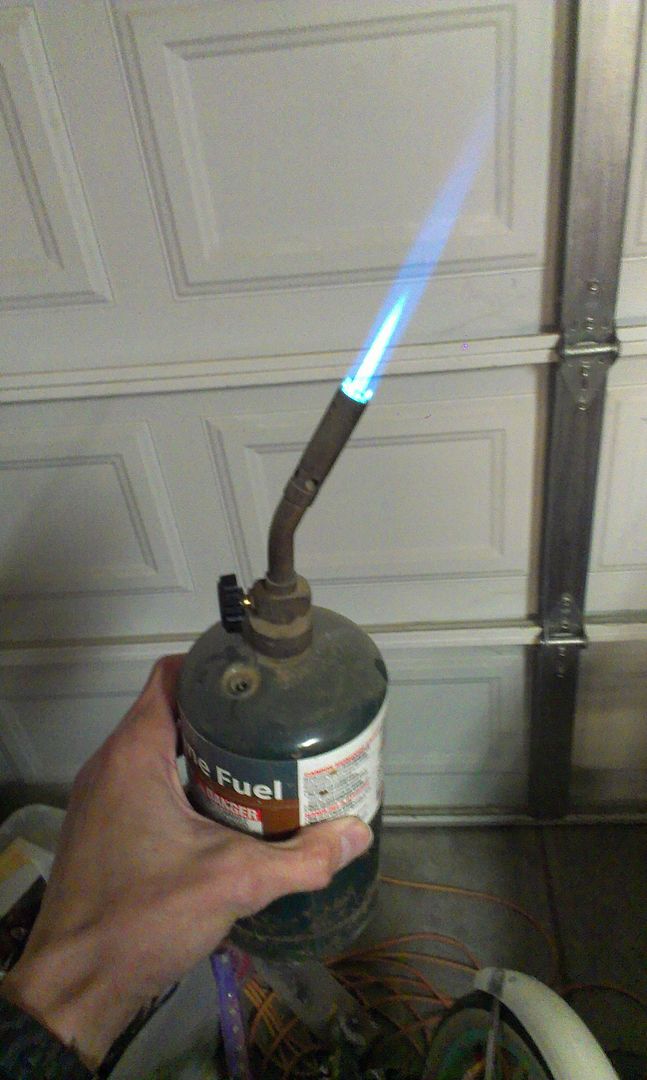
Hey guys, I'll be building a new 2bf soon. I have a couple of torch heads that I got years ago.

I know it's hard to tell, but from the pic, do you think this type of head will work with the forge?

IMAG1912_zpsa99342c2.jpg


I'll buy a higher output torch if these aren't good enough, but figured I'd use one (if it'll work) since they are free.

Also, is a tc and pyrometer usable with a 2bf? I don't see it mentioned much, I guess because it's hard to regulate the output from the torch?

Thanks
 
Last edited:
Not even close. That's a pencil tip torch, putting out about 3000 BTU. In my forge, you can get to about 1700° in one spot with that type of torch. That's on the cold end of forging. You can probably get a full blade up to about 1400°, not enough to HT.
 
I imagine I'll have a few questions, I'll just post them here.

Ideally I'd like to use the forge for o1, 1095 and 1084. I don't see soak times as being an easy thing though. Really, I'd just stick to 1084 but for the small wood carving blades that I want to HT I see the other two as being a better option.

As I look through the stickies, I've noticed a recommendation for using a 2" steel pipe in a forge to attain even heating. Is this appropriate for a 2bf? I'm trying to figure out what a simple forge can be compatible with in terms of features used in bigger forges.

PID? I think this is a no go because of the need for two burners vrs. the small size of the forge.

Venturi or is forced better or even ever used with these forges. Forced is better because of efficiency right?

I'm not seeing any reason why a pyrometer can't be used with one of these.

If not the pipe, what do you recommend for a floor? I have some hard firebrick. If I cut that I imagine it would be great for a floor, but I've gotta figure out how to do that while retaining swirl. Just thinking out loud, not really a question.

If this stuff is all in the stickies, I'll find it. I'm still working my way through all of the pages. If you have thoughts though let er rip.
 
If you look at the flame, there's a hard central cone of pale blue flame, then a soft outer flame some way beyond it.

The hard central flame is where the primary air (the air that is drawn in at the back of the burner and mixed with the gas before it burns) is burning. The outer flame is where the secondary air (effectively ambient air) mixes with the partially-burnt gases from the primary stage and continues to burn.

The overall flame temperature is affected by the Air:Fuel ratio. Hottest occurs when all the fuel burns with all the Oxygen from the air. In forge terms, this gives a neutral atmosphere.

Going leaner (more air), reduces the flame temperature (the extra air absorbs some of the heat produced) and gives an Oxidizing atmosphere.

Going Richer (less air/extra gas) also reduces the flame temperature (the extra gas absorbs some of the heat produced) and gives a Reducing atmosphere.

If you have a rich flame in a forge, the secondary flame, where the hot gases burn with ambient air, happens outside the forge as dragons breath.

You have very little control over the primary air with a torch, but you can control the secondary air to some extent, by altering the position of the torch to vary the amount of air getting in around the outside of the torch.

When I made my 2BF a few years ago, I made the burner hole conical (Though TBH, I don't know how much this helped, as I didn't try any other arrangement). With the torch pushed in to the narrow end of the hole, there was very little secondary air gap. backed out to the big end, or even just beyod, there was a big secondary air gap.

With the combination of mixture adjustment and gas pressure adjustment, I was able to get forging temperature with no problem and could (just about) get down to a usable O1 soak temperature (805-810 degC; 1480-1490 degF). I was using the biggest head of 3 from a cheap no-name torch set. I had lots of dragons breath at the HT temperature and less, but still quite a bit, at forging temperature.

Interestingly, I was able to get up to welding temperature by changing just the jet in the torch for the one from the smallest torch head. Much less dragons breath.

Type 23 Insulating Fire Brick melts, by the way. I built my next mini forge with 1400 degC CF blanket.

I used a Mineral-Insulated thermocouple with a handheld readout to make the adjustments but took it out to actually use the forge.

I later found I could get much better control with a purpose-built burner incorporating a sensitive choke. This provides all the adjustment needed on the primary air and gives only two variables; gas pressure and the choke setting. With the thermocouple to provide feedback on what is going on, it's relatively easy to get things to where you want them. My burner used a commercially-available adjustable Venturi, which I'll concede is probably cheating.

Later still, I used pretty much the same burner in a drum forge made from about 18" of 10" pipe lined with 1" CF blanket (I used 1" CF board for the ends because I had it laying around, but blanket and sheetmetal would have done the job just as well). The idea was to make a scaled down version of a Don Fogg-style 55 gallon drum HT forge. It seemed to work ok. I could get adequately consistent 01 HT temperatures for as long as I would ever want them and over the full area of any blade I might ever make.

With the rich burn and reducing atmosphere, scaling doesn't seem to be a problem at all. If you can get a good burner, this would be my recommendation for a cheap HT setup in a small shop. Use it outside though; rich burn means Carbon Monoxide.

Bear in mind the temperatures in the pics are in degreesC

http://i667.photobucket.com/albums/vv31/timmgunn1962/P2240429_zpsbd62d989.jpg

http://i667.photobucket.com/albums/vv31/timmgunn1962/P2240428_zpsc728e337.jpg

http://i667.photobucket.com/albums/vv31/timmgunn1962/P2240427_zps4fbcc6e8.jpg

 
If you look at the flame, there's a hard central cone of pale blue flame, then a soft outer flame some way beyond it.

The hard central flame is where the primary air (the air that is drawn in at the back of the burner and mixed with the gas before it burns) is burning. The outer flame is where the secondary air (effectively ambient air) mixes with the partially-burnt gases from the primary stage and continues to burn.

The overall flame temperature is affected by the Air:Fuel ratio. Hottest occurs when all the fuel burns with all the Oxygen from the air. In forge terms, this gives a neutral atmosphere.

Going leaner (more air), reduces the flame temperature (the extra air absorbs some of the heat produced) and gives an Oxidizing atmosphere.

Going Richer (less air/extra gas) also reduces the flame temperature (the extra gas absorbs some of the heat produced) and gives a Reducing atmosphere.

If you have a rich flame in a forge, the secondary flame, where the hot gases burn with ambient air, happens outside the forge as dragons breath.

You have very little control over the primary air with a torch, but you can control the secondary air to some extent, by altering the position of the torch to vary the amount of air getting in around the outside of the torch.

When I made my 2BF a few years ago, I made the burner hole conical (Though TBH, I don't know how much this helped, as I didn't try any other arrangement). With the torch pushed in to the narrow end of the hole, there was very little secondary air gap. backed out to the big end, or even just beyod, there was a big secondary air gap.

With the combination of mixture adjustment and gas pressure adjustment, I was able to get forging temperature with no problem and could (just about) get down to a usable O1 soak temperature (805-810 degC; 1480-1490 degF). I was using the biggest head of 3 from a cheap no-name torch set. I had lots of dragons breath at the HT temperature and less, but still quite a bit, at forging temperature.

Interestingly, I was able to get up to welding temperature by changing just the jet in the torch for the one from the smallest torch head. Much less dragons breath.

Type 23 Insulating Fire Brick melts, by the way. I built my next mini forge with 1400 degC CF blanket.

I used a Mineral-Insulated thermocouple with a handheld readout to make the adjustments but took it out to actually use the forge.

I later found I could get much better control with a purpose-built burner incorporating a sensitive choke. This provides all the adjustment needed on the primary air and gives only two variables; gas pressure and the choke setting. With the thermocouple to provide feedback on what is going on, it's relatively easy to get things to where you want them. My burner used a commercially-available adjustable Venturi, which I'll concede is probably cheating.

Later still, I used pretty much the same burner in a drum forge made from about 18" of 10" pipe lined with 1" CF blanket (I used 1" CF board for the ends because I had it laying around, but blanket and sheetmetal would have done the job just as well). The idea was to make a scaled down version of a Don Fogg-style 55 gallon drum HT forge. It seemed to work ok. I could get adequately consistent 01 HT temperatures for as long as I would ever want them and over the full area of any blade I might ever make.

With the rich burn and reducing atmosphere, scaling doesn't seem to be a problem at all. If you can get a good burner, this would be my recommendation for a cheap HT setup in a small shop. Use it outside though; rich burn means Carbon Monoxide.

Bear in mind the temperatures in the pics are in degreesC

http://i667.photobucket.com/albums/vv31/timmgunn1962/P2240429_zpsbd62d989.jpg

http://i667.photobucket.com/albums/vv31/timmgunn1962/P2240428_zpsc728e337.jpg

http://i667.photobucket.com/albums/vv31/timmgunn1962/P2240427_zps4fbcc6e8.jpg
Cf being ceramic fiber? I'm so used to it being short for carbon fiber, I was really wondering how much you spent until I looked at the pics and realized you must mean ceramic. Not to mention carbon fiber wouldn't work at all... :p

Okay, first, thank you very much for your input. It addresses questions I didn't even know I had.

So a rich (reducing atmosphere) is what I want? Forgive me, it'll take a couple of re-reads to grasp everything you're saying. This will increase dragons breath, (a good thing, or just a thing?), and create less scale (definitely a good thing).

With the inexpensive torch heads I'm looking at (bernzo ts4000) I won't be able to fiddle with the hard central flame, right? Where did you get the fittings that you show in the pic? I imagine I could build one from the stickies, but that looks tidy.

Forced air would be the easiest way to tune for richness right? Add less air, more fuel (propane), and watch for a small secondary air condition? Will it still present itself the same, or more like a flame?

Also, which part of the frame is hottest?

Do you have a floor in your forges, and what do you use?

I should have pointed out from the beginning that I only intend to use this for HT. No real forging or welding. It might be nice, somewhere down the line, to try some mokume gane though it's far from a priority.

Thanks again for your help!
 
Sorry for the CF confusion. You got it.

The rich/reducing atmosphere is definitely a good thing for Carbon Steels. For Stainless, I don't think it will prevent scale on its own.

The dragons breath is really just a thing. Look at it from one side, it's wasted heat, from the other, minimal scale. Burning rich does generate Carbon Monoxide though, so safety needs to be considered.

The cheap torches (in fact all torches I'm aware of, regardless of price) give you no control of the primary air. To get the control, you need to buy or build a burner with the facility to adjust the primary air over a wide range.

Forced air is certainly one way to get the mixture control and, unless you can find a very good Venturi burner design, may well be the easiest way for you. It all boils down to what is available and what you are comfortable with.

I have been using "Amal" gas injectors at work for over twenty years, though mostly the bigger 1" and 2" units, so when I wanted an easily-adjustable small burner, I stuck with the familiar and bought a 1/2" injector. Ball-park price was $50-60 over the counter. I'd expect something very similar to be available in the USA, but I don't know of a manufacturer over there.

http://amalcarb.co.uk/downloadfiles/amal/amal_gas_injectors.pdf

http://burlen.co.uk

For information, Amal's jet sizing sytem is based on cc/minute of gasoline (they are best known for motorcycle carburettors), which gives me a headache. By experiment, I have found it best to use their size 30 gas jet in the 1/2" LV injector running on Propane: primary air-only is a fairly unusual way to run and deliberately trying for incomplete combustion is complete anathema to anyone involved in heat and combustion. It seemed easier to get a handful of jets and play, than to try to explain to them exactly what I wanted. Besides. I like playing.

The likes of Ron Reil, Rex Price and Mike Porter have done a lot of work on forge burners. I had played with a burner or two built to Mike Porter's design and got the impression that it was a lot of work for something that probably didn't work quite as well as the Amal at the low temperatures needed for HT. I even got hold of a copy of Mike Porters book and built one myself. It cost about the same in parts as going the Amal route.

Where I feel the Amal really scores is in the almost micrometer-fine adjustment afforded by the screwed choke. I think it would probably be worth trying a screwed adjuster on the choke sleeve of, for example, a Hybridburners 1/2" Shorty or a T-Rex, maybe even a Porter.

At school, they always told me the hottest part of a Bunsen burner flame was just at the tip of the central cone.

As I understand it, There is a lot of reaction going on in the central cone, producing heat and emitting light, but, once all the primary Oxygen has been consumed, there's nothing to react, so most of the outer cone is just the hot, partly-burned stuff doing nothing very much. At the very edges of the outer cone, the partly-burned stuff mixes with air, finds the Oxygen it needs and burns, giving another flame-front which is easily visible.

In the forge, the various stages are kept separate. the flame at the end of the burner that you see when you look in is effectively the central cone. The rest of interior of the forge is filled with that nothing-really-happening bit in the outer cone and it even extends out of the mouth of the forge. The secondary flame at the edge of the outer cone is the dragons breath.

Throughout the nothing-really-happening bit, the hot gases are radiating heat to the surroundings and cooling down somewhat as they go from the outer edge of the inner cone to the edge of the outer cone.

So in the forge, the hottest part will be at the end of the primary flame.

I've not really put a floor in a forge yet. The only one I've tried welding in with flux was a 20-Brick Forge made from cheap Insulating Fire Bricks. They don't insulate nearly as well as the Thermal Ceramics JM23 or K23 IFBs, but they don't melt at the temperatures my burners reach. I built it as a consumable item to take to a hammerin and the floor thinned down by 3/4" in 2 days. I've been playing with a Porcelain floor tile as a floor in my Electric HT oven to protect the IFBs. It seems to hold up well even at 1200 degC (2192 degF), but I've not subjected it to the rapid temperature changes or steep temperature gradients of a forge yet. I'd expect it to work fine for a gas HT forge.
 
Well one things for sure. I'm glad this was posted in a thread that I made since I'll be referencing it a lot.

Funny, as far as car/bike stuff goes (I own, work on and drive/ride both), I always hear older gentlemen saying that they miss carburetors, and that fi is voodoo. I'm the opposite. Hand me some jets and a choke and I couldn't tell you what they do. :)

I can only imagine the look on an automotive engineers face when asked how to deliberately get a rich condition burn using their parts. :D

Ceramic tile for a floor? I'll admit, it occurred to me, but I dismissed it thinking it wouldn't tolerate the heat. Would be far easier to make than trying to use these hard firebricks though.

Another question. I bought 2000° ref. cement to line my bricks with. The 2700° stuff is what has been recommended. Will there be an issue with the lower temp stuff? The soft bricks are fairly hard for me to come by, in fact these were given to me by zaph1 (thanks zaph!!) so I really don't want to screw this up.
 
Aye, most of us old codgers like the pretty mechanical stuff. It's so much easier to pretend you understand it.

The tiles need to be unglazed porcelain, not just any ceramic. Porcelain is high in Alumina and needs high temperatures to fire. Looking at the specs for porcelains in the pottery catalogs shows firing temperatures of 1200 degC (2192 degF) and up. My understanding is that using porcelain for floor tiles is a fairly recent development, largely because of the high temperatures involved.

I suspect using just any ceramic tile will result in a mess. I'm sure using a glazed tile will result in a horrible, dribbly mess.

I can't help on the cement. They all seem to be different and the only one I've used the past was rated to 1250 degC.

Lately, I tend to use a 1:2 mixture of HF powdered porcelain and Zircon (Zircopax) in ceramic fiber rigidizer to paint on CF, but I've used it on soft brick too. It seems to work and, being white, looks much less of a mess when inexpertly applied by me than the darker cement.
 
Oh, man, I could have added a packet of ITC-100 and 3000° refractory. It doesn't take much to line a forge made of bricks. I've seen people use a piece of stainless to line the bottom of the forge to protect from flux. It should work, in theory.
 
Aye, most of us old codgers like the pretty mechanical stuff. It's so much easier to pretend you understand it.

That actually made me laugh out loud.

I should point out that I'm only really concerned by damage to the floor from the steel resting/moving about on it. With decent cement, I'm probably worried about nothing. :)

Oh, man, I could have added a packet of ITC-100 and 3000° refractory. It doesn't take much to line a forge made of bricks. I've seen people use a piece of stainless to line the bottom of the forge to protect from flux. It should work, in theory.

Thanks zaph, you've done more than enough. :thumbup:

I'll find something more suitable.
 
Zaph, I just received the box. Um, I wasn't expecting this! I'm very excited to get this up and running, especially now.

Thank you. :)

I was pretty concerned when I saw that they put the trashed box in a plastic shopping bag, but only corners got damaged. They may have actually cut the box open now that I look at it. Stupid post. :(
 
So on the subject, I made a 2 brick forge with a 2.5 inch diameter by about 8 inch deep opening. Will a map gas torch work to generate enough heat to ht 1084 and 1095? I have some pretty good swirl going on in it so I don't imagine why it wouldn't
 
So on the subject, I made a 2 brick forge with a 2.5 inch diameter by about 8 inch deep opening. Will a map gas torch work to generate enough heat to ht 1084 and 1095? I have some pretty good swirl going on in it so I don't imagine why it wouldn't
 
So on the subject, I made a 2 brick forge with a 2.5 inch diameter by about 8 inch deep opening. Will a map gas torch work to generate enough heat to ht 1084 and 1095? I have some pretty good swirl going on in it so I don't imagine why it wouldn't
 
I think holding the proper temp is a problem (without additional equipment) as far as 1095 goes, regardless of your heat source, but hopefully someone can elaborate on your question.

So I went out to grab some of the goodies that I'll need to finish this forge. I was a little surprised at the final cost. Even cutting a few corners (I bought a 6' piece of all-thread instead of bolts and stuck with the 2k cement since I'd have to order the good stuff) it cost a lot. I did have to buy a decent hacksaw, and I needed it anyway to cut steel, but I also had to buy a bunch of hardware cloth since I couldn't find it by the foot. I believe I still need to buy a propane regulator too for the burner.

All in all it'll be the best set-up I've had for hardening steel, but I kinda wish I had saved up for an Atlas forge from the beginning.

I'm sure this could be done more inexpensively if one tried to be more resourceful but I just want to get it done. :o

I'll post pics as I go. :)
 
So, I'm guessing that the box of bricks arrived opened and damaged, missing the burner that I included? The burner was about 2" shorter than what I normally sell, a bit of leftover from the 10' stainless pipe that I cut down. It still lit and burned fine when I tested it, but I really couldn't sell it as is.
 
You included a burner?!

Just kidding, no, it arrived just fine. :) (wasn't sure if you'd rather me not mention it)

It was probably a bad idea, but I took it with me to the local hardware stores to ask what was necessary to hook it up. I say bad idea because I got a few different responses, from "it won't work" to "bring everything you have in and we'll get all of the things you need together". The first reply I ignored. The second, while kind, screamed "I'm going to sell you 8-15 fittings and expensive parts".

The more I ask for local help the more I regret it it seems.

The only thing I picked up for the burner is some yellow tape. I figured that was a good idea.

One bit of good news is that I learned of a fireplace store in the next town over. I was told that they don't sell the right bricks (although no one seemed to know what these are), but that they may stock the cement.

I like supporting the mom & pop hardware stores, but they are lacking in knowledge sometimes.
 
Oh yeah, I'm going to try to make something to cut the holes instead of a $20 hole saw. These seem soft enough to cut with a can. Hopefully I won't regret it. :o
 
Back
Top