Basic forge questions

I could have cut them for you. Actually, it was more hassle getting uncut bricks out than cut ones. Cut bricks are on a large cart, uncut bricks are in old, musty boxes that fall apart when you touch them. I have had the drill jig set up for 2 week. I've got 300 bricks to drill.

You need a 0-20 PSI regulator and 1/4" NPT - 3/8" flare adapter. Here are links to each:
http://usaknifemaker.com/atlas-forge-0-20-psi-regulator.html
http://www.menards.com/main/plumbin...s/3-8-x-1-4-flare-to-fpt/p-1713362-c-9434.htm
17000175.jpg
 
Thanks again. :)

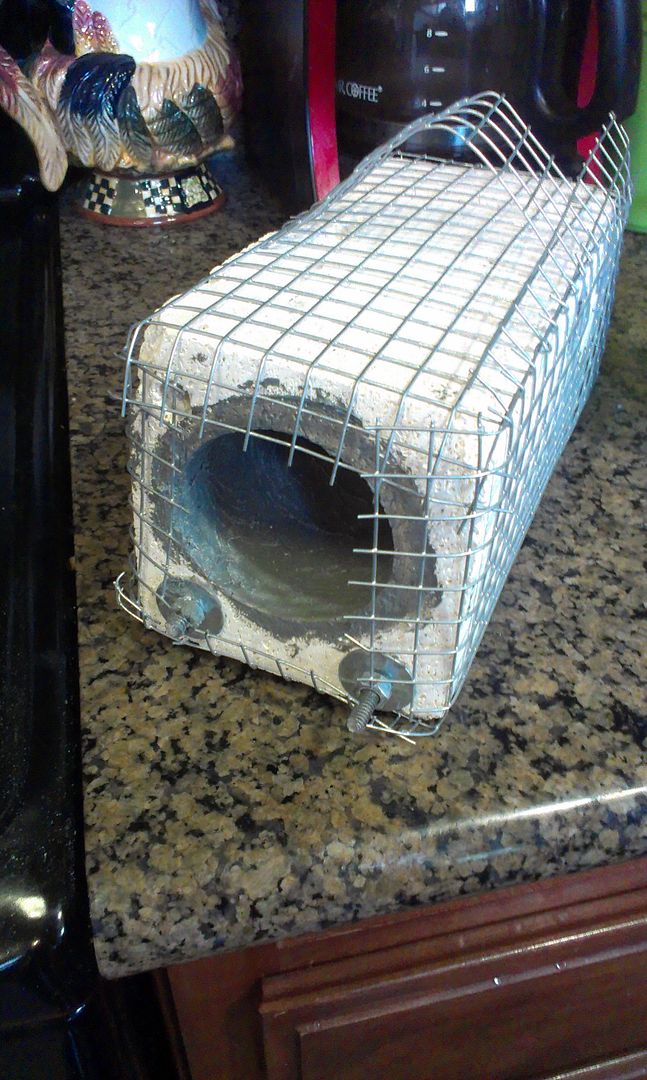
Well I mostly got it finished before the yard people came and I had to close the garage.

Obviously it still needs a little work, but here's where I'm at.

IMAG1921_zps610d5fad.jpg


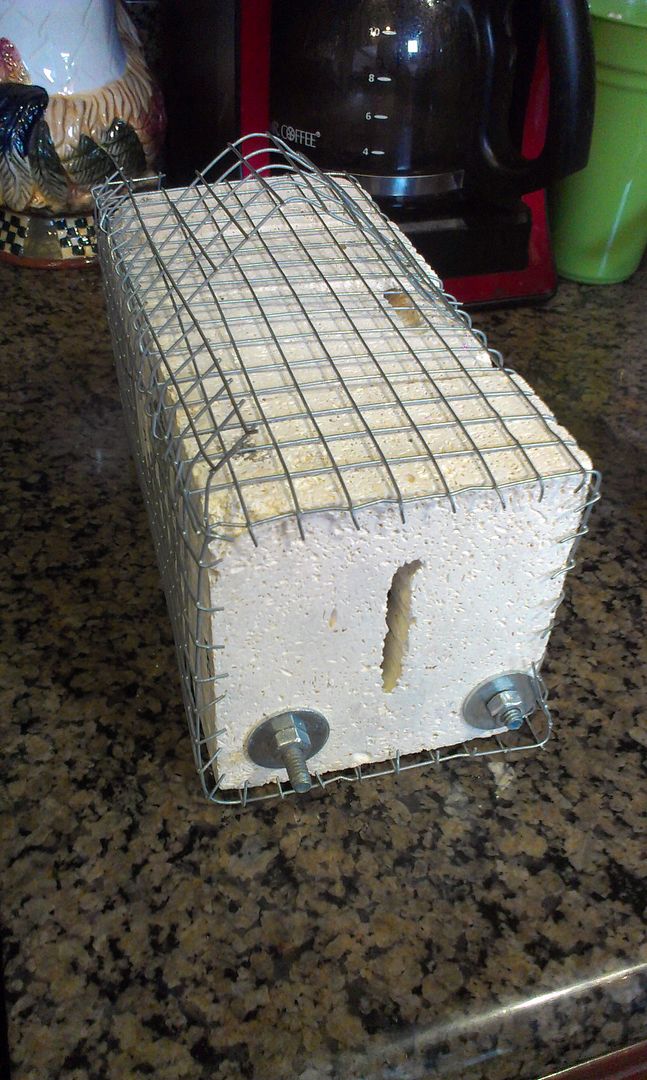
I'm not sure if I read the wip correctly. I read over it a few times, but couldn't really figure out what the pass through on the back block is for. I mean you put a blade in there, but why is the other end open?

IMAG1922_zps7a094267.jpg


In any case, I have a great deal of confidence that this is going to work really well. It's really sturdy, much more than I thought it would be.

I couldn't do a bolt at each corner, but the two that are there seem to hold it together nicely. I imagine that anyone building one will need to make some alterations, but I think it's close enough.

Now just to wait until tomorrow for the cement to dry then I'll fire it up. :)

Edit - oh also, if I had to do this over again, I'd probably spring for (or borrow) a hole saw. I ended up cutting up a can that had spray whipped cream in it. The can was roughly 2.5" in diameter. It would have worked better had it been more sturdy. I file sharpened the edge and it cut okay, but the holes didn't perfectly line up. Fixed it mostly by sanding, but the cement probably would have filled the gaps just fine.
 
Last edited:
Zaph, is there any reason to keep the pieces that came out of the holes?

I have a feeling either they, or the dust that I can make with them might come in handy for something?
 
If you are planning on HT in the forge, it can sometimes be helpful to reduce the size of the opening to give more even heat distribution at low heat inputs. I use odd bits of CF blanket, but the brick cores would be ideal.

You'll need to wait and see if you need them for your application, but keep them somewhere you can find them easily.
 
If you are planning on HT in the forge, it can sometimes be helpful to reduce the size of the opening to give more even heat distribution at low heat inputs. I use odd bits of CF blanket, but the brick cores would be ideal.

You'll need to wait and see if you need them for your application, but keep them somewhere you can find them easily.

Yeah, that's a great idea. :) I figured I'd cover the hole with a hard firebrick (like I used to do) but the slug makes better sense.
 
Strigamort, I don't know about keeping them. I have boxes full of dust and haven't found a use yet, although I'm thinking I might use it if I make a larger, cast refractory forge.
 
I coated the "plugs" that I cut from the bricks with high temp cement and use them to plug the back of my 2BF to help it heat up faster. On my forge the round hole goes all the way through. Some of the time I leave the "plug" in for simple HT, sometimes I take it out depending on blade length and thickness. Depending on burner design you may need to keep the blade moving in the forge to have even heating of the steel. I'd post a picture of the burner that I came up with, but I'm not sure it is OSHA approved!

Jeff
 
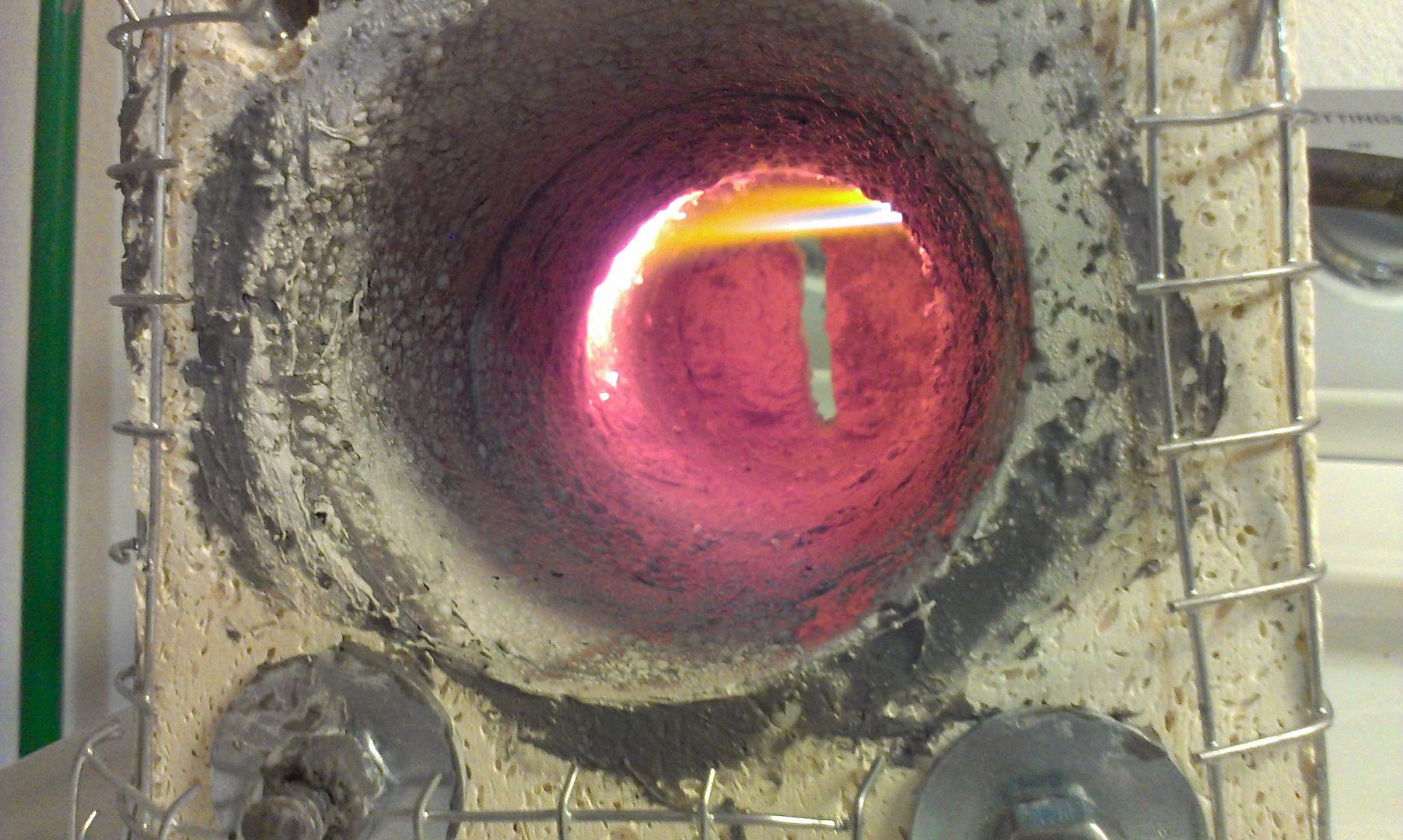
I haven't hooked up the Atlas burner yet (working kills all of the fun), but even with the little torch from above, the thing gets pretty hot after a few minutes, and I'm getting a good swirl.

With the big burner this thing should be quite intense!
 
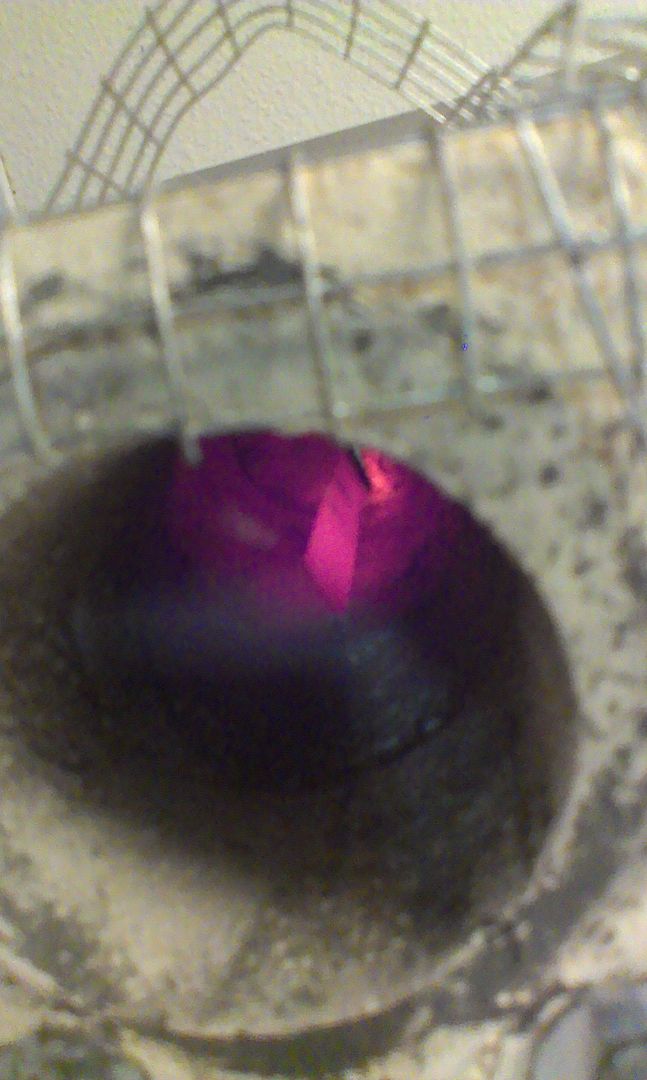
Can't see the swirl in the pic, but it's there.

IMAG1924_zps2222e030.jpg


If I plug the open end it'll take a couple of inches out of the volume. Pretty sure that it could get a small carver (2-4" with tang) up to temp.

Btw, I forgot to mention... Because of my awesome skills, the outsides of the bricks didn't line up at all. Instead of having them all wonky I flattened them on my wood sander. I mention it because doing so made the forge smaller overall, and makes the chamber look bigger in pics.

I'm really digging this thing. :)
 
Howard just sticks a small piece of kaowool over the front. It works great and doesn't shrink the chamber.

I was thinking that, so long as the blade fit, taking some volume out would be a good thing?

Doesn't matter though. I plugged it earlier this morning (fit was good with no apparent heat loss), but as you correctly pointed out, the little torch isn't enough it seems. Might be good for something, but it probably isn't enough for anything short of a tiny blade. Even then, I had to get the point directly on the steel (scrap 1095, not the steel in the pic) to get it past non-magnetic. Definitely not what I wanted, which means the burner that you sent is all the more valuable. :)

Good deal. Time to get more heat in the chamber!
 
So I have a question about grain, but didn't want to make yet another thread so I'll just post my questions here.

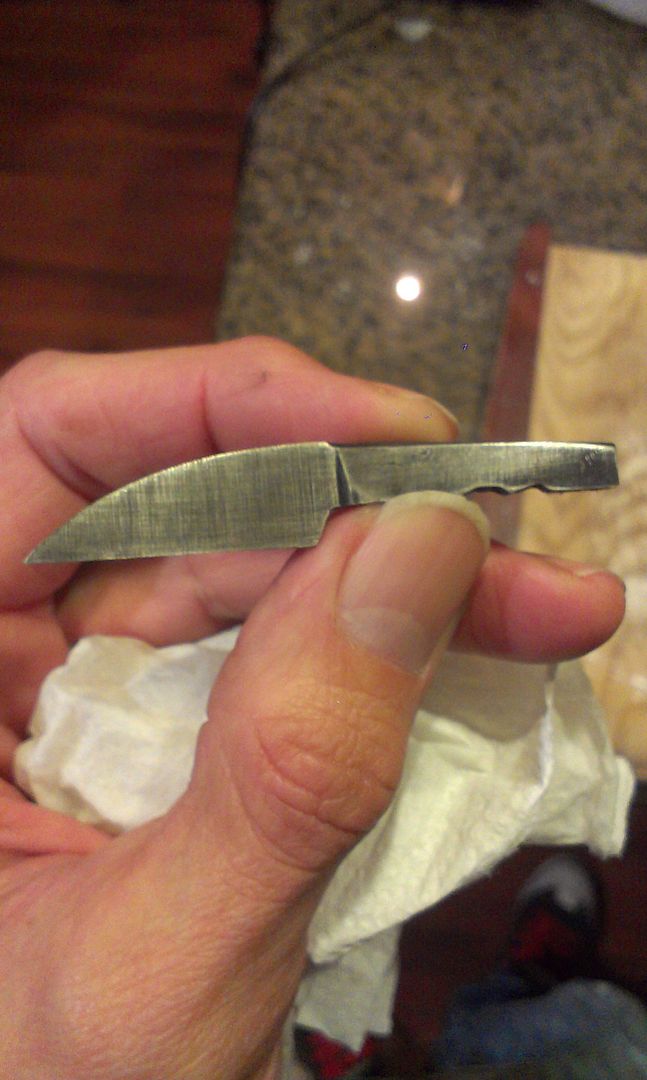
I ground out a short wharncliffe carving knife blade. I'm waiting for my 1084 to arrive so I figured I'd get some grinder time in while I wait. I'm using 1095 for now.

My question is... Can you tell anything from a broken (as quenched) blade?

IMAG1936_zpscf7fa5cb.jpg


I was messing around with my forge and got two of the little burners going. Got my scrap piece of 1095 about a shade past non-magnetic, then quenched in warm water. The blade skipped a file and I decided to snap the end off to have a look. Yes, I know that this is far from ideal, and have no plans to sell anything.

I doubt it means anything, but the grain seems very uniform and small. Actually, no real discernable grain, but I haven't really looked at it under magnification.

I'm just wondering if this might indicate success. If so I'll go ahead and do the same with the carver.

Thanks
 
Sorry, I missed the question earlier. The port on the back is dual purpose. First, it lets you put a longer blade through. More importantly, it allows gas to escape through the rear. This makes the back of the chamber hotter. If you put too big of a hole, all the hot air will blow through and the chamber won't get as hot.
 
Thanks zaph, I didn't realize that. Makes sense. :)

Went ahead and did my little carver. Skipped the file, but who really knows what's going on in the steel.

After 1 hour at 400°, it's in again at the moment.

IMAG1937_zps7ec51894.jpg


Once I get it sharpened and mounted I'll do a bunch of cutting tests.
 
Man, trying to find that flare fitting has been an exercise in futility. I don't want to pay $7 (shipped) for a $1.50 part, but no one seems to have them around here.

Zaph, I had tried finding the 2700° refractory cement everywhere (just like everyone else in your wip thread) and ended up using the 2k in a tube stuff. Interestingly enough, while looking for the fitting at Tractor Supply, I saw that they are now stocking the exact cement from your thread. Must be seasonal. I grabbed a tub because I haven't even seen the tube stuff anywhere else and the recommended stuff was only $4. Who knows when the desire to try a hamon might hit. :)

My question... Is there any good reason to coat over the lower temp stuff with this new high temp cement? They are both Rutland, and I know that it's okay to layer the 2k stuff. So far it seems to be holding up fine, but I haven't subjected it to a real blast of flame (for obvious reasons).
 
I changed the title of this thread because I'll have ongoing questions, and it's silly to make new threads.

So my question is about thermocouples.

I know I need a K type probe. Are the $5 probes and readers from Amazon good? They seem to get (mostly) good reviews.

To install the probe in my 2 brick forge, should I just drill a hole in the back (pass through) and insert it there? I assume cementing it in place with refractory cement is fine.

Anything else you want to mention is cool. I hadn't planned on doing it, but the components seem inexpensive enough to be worthwhile.
 
Just read a thread that answered some of my questions.

So since it's gas, permanent mounting is not a good idea.

Sounds like Stacy runs the forge to temp then kills the lp and gets a reading then.

Is a ceramic sleeve the right choice for the probe? Some of the probes seem to have a ss sleeve. Is that only for electric ovens (no gas forges)?

Maybe I'll skip this while working with 1084. I know it's a great and useful tool, but if it's going to cost a bunch there are probably better ways for me to spend the dough for now.
 
Get a good probe. The cheap ones will give you a temp, but they are just that, cheap. I have one that has an inconel sleeve. I used stainless for a while for gas but it was less than ideal. It gave no where near a fast reading... What Stacy set up is way simpler than it sounds. One valve is full on and controlled by PID. The second is just a permanent idle which is set manually. When the PID hits the upper limit is shuts off the valve running full on. Then the burners run at idle. When it hits lower limit, it kicks back on.
Flow of the burner into the forge is key, as is proper lining. Read the thread where I started asking about going blown and got a lot of really useful advice and saved myself a lot of headache by getting answers from Stacy and Page etc.
Man, being on night shift sucks... Posting at 4 am. I need to get back into the real world.
 
Back
Top