

- Joined
- Jan 28, 2005
- Messages
- 2,154
Past few weeks I've been reading/watching to try to pull together all the details of making my first knife. I've decided to start with 1084 and will be using basic supplies I have on hand (average joe kinda items) outside of a dremel, drill press and angle grinder. I have to build a forge as I want to do the whole thing here at home, and will be going basic on that as well. I'm even going to try to make my own sheath. I work best off of simple lists instead of retaining tons of reading, so I made this basic list of the process I plan to follow with the materials list included. I have some of the supplies already but I'm listing in case any other guys want to use this as a starting point for their first build project. Could you guys review it and let me know what I'm missing or anything I should change? Much appreciated! - John
Note: Safety is most important!!!
Order supplies:
========================================
Safety:
---------------
Quality resperator and canisters (3M)
Welding gloves
Glasses/full mask
Fire Extinguisher
Bucket of water
Long/Sturdy Tongs (for holding hot blade)
Blade Supplies:
-----------------
1084 from Aldo:
- 3/16"x2"x48" = $27
- 1/8"x1"x48" = $9
Layout die - $10
Flat bastard files $15 each
Round/Half-Round bastard files $15 each
Norton No-Fil Sandpaper (60,120,220,400,600,1000) - $3 each
Magnet to test heat treat
Canola oil for quench
Bucket for quench oil
DIY Forge (for heat treating only at this time):
----------------------------------------------
TBD - It'll update once I decide on coal or gas (but will be simple/cheap/safe/effective setup)
Handle Supplies:
-----------------
Handle material (G10, wood, micarta)
Handle pins/bolts
Epoxy/Glue
Sheath Supplies:
----------------
Kydex
2 PVC foam sheets to mold kydex
Rivets
Heat gun or toaster oven
Knife making process for 1084:
========================================
1. Make a pattern
2. Transfer pattern on steel
3. Cut shape with hacksaw/grinder/bandsaw
4. Drill holes in handle to secure to bench if not using vice.
5. Scribe edge
- Make two scribes (one on each side) leaving a bit of material in between for finishing by hand
6. Secure blade to bench or in vice to begin grinding basic shape
- I'll be using a hacksaw/grinder for this step
7. Grind the bevels
- Use 60 grit belt/paper,then switch to a 120 and then a 220
- If using files go coarse, med, fine
- If using sandpaper, use a block so you get even pressure
8. Drill the pin holes for the handles (if not done yet)
9. Ready for heat treating
Heat Treat Instructions:
======================================
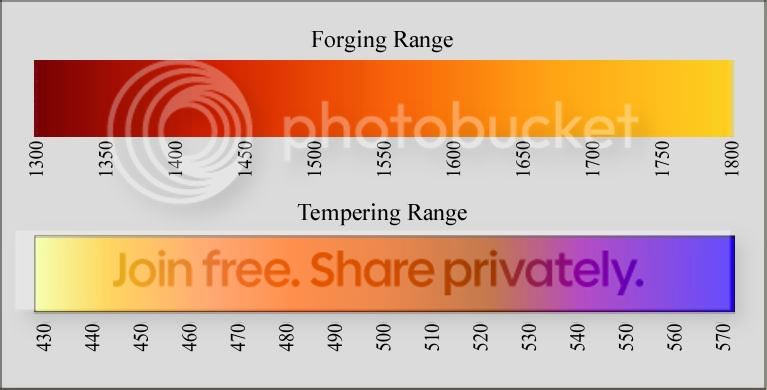
1. Get blade to critical temp (bight orange) @1450-1600 degrees.
2. Test with magnet every few mins until non-magnetic
3. Normalize by pulling in/out of fire until you have an even glow
- Once even glow is acheived, let cool for several minuites
- Place back in forge and bring back up to critical temp
- Repeat this 2-3 times
4. Heat again to critical temp
5. Quench it in oil within 3-4 seconds of pulling out.
6. Check for straightness.
- If warped, repeat heat treat process.
7. Temper at 450 for two one-hour cycles in oven (thanks honey!)
- Make a rack so the blade is on it's edge or spine standning up, not its side.
- Let cool completely between temperings
8. Again, check for straightness.
- If warped, repeat heat treat process.
Post Temper/Heat Treat:
=======================================
1. Grind the scale off
- Use fresh 220 grit belt/paper
2. Tape side of blade not working on to protect finish.
3. Hand sand blade with a block and WD40 (to cut)
- When you switch grits, change directions
- Think ahead so that your final grit runs parallel to the blade.
- Use smooth even strokes
- Start with 220 grit
- Move to 400 grit
- Finish with 600 grit
- Before using 600 grit, clean blade, use fresh paper
4. Flip and repeat on opposite side.
Handles(wood):
=======================================
Cut your handle material roughly to shape
Drill the pin/screw holes
Insert pins/screws
- If using pins, leave your pins a bit long, so they stick out the sides of your handles
Profile the front edge of the handle prior to gluing
Use 2 part 60 minute epoxy or alike
Glue the handles, and clamp lightly and allow to fully cure overnight
- The strength of the joint is in the glue, and if you clamp too tightly, you’ll squeeze too much glue out.
Take the handle down to at least 220 grit with preference to 400 grit.
Seal your handles sanding between coats to finish you like.
Final Edge:
======================================
This is personal preference
Back to the belts/paper/stones to put on final edge.
Note: Safety is most important!!!
Order supplies:
========================================
Safety:
---------------
Quality resperator and canisters (3M)
Welding gloves
Glasses/full mask
Fire Extinguisher
Bucket of water
Long/Sturdy Tongs (for holding hot blade)
Blade Supplies:
-----------------
1084 from Aldo:
- 3/16"x2"x48" = $27
- 1/8"x1"x48" = $9
Layout die - $10
Flat bastard files $15 each
Round/Half-Round bastard files $15 each
Norton No-Fil Sandpaper (60,120,220,400,600,1000) - $3 each
Magnet to test heat treat
Canola oil for quench
Bucket for quench oil
DIY Forge (for heat treating only at this time):
----------------------------------------------
TBD - It'll update once I decide on coal or gas (but will be simple/cheap/safe/effective setup)
Handle Supplies:
-----------------
Handle material (G10, wood, micarta)
Handle pins/bolts
Epoxy/Glue
Sheath Supplies:
----------------
Kydex
2 PVC foam sheets to mold kydex
Rivets
Heat gun or toaster oven
Knife making process for 1084:
========================================
1. Make a pattern
2. Transfer pattern on steel
3. Cut shape with hacksaw/grinder/bandsaw
4. Drill holes in handle to secure to bench if not using vice.
5. Scribe edge
- Make two scribes (one on each side) leaving a bit of material in between for finishing by hand
6. Secure blade to bench or in vice to begin grinding basic shape
- I'll be using a hacksaw/grinder for this step
7. Grind the bevels
- Use 60 grit belt/paper,then switch to a 120 and then a 220
- If using files go coarse, med, fine
- If using sandpaper, use a block so you get even pressure
8. Drill the pin holes for the handles (if not done yet)
9. Ready for heat treating
Heat Treat Instructions:
======================================
1. Get blade to critical temp (bight orange) @1450-1600 degrees.
2. Test with magnet every few mins until non-magnetic
3. Normalize by pulling in/out of fire until you have an even glow
- Once even glow is acheived, let cool for several minuites
- Place back in forge and bring back up to critical temp
- Repeat this 2-3 times
4. Heat again to critical temp
5. Quench it in oil within 3-4 seconds of pulling out.
6. Check for straightness.
- If warped, repeat heat treat process.
7. Temper at 450 for two one-hour cycles in oven (thanks honey!)
- Make a rack so the blade is on it's edge or spine standning up, not its side.
- Let cool completely between temperings
8. Again, check for straightness.
- If warped, repeat heat treat process.
Post Temper/Heat Treat:
=======================================
1. Grind the scale off
- Use fresh 220 grit belt/paper
2. Tape side of blade not working on to protect finish.
3. Hand sand blade with a block and WD40 (to cut)
- When you switch grits, change directions
- Think ahead so that your final grit runs parallel to the blade.
- Use smooth even strokes
- Start with 220 grit
- Move to 400 grit
- Finish with 600 grit
- Before using 600 grit, clean blade, use fresh paper
4. Flip and repeat on opposite side.
Handles(wood):
=======================================
Cut your handle material roughly to shape
Drill the pin/screw holes
Insert pins/screws
- If using pins, leave your pins a bit long, so they stick out the sides of your handles
Profile the front edge of the handle prior to gluing
Use 2 part 60 minute epoxy or alike
Glue the handles, and clamp lightly and allow to fully cure overnight
- The strength of the joint is in the glue, and if you clamp too tightly, you’ll squeeze too much glue out.
Take the handle down to at least 220 grit with preference to 400 grit.
Seal your handles sanding between coats to finish you like.
Final Edge:
======================================
This is personal preference
Back to the belts/paper/stones to put on final edge.
Last edited:

 . There seems to be so many different methods (even when talking about same steels, ala' 1084). Once I get good with the 1084 I know learning process will start over when I try a new steel (1095, A2, 01, 154CM).
