Batoning query.

I think people expend a lot of bandwidth on this topic. There are almost always small twigs around that can be used along with various sized twigs and branches becoming progressively larger.

I would suggest that the real answer for a lot of people simply comes down to the choice of what they WANT to do. Sometimes I want to process a bigger log, so I carry larger tools. Most of the time (when I really NEED to make a fire), I could use practically any size knife to make the shavings I need (even if the wood is wet...just keep whittling to the dry stuff).

Perhaps there are areas where the only thing that exists are 5+ inch rounds that are soaked to within a few inches of the core...but around here trees grow and die with smaller branches that can be broken by hand and careful foraging will usually turn up dry material even on wet days. YMMV

When I'm out with friends I usually like to drag dead trees out of the bush and make bonfires. The only tool I use is a Bic.
 
I baton because it's fun, and more enjoyable (to me) than using an axe. That is all it really comes down to. Either you like to baton, or you don't. You'll likely never persuade one side to the other, as they know their way and will stick with it.
 
I baton because it's fun, and more enjoyable (to me) than using an axe. That is all it really comes down to. Either you like to baton, or you don't. You'll likely never persuade one side to the other, as they know their way and will stick with it.

I'd agree...but I baton once in a while and use a hatchet other times and use a small folder other times.

For me, I just enjoy practicing doing things from several different angles. It's all pretty senseless considering I never truly NEED fire, since I'm never more than an hour from my truck and could simply drive home or to a motel;)
 
I have never needed to baton to save my life. But I'm sure my knife of choice can handle it (seen it done on the interwebs).
It seems to me a knife has more uses then an axe. I like multitasking.
 
My favorite for the backyard campfire would have to be a fiskars x27 & a large survival blade. After a hatchet accident a few weeks ago, I'd rather not use one for small chopping. I can get the logs small enough with my axe initially and then split the pieces smaller with the blade for kindling.

My favorite backpacking / camping setup is a sawvivor, monster blade (Rtak 2, Buck Hoodlum, SP10, BK9, etc.), and small necker. The same weight as an axe but with MUCH more capability.
 
Last edited:
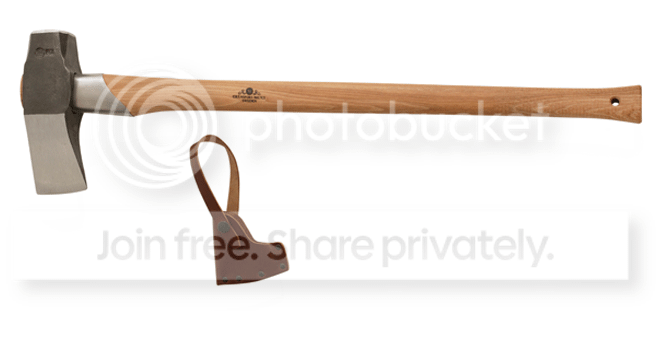
I'll clarify. An axe or a hatchet, by it's design profile is designed to cut wood, such as limbing or felling a tree. Because of it's acute blade profile, when used for splitting, an axe or hatchet will tend to bind in the wood. The tool of choice for splitting is known as a Splitting Maul as shown below.

Splitting-Maul.png

You will notice the more obtuse angle on the blade, which forces the wood apart readily and will not tend to bind as readily. Now, if you are horse or jeep camping, a maul is a handy accessory, but not so much if you are packing on your person, for obvious reasons. In a back-pack situation, a good 7" to 9" knife will do a good job of splitting via a batton and will do a pretty fair job of cutting as well. As with all tools, go for as good as you can afford.

I absolutely hate my 8-lb maul, the handle is too long to aim accurately and I'm always overstriking, and it's ridiculously dull... just thought I'd share. :P
 
My favorite for the backyard campfire would have to be a fiskars x27 & a large survival blade. After a hatchet accident a few weeks ago, I'd rather not use one for small chopping. I can get the logs small enough with my axe initially and then split the pieces smaller with the blade for kindling.

My favorite backpacking / camping setup is a sawvivor, monster blade (Rtak 2, Buck Hoodlum, SP10, BK9, etc.), and small necker. The same weight as an axe but with MUCH more capability.
That's what I've been rolling out with. I've just been curious about replacing the chopper with a smaller axe for trips to other areas. SC mainly has softer woods, so I can make do with a chopper/machete, but it's nice to get a good feel for other kinds of tools.
 
First, I'm new to doing anything more than processing firewood with an axe. Second, I've always used a larger axe, which worked well but is too heavy to tote around hiking. Using a smaller axe or hatchet demands much more work for the same result, versus both an axe and a chopper being batoned through the wood. It just doesn't have the heft for it. If you'll reread my post, you'll see that I ask how people get around that lack of power.

Kind of lost the question

You know how to use a felling axe for processing firewood
You have a Boy's axe for hiking (2 lbs and 28" handle?)
You just will split smaller diameter rounds, or slice off the side of round if it is too thick to split in one go.
Brain not brawn

And what you can split with a Boy's axe will in my opinion be easier than battoning with a long knife

And if the Boy's axe is sharp then you will not jump light years ahead with a Swedish axe
 
My favorite for the backyard campfire would have to be a fiskars x27 & a large survival blade. After a hatchet accident a few weeks ago, I'd rather not use one for small chopping. I can get the logs small enough with my axe initially and then split the pieces smaller with the blade for kindling.

My favorite backpacking / camping setup is a sawvivor, monster blade (Rtak 2, Buck Hoodlum, SP10, BK9, etc.), and small necker. The same weight as an axe but with MUCH more capability.

AMEN, we are on the same page.

I learned this a LONG time back and those that call me a ninny or just dont get it --- too bad.

Works for me and keeps me from bleeding !.
 
You can baton the axe but only hit the poll where there's metal. Don't hit the haft. Your best bet though is to use wedges. Or, get a big knife and a saw and make fun of the guy still using the small axe while you're sitting there with your work done and a beer in your hand. ;)
 
It's worth noting that batoning is the best method of making controlled splits of a specific size and can be used for rapid shaping of wood when bushCRAFTING. :)
 
It's worth noting that batoning is the best method of making controlled splits of a specific size and can be used for rapid shaping of wood when bushCRAFTING. :)

Ha maybe I'm biased because I'm used to machetes, but I usually find your advice the most logical. I've split wood with cane machetes, much like your favorite tool, many times. The only reason I'm looking at axes is for camping trips to hardwood areas. Using a more modernized knife with stronger, thicker steel is actually much less tiring, whether it is considered a proper tool or not, than an axe. IMO anyway.
 
I find that an axe really shines when it comes to dedicated felling or splitting, but is less than ideal for most other tasks. I don't know about you, but I don't do a lot of dedicated felling and splitting when I'm in the woods. And try clearing brush and brambles with an axe. It just doesn't work well. :D

I like a machete because I can fell if I have to, I can split if I have to, but I can also do a lot of other tasks with it. It may not excel at either of those tasks, but it gets the job done and many others besides. Batoning really should only be attempted on moderately sized pieces of wood anyhow. Trying to tackle an 8" thick log is a fool's errand because when there's a downed tree that big around chances are there's lots of smaller stuff too. If you really need to burn a log that big just build a big fire with the small stuff first! :D But for making a lot of finger to matchstick sized kindling from wrist to arm sized branches and whatnot batoning does a lovely job. And yes--you can baton hatchets to start a split when a chopping block isn't around. Works great.
 
Ha maybe I'm biased because I'm used to machetes, but I usually find your advice the most logical. I've split wood with cane machetes, much like your favorite tool, many times. The only reason I'm looking at axes is for camping trips to hardwood areas. Using a more modernized knife with stronger, thicker steel is actually much less tiring, whether it is considered a proper tool or not, than an axe. IMO anyway.
The knife I have is designed for splitting and does it faster, safer, and with less energy then a hatchet/axe. How people are saying that it's the wrong tool for the job still has me scratching my head.
I find that an axe really shines when it comes to dedicated felling or splitting, but is less than ideal for most other tasks. I don't know about you, but I don't do a lot of dedicated felling and splitting when I'm in the woods. And try clearing brush and brambles with an axe. It just doesn't work well. :D
I agree. I've found that I don't do a lot of chopping when out beyond limbing finger sized branches which a knife is more then adequate at. If I had brambles I needed to clear I'd pick a machete but I don't. That's why a knife is working really well for me right now. Of course next year I'll be on to some other tool for kicks and giggles. :D
 
Yup! Always carry gear as tailored to your general environmental needs and personal preferences as you can. Increases your range of utility and function when out and about, and that can sometimes make or break your enjoyment of a trip.
 
Serious pounding on (or with) the pole of an axe is not recommended as that part of the tool is usually left dead soft. The impact can deform the eye, as noted, or mushroom the pole, even cause (if pounding metal) pieces of steel to fly off to uncertain destinations (eyes).

Pounding on the haft of an axe is not recommended as that will damage the haft.

Pounding on a knife, especially a folding knife such as a multitool, with another metal tool is not recommended as it will damage the poundee.

An axe works as a wedge, just not as well as a dedicated wedge. Some axes are more suitable. Some, like the GB SFA, are less suitable. Hawks are typically at the "less" end. Blade profile. O--

Splitting wood with a blade works. See "froe." It's all a matter of degree and judgment, not black and white. It can even be done, very slowly and carefully, with a folding knife.

"Use the best tool"? Sure, if you have it. But it may come to "Use the better tool" or "Use what you have." Good to know about making tools on the spot (wood wedges).

If you don't have the "best tool" (hydraulic wood splitter, say), you do what you have to do. It's nice to know how as there are better and worse ways to use any tool.

You may elect not to carry the best tool (hydraulic wood splitter, say) on grounds of availability, weight, or personal preference. It's a free country. People are free to be snarky, for example, when discussing this topic.
 
Yup! Always carry gear as tailored to your general environmental needs and personal preferences as you can. Increases your range of utility and function when out and about, and that can sometimes make or break your enjoyment of a trip.
I can't wait to try out a Baryonyx btw! Would you consider multiple handle choices when you start to sell them?


Serious pounding on (or with) the pole of an axe is not recommended as that part of the tool is usually left dead soft. The impact can deform the eye, as noted, or mushroom the pole, even cause (if pounding metal) pieces of steel to fly off to uncertain destinations (eyes).

Pounding on the haft of an axe is not recommended as that will damage the haft.

Pounding on a knife, especially a folding knife such as a multitool, with another metal tool is not recommended as it will damage the poundee.

An axe works as a wedge, just not as well as a dedicated wedge. Some axes are more suitable. Some, like the GB SFA, are less suitable. Hawks are typically at the "less" end. Blade profile. O--

Splitting wood with a blade works. See "froe." It's all a matter of degree and judgment, not black and white. It can even be done, very slowly and carefully, with a folding knife.

"Use the best tool"? Sure, if you have it. But it may come to "Use the better tool" or "Use what you have." Good to know about making tools on the spot (wood wedges).

If you don't have the "best tool" (hydraulic wood splitter, say), you do what you have to do. It's nice to know how as there are better and worse ways to use any tool.

You may elect not to carry the best tool (hydraulic wood splitter, say) on grounds of availability, weight, or personal preference. It's a free country. People are free to be snarky, for example, when discussing this topic.

So true. My original purpose for the post was to gather a little knowledge before a purchase. That purchase was based on accumulating most of the tools I'd need for camping/backpacking trips to other areas of the country that I'm not familiar with. I appreciate your sound logic.
 
Back
Top