Bearing and steel question...Scottikes

Joined
Oct 30, 2002
Messages
3,974
A patient of mine owns a large machine shop that performed tasks and fabrication for heavy duty applications. They've built everthing from custom machinery to 100,000 pound cookers for seed processing. Anyway, today he brought me in 5 roller bearings and a piece of mystery steel.

The rollers 2 inch diameter X 2 & 1/4" long and are used in flaking rolls for cotton seed mills and run continuously inside of a 14"+ races. The flaking rolls weigh in at about 8000 pounds each and can process over 25 tons of cotton seed every day. Any idea what kind of steel in these bearings? Hoping for 52100 and not case hardened. He's going to grab the part number for me so I can figure out what they are made of. He's got lots more along with races, and since I'm wanting to get into forging, I'd like to score it if it's a good find. I'd hammer it out thin, heat treat it, and break it, but I don't have access to a forge or an anvil. Once I have the part number, maybe I can track it down better.

Also, he gave me a piece of tool steel that was used in manufacturing railroad car wheels. He says its a REX CPM tool steel, but he's not sure about it more than that. Any guesses? My guess is that it's not suitable for knife purposes, but I may be able to salvage a couple of filing guids from it.

Appreciate the help!

--nathan
 
Until I have the part numbers, I can't help you. Once I have the "FULL" part number and the manufacturer (timken or torrington or skf or nsk, etc) I'll definitely be able to help you.
 
Figured as much. I remembered from prior threads that you worked for Timken (if I remember correctly) and look forward to your input.

I'll hopefully have the part number on Wednesday, Thursday at the latest. Thanks for the help!

And mete, when searching the internet, I was able to find that Crucible made different grades for REX steels. Thanks for the link, though. Probably no way to tell what grade it is, but I'll hit it with a file and if holds mustard, I'll try and fashion some filing guides or throw it in the scrap pile for later hairbrained schemes :). I'm guessing it will be a ***** to drill, so I'll probably epoxy or clamp it to a frame of sorts if I make a guide from it.

--nathan
 
He says he knows they are hardened all the way through and not case hardened. He's going to bring the part number and the spec/composition sheet with him tomorrow.

--nathan
 
Nathan-


Just so you know, the part numbers might not mean much. I had two huge bearings that Scott was kind enough to look up for me. The numbers off of them told him that they were both 52100.

I was having some steel tested and went ahead and had the bearings tested too... a piece from each: inner race, outter race, and bearings themselves. None of it was 52100. It's all a bearing steel, but quite a bit off from 52100.

This isn't trying to be negative towards Scott at all, he was helping me out by looking up the numbers. I just want to point out that the numbers don't always jive.
 
Probably a different manufacture using a different supplier. I would suspect that not all bearing manufactures use top of the line steel. What should be 52100 could be something somewhat like it. China, Tiawan, India all come to mind and who knows the sources and suppliers of 52100 like steel
 
I think maybe the suppliers could have been a bit shadey... who knows.

The first bearing was a Timken and the second was an SKF.

They should at least make nifty paperweights! :D
 
This is really a fairly easy question to come to a 'close' answer for.

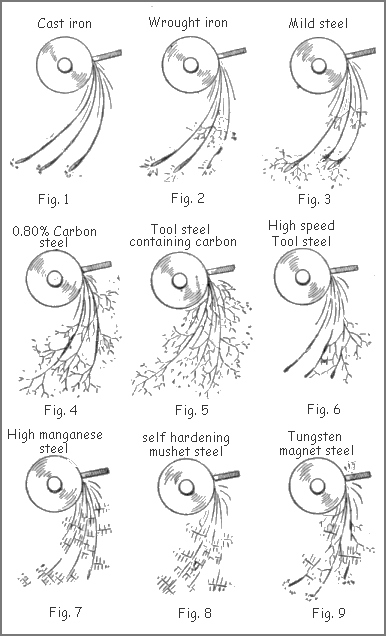
If you have a wheel grinder, a chunk of 1095 , an el-cheepo wrench, big old band saw blade, circle saw blade a sample of 5160, L-6 and another of 52100 and what ever else is under the bench or around the shop, run a grind/spark test. The sparks will give you a fair value.

By matching the sparks to about everything you can think of, you will get a fair idea of what you have.

Some saw blades and tools say right on them what there made of, there are more variables then answers watching sparks sometimes,,,,, but it will at least tell you if you should invest the time making a blade out of it. I would hope for a very short trail of very fine sparks,,,,,,, then make a blade , quench at critical, temper for a say, say 385? , and see how it cuts!


Experimenting is part of the fun!

spark.gif
 
Its ball don't lie. Sparks can give you a little help but a long ways from being fool proof. Right now I've got at least 4 different types of 52100 and each has a different spark.
 
Well, I really don't think this information is going to help much, but here's what my patient gave me.

Bearing #: 22334

He says they've been run for 23,700 continuously at around 350F. Don't know if he's sure, but he says it is carburized tool steel. So, case hardened.

Oh well, they make nice paper weights. Also, they're great for changing attitudes when placed in a tube sock or pillow case :D.

--nathan
 
Well, I really don't think this information is going to help much, but here's what my patient gave me.

Bearing #: 22334

He says they've been run for 23,700 continuously at around 350F. Don't know if he's sure, but he says it is carburized tool steel. So, case hardened.

Oh well, they make nice paper weights. Also, they're great for changing attitudes when placed in a tube sock or pillow case :D.

--nathan
That number is only the base part number. All it gives me is the size of the bearing. There should be a series of letters and numbers after it that gives more information.
 
Back
Top