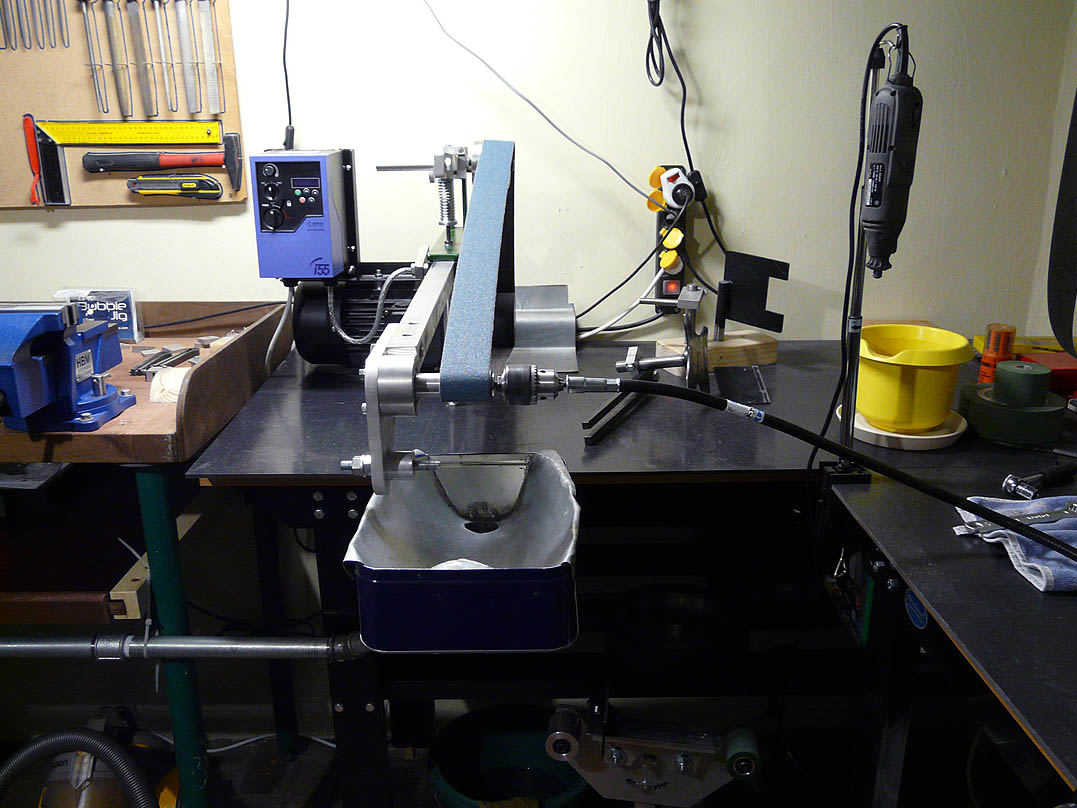
Belt grinder as rotary tool

Joined
Nov 30, 2010
Messages
14
I was tired of the low power of my dremel clone, it kept stalling even with light pressure. The 100W just doesn't cut it for rougher jobs.
So I started looking for a more powerful version, but other alternatives were either expensive or still low powered.

While looking around in the local DIY shop I saw a flexible drill extension and thought to myself, why don't I attach that to my belt grinder...
So I bought the extension and an SDS chuck so I could fit it onto my multiwheel grinding head.
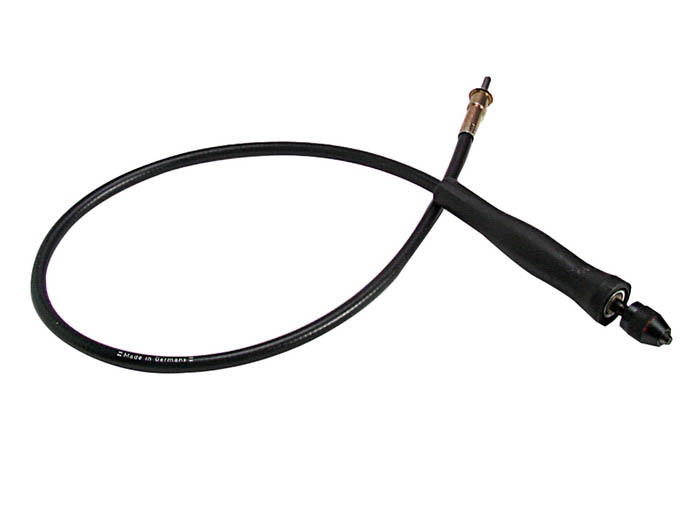
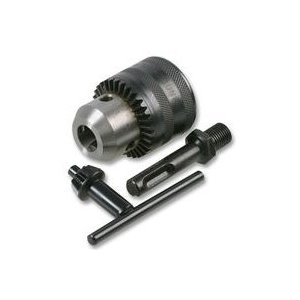
drill_extension_small.jpg

beltgrinder_dremel_7.jpg


The contact wheels on the Aly maxi grinder are kept on with a small bolt roughly the imperial equivalent of a metric m8. Replacing that bolt with the SDS chuck would allow me to use the extension as a dremel flexi shaft. I didn't have an imperial tap & die set though so I tapped the hole and threaded the bolt to m8.

Next the SDS adapter needed to be m8 as well so I ground it down until it was about the same diameter as the bolt and threaded that as well. I wasn't able to get it perfectly straight unfortunately so it wobbles a bit while spinning, a lathe would have come in handy there. Putting it in the drill press would have damaged the threads on the other side, while the nut was too big to chuck up. :rolleyes:
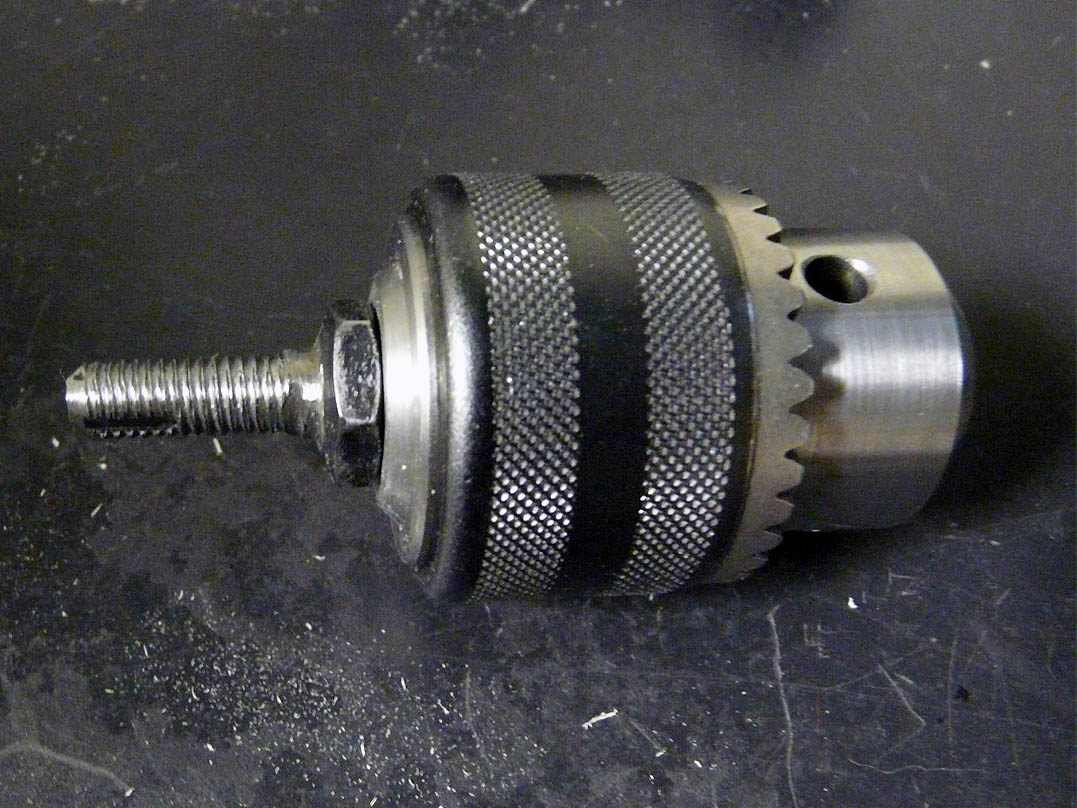

beltgrinder_dremel_1.jpg


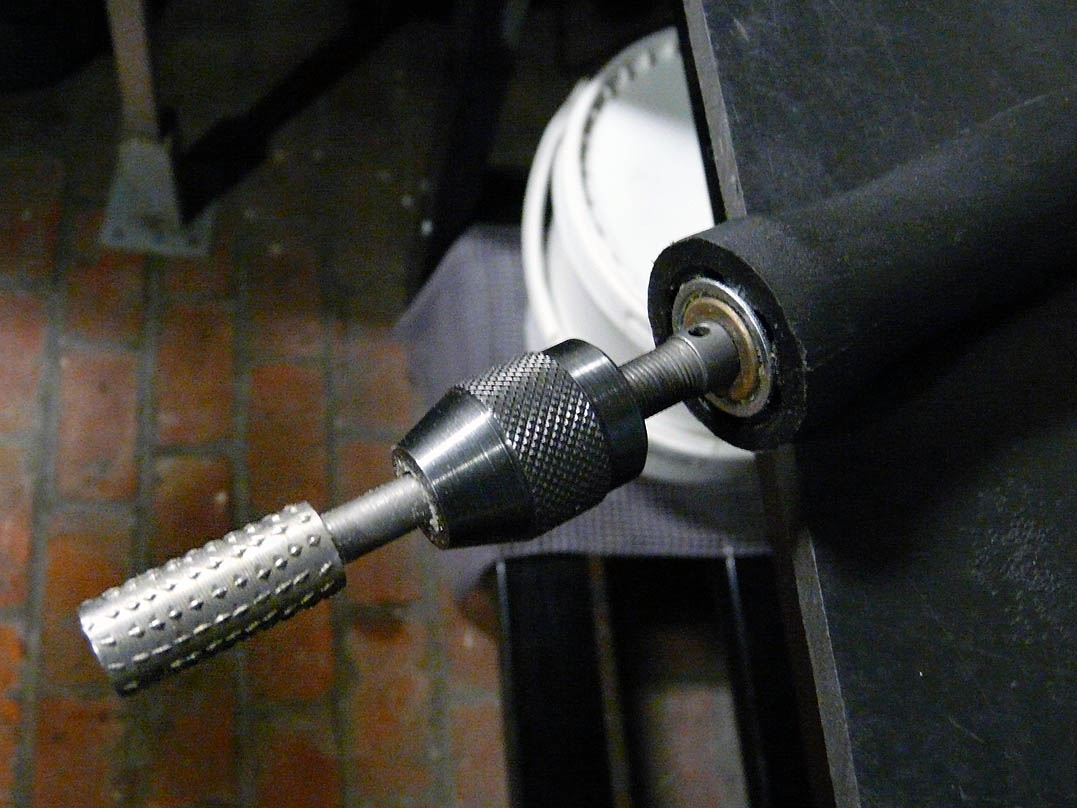
So all I needed to do now was switch the grinding head bolt for the chuck and attach the extension.
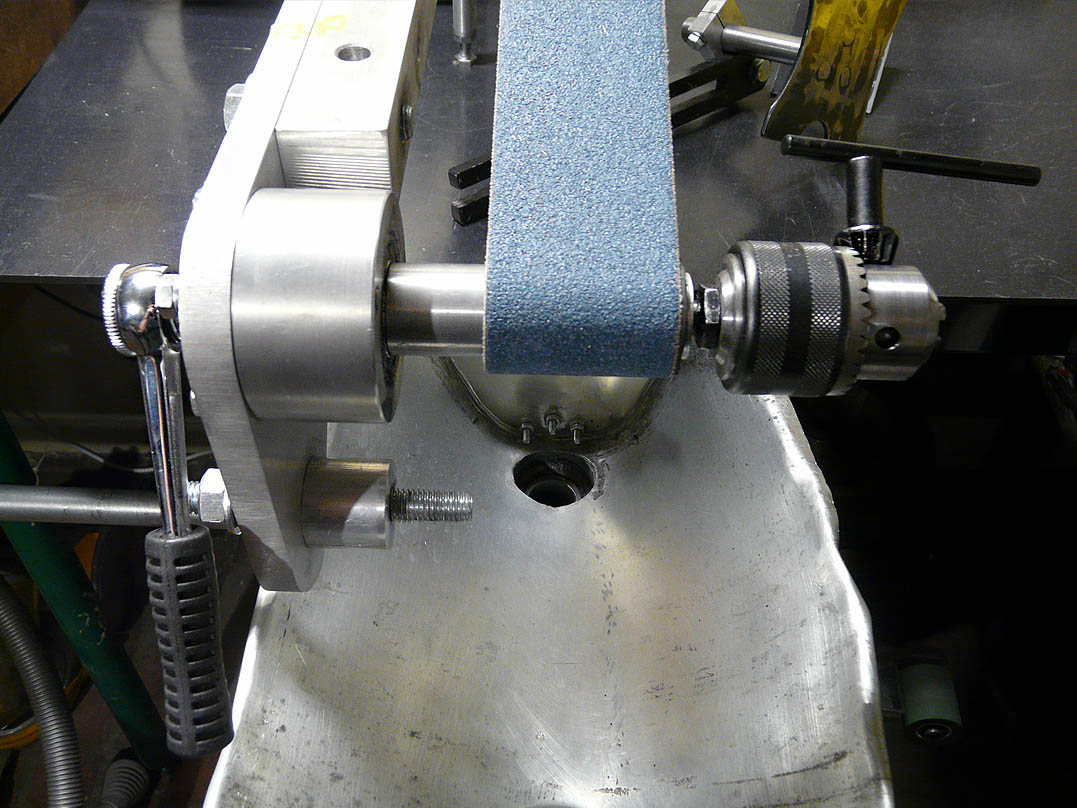
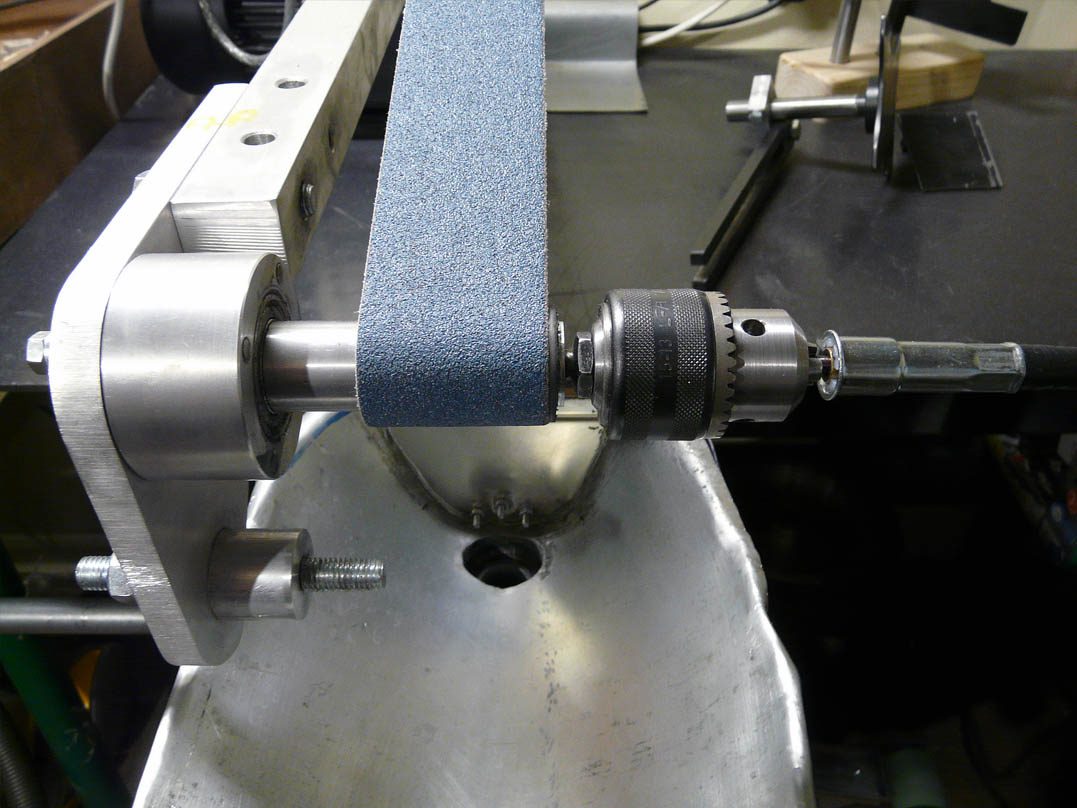
beltgrinder_dremel_6.jpg


beltgrinder_dremel_2.jpg


beltgrinder_dremel_3.jpg


It can take shafts up to 6mm so I can use dremel bits or larger ones like a rotary rasp.
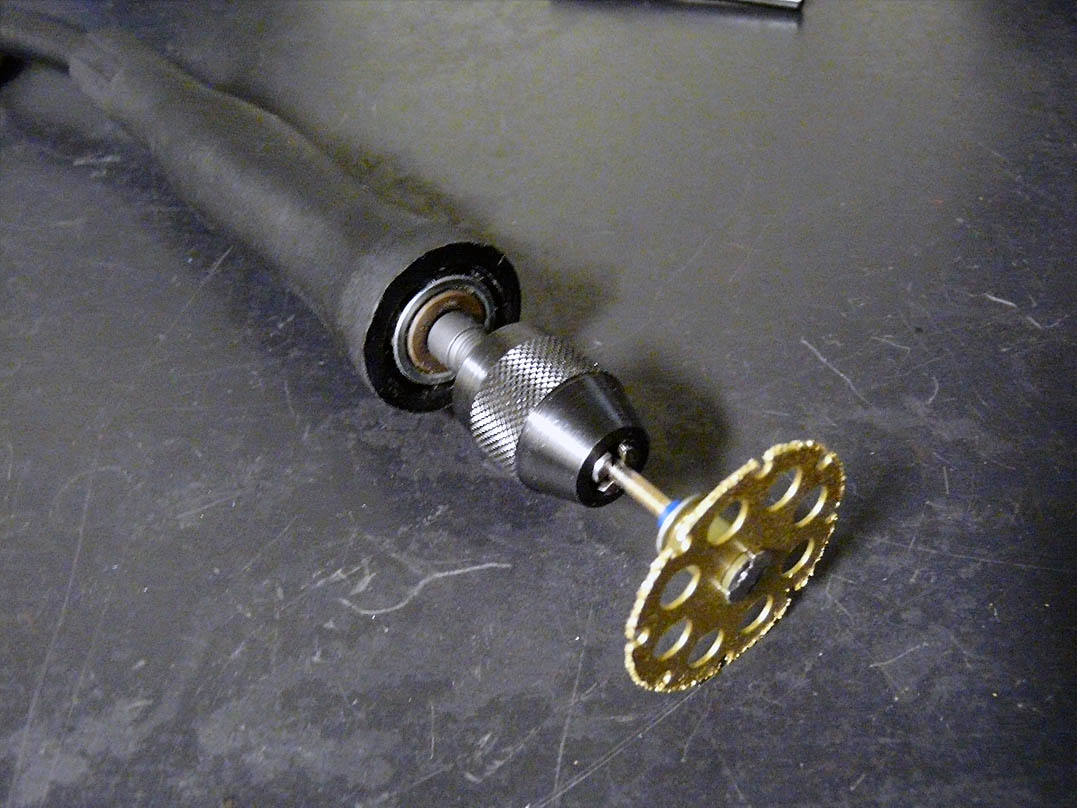
beltgrinder_dremel_5.jpg

beltgrinder_dremel_4.jpg


I've got Aly's direct drive maxi grinder so at 100 hz the motor spins at 2850rpm (Aly and the grinders he makes can be found on British Blades btw). With the 4" drive wheel, speed settings are easiest to read when using the 35mm contact wheel on the grinding head. This gives me a max speed of 9818 rpm which makes 1 hz just a tad less than 100rpm. This extension can only handle 3600rpm though so 36 hz is the maximum safe speed, but if I can find a way to attach the dremel flexi shaft, I could go up to 100 hz no problem.

So what I ended up with was a 1500 Watt variable speed dremel. There are a few flaws of course, such as portability :rolleyes: and a lower maximum speed, but overall it works quite well and I very much doubt I'll be able to stall this. :P


I also got the suggestion to put a polishing mop on there by FGYT on BB, making it even more versatile. :) I already have a 1 horse buffer with 8" mops, but it has a fixed speed of 2950rpm so the vfd should be handy for more delicate things.
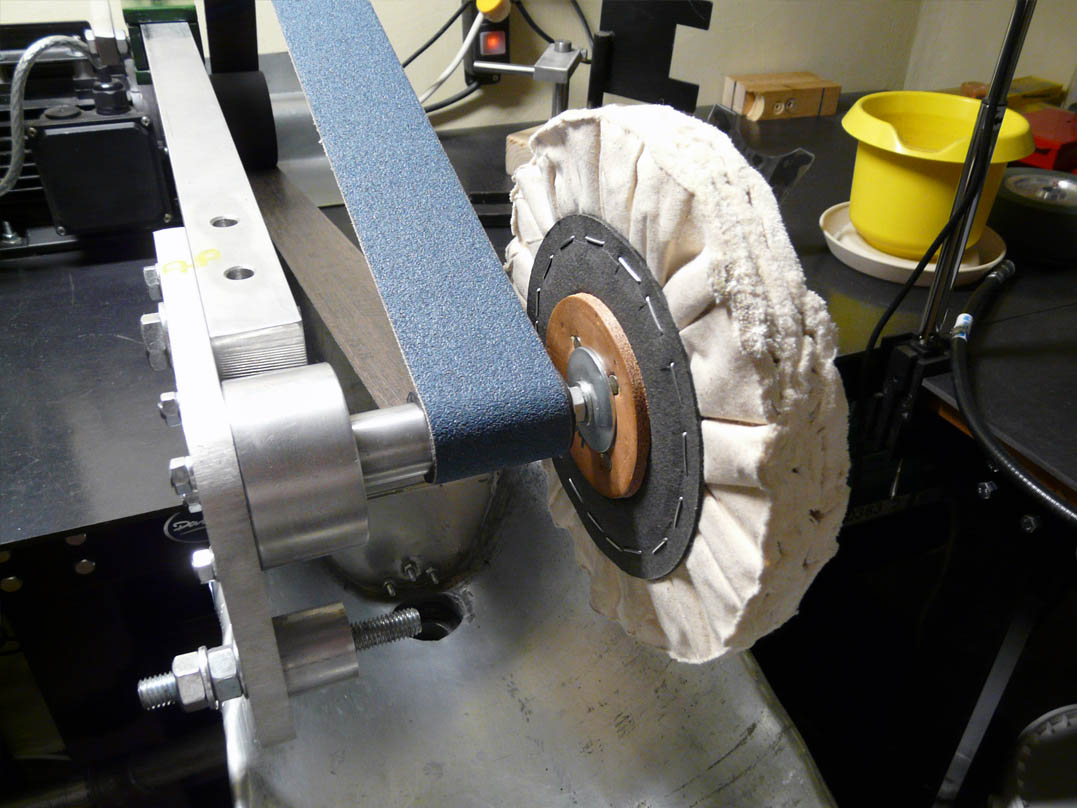
beltgrinder_buffer_1.jpg


Has anyone else done anything similar?
 
That may be a pretty dangerous setup. The sheath isn't attached to anything, so when (not if) the core shaft kinks under the way powerful motor, whole thing will pull out of your hand and become the spinning whip of death. Hopefully the shaft will tear itself in half before too much damage or blood is drawn.

I'll be honest, If I was visiting your shop and you were going to use it while I was there, I would leave.
 
seems a little precarious. a 60 grit belt running unattended to run a drill chuck that is attached to a flex shaft for a dremel? It may work, but how safe?

Foredom tool is the way to go.
 
I was using a worn belt for 'safety', but apparantly I hadn't thought it through properly. It seems to me that even should the sheath be fixed to the grinder to prevent it from spinning, the power of the motor would still be too much and rip it out anyway. Using a different kind of drive belt, one that would slip more easily to limit the power might work, but I reckon it's not worth the gamble. I'd rather spend some more time than injure myself.

So, thanks for the feedback guys. :)
 
Spend the money and get a 1/4HP or 1/3HP flexshaft unit. It will do everything you want and more....safely.
 
I think Tjolbi deserves a bit of credit for thinking, and implementing his thinking, outside the box here, even if what he came up with is a "bit" scary. Lots of people walk the line on safety when they try to do something "economically" sometimes they get away with it.................. sometimes they pay with blood. I don't think the idea of driving an accessory off that end of the grinder is new. I think I've seen setups like this on BF before.

I'll second the idea that a Foredom is a dandy investment on a tool, Lord knows I could have probably bought one for what I've spent on burnt up Dremels over the years. Good tools are a joy and cheaper in the long run.

Nice try Tjolbi

Syn
 
I know that "Thinking Outside the Box" is popular....but sometimes there is a reason the box is drawn.

I have worked with these type of tools daily for over 40 years. You can give credit to Tjolbi if you want, but I hope he takes my word of experience over your encouragement to "Go for it".

I once say a gal's pant leg get ripped off when she dropped the tool while hogging on wood. She accidentally nicked her finger, and let go of the tool on a 1/3HP flexshaft with a 3/4" carbide wood carver tip. She was using a bench control ( one reason I don't like them) and thus the tool stayed at full speed. It hit her leg and caught the material of her pants. It tore half of the pants leg off before the shaft broke. Luckily, she was more scared and embarrassed than injured. If it had caught the skin instead of the cloth, it would have taken off a big chunk of meat.

I would hate to have seen what would have happened if the tool was running on a 1HP+ motor, with no instant off.
 
I NEVER TOLD HIM TO "GO FOR IT"

I wasn't encouraging him to continue with this particular attempt. I was suggesting that he try again and look for a SAFER way............which might be the Foredom, if he can afford it. I just thought it was interesting and decided to give him a pat on the head. He got advice here that might well save him injury, which is what it's all about. So Stacy, I appreciated your safety comment FULLY. I am all for safety first, which might be why I haven't ever lost chunks of my anatomy to run away power tools. Not to say I haven't had cuts and burns due to inattentiveness now and then. There are lots of hazards we can't avoid without creating our own through excess zeal.

As I get older, I've gotten more willing to invest in better tools, so it's easier to seek out the ideal tool to do almost anything I have to do these days. I do wish that, when I was younger I'd learned to use some tools more skillfully so I could apply those skills with my better tools now when I have more time available.

I also like the idea of deadman foot switches on things like routers and flexshafts. Runaway tools at 30,000RPM are a nightmare......

Syn
 
I'll take your advice to heart, I value my safety far above time or money spent. ;)

Regarding deadman foot switches, I have a clipper line master foot pedal, which I mostly use for saws but not every machine stops instantly once power is cut. It's certainly an improvement over reaching for an off button though.
 
Last edited:
well i dont think you where totally off on your idea.... the theory was there but using the sander wasnt the best
c

but saying that for what its worth you can use a drill press to run a flex shaft which i have considered. Now as any tool in our shops if you misuse or loose concentration as stacy mentioned about his friend who had it caught then yes accidents can happen but you can also hurt yourself using your sander, grinder, everything.

my dremel copy tool has no emergency off when using a flexshaft attachment, its turned on, hung up and used so i think maybe the using it off the belt was a tad risky and scary and someone will most likely disagree with the drill press attachment but its another option anyway

http://www.sawbird.com/flex_shafts.htm
 
The extension I used was originally meant for a drill press, like the one you linked to.
 
I agree a low speed and low HP drill press will be a far better power choice.....but still has some risks you need to understand.

Where things get iffy is the sheath. On a regular flex shaft tool, the sheath is attached to the motor frame. It is held rigidly in place and can't rotate. The shaft runs concentrically in the sheath and it does all the rotation. The shaft is greased with special lubricants, and kept away from the sheath walls by a spacer spring that acts like a flexible bushing.
Now, if you just attach the shaft, and don't secure the sheath, it will try to rotate. If the shaft is well greased and has a spacer, it will not impart much torque to the sheath, and your hand gripping the tool will be enough to resist it. However, most of these $20 flex shaft conversions have only a flexible shaft inside a flexible metal sheath with a rubber coating. They are only lubed with some cheap lithium grease. Thus, if one of two scenarios happen, the sheath will turn, and the whole tool can become a powered whip -

1) The tool attachment ( drill, sander,burr, etc) grabs while being used. This will stop the shaft from turning, and the shaft will try and twist into a knot. The sheath will jam with the shaft, and try and form a knot,too. The whole assembly can pull out of your hand and start spinning around until ( hopefully) the shaft breaks off and it stops spinning. The tool is ruined, and you probably need new pants.
2) You set the tool down to make an adjustment or inspection of what you are working on. Since the power source is a fixed machine, you decide to just let it run and the tool spins freely....no problem....until the friction of the shaft in the sheath starts to cause the sheath to turn, which makes the whole thing rotate, and then it twists ...and then it knots...and then you are in scenario 1, but with even less warning.

The more powerful the motor, the worse the problem will be. Just because the flexshaft says it is rated at 5000 RPM, does not mean it can be safely operated at 1HP....different things.
Also, as these cheaper flexshaft units get older, the grease gets gummy ( and you can't usually re-lube them), exacerbating the problem.
In the jewelry industry, we re-lube the shaft every 50-100 hours of use.
 
Put a vise grip on the sheath and wire it to the bench, better yet weld a bracket on the vise grip and bolt it to the bench ;0)
 
Put a vise grip on the sheath and wire it to the bench, better yet weld a bracket on the vise grip and bolt it to the bench ;0)

While better than leaving it as is, the chances of getting a perfect alignment with the chuck arbor will be hard to do. That could make things shake and vibrate like heck, and wear out the shaft/sheath even faster.

I think I have made my point, and will let the OP do as he wishes. No need to get into a design war for a new wheel.

Which reminds me. Does anyone have a link to the photo of the car with non-round wheels? It had ovoid rear wheels, with a crank shaft shaped axle that made the car body stay even as the wheel went up and down. I think the photo was called "Re-inventing the Wheel".
 
Back
Top