Bending bronce

Hengelo_77

Basic Member
Joined
Mar 2, 2006
Messages
6,319
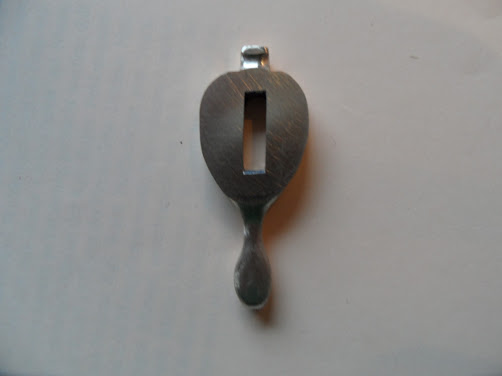
I'm working on a bronce guard. I want to bend the botom part backwards.
I've never done that before.
My idea is to put it in a vice, heat the part where i want the bend with a burner and tap with a hammer.

Will that work? Any input?

SAM_1262.JPG

SAM_1261.JPG

SAM_1258.JPG
 
I find that method works poorly.

Normally, you profile the guard, bend it to the curvature you want, and then grind in the details. You can still do it now, but it is going to be much more of a trick. It also depends on the type of bronze, as some types bend more easily.

Here are the basic steps to try:
Make a shaping mandrel from a piece of oak or maple. It should be the curvature you want to bend the guard to. Put it in a vise to use as a shaping anvil.
Hold the guard in a flat jaw tong and bring it up to a very dull red color. Let it cool to black and use a soft hammer to shape it on the wooden form. A wooden mallet or a brass hammer is best, but use what you have. If it stops moving easily, don't force it. Heat again and bend some more.

Be aware that it will almost surely try to bend the most, and may well pop right off, at the thin neck you have ground. Energy always takes the path of the least resistance.

If it doesn't work. Start again, and shape the curves before you shape any thin places.
 
If you do it in the dark, you will see the colours better

I would definitely use heat, but not necessarily a hammer
You have less control over the bend and will have to work out all those dings later.

If you must hammer, maybe a lead hammer and do it over a form to control the shape.


I'd try smooth or soft jaw pliers, or a pipe that slips over.


EDIT it looks like I had that window open too long, Stacy has it all layed out.
 
Are you sure it's bronze rather than brass ? What type of bronze ? Traditional would be copper /tin but there are many types. Get it to glow and gentily hit with a hammer but don't let the part get cool. When the color goes , reheat.
 
Bronze is usually more brittle than brass , but they both anneal pretty much the same way ,by heating them up and quenching. After that they work harden rapidly .
 
What alloy? and are you sure it is not brass?

True bronzes usually bend reasonably well if annealed by heating to a dull red (dark conditions) and plunging in water or brine then bent cold. Brasses can be a whole different ball of wax if they have a high zinc content or are leaded for free machining. Some bronzes can be bent hot, most I have worked with it is a really bad idea. Most nonferrous metals are best worked annealed and cold

-Page
 
Thnx for the replies guys.
I don't know the exact alloy, it was bought from a knife supply house. The bar I cut it from was aged to a nice brown, unlike the more yellow brass. I'm not a very photographer that might account for the colour.
I'm confident it is bronce.
I'll give it a try this weekend and keep you guys posted.
 
Funny timing on this thread.
I got a call last night on the way home from a knifemaker friend who was working on a Damascus "C" guard. He was trying to bend it just like Hengelo was....put it in a vise and hit it with a hammer.
Needless to say it wasn't working. I picket it up and took it home to the forge, where it bent quite nicely at 2000°F (1100C). It took longer to get his dings an vise marks out than it did to curve and bend.
 
I finaly came around to do this. It was a first to me and I'm not unpleased with the result.
But I've learned that I've done things in the wrong order.
I had the slot for the tang filed to a good fit before I heated it with the burner.
It bend quite well but it is now oxidised.
Before epoxying it needs to be cleaned but I'd prefer to not file it again as it will widen the slot.
I'm thinking about using sulphuric acid. I've read that goldsmiths remove fire scale like that, but I have zero experience on it.
Any input/idea's?
I also got some 'brass black' I want to use on the guard. Also a first to me.
Just brush on and wait?

pics: :)
brons2.jpg

brons.jpg

SAM_1296.JPG
 
The Sulfuric acid jewelers use is very dilute. It is also pretty dangerous to handle. Most jewelers use a different acid called Sparex ( and other brand names), simply calling it "pickle". It is a sodium Bi-sulfite powder dissolved in water, and acts like a mild sulfuric acid. A perfectly good home version can be made by dissolving alum ( aluminum ammonium sulfate) in water.
 
Sparex is a very nasty version of sodium bisulfate. It has an oily byproduct of its manufacturing process that floats and clings to metal. Go to a pool or hot-tub place and buy "PHDown" which is sodium bisulfate that is pure enough to be put in swimming pools for making the PH a little more acidic. Remember the rule when you are mixing it, always add acid to water, not the other way around. The mixing is slightly exothermic. You can also use clean bisulfate for doing "discovery etches" on damascus, just never use pickle that has been used for anything with copper in it on any ferrous metal as it will plate the copper onto the ferrous metal

-Page
 
Back
Top