
- Joined
- Apr 14, 2006
- Messages
- 7,021
In the continuing effort to explore the world of knots, bends are next.
Ashley defines a bend as "A knot which ties two ropes' ends together."
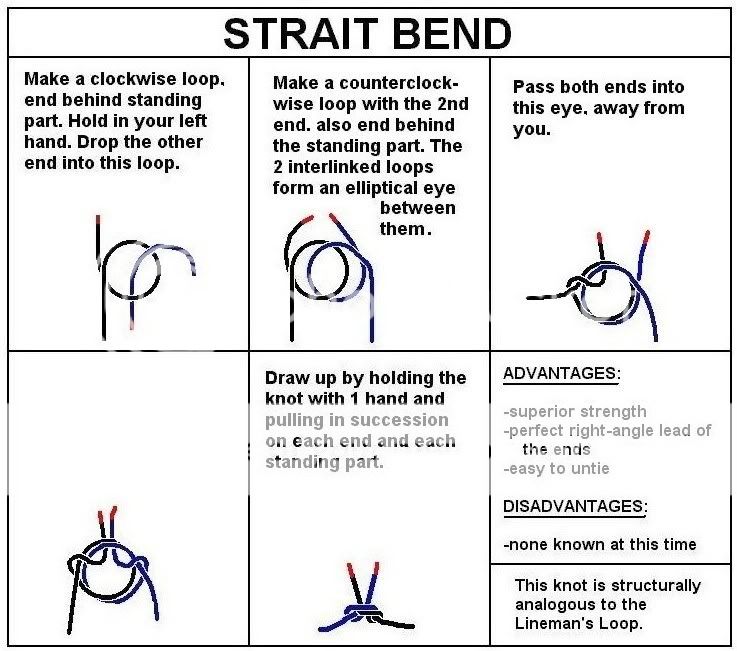
My favourite and most used bend for joining two ropes of equal diameter is the Strait Bend (AKA the Alpine Butterfly Bend, IIRC). This knot holds very well, and still is fairly easy to untie after a load is applied. Both ends can be run back through to make the knot slippery, as well.
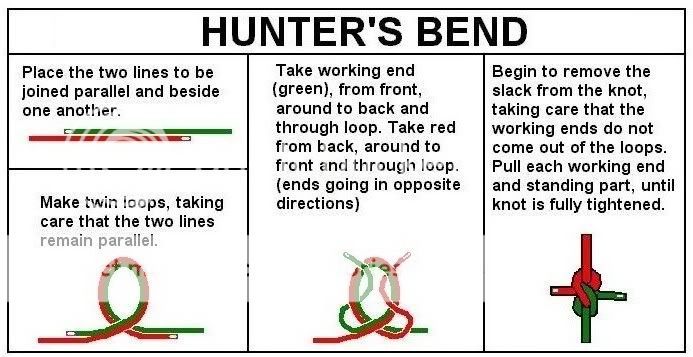
Having said that, I find that more and more I'm using the Hunter's Bend and the Zeppelin Bend. What determines which knot I use, is the ease of tying. Many years ago, I learned to tie the Hunter's Bend, but kept forgetting how to do it, because of the method I learned. More recently, I learned a different method, which is much easier to remember and it improves the knot immensely, for me. Below is the easier method, at least, IMHO.
Brother Coote has mentioned before, of his affection for the Zeppelin Bend. I also used to find it awkward to tie and often forgot how. A newer method has greatly simplified the tying for me, and now find I use it quite often.
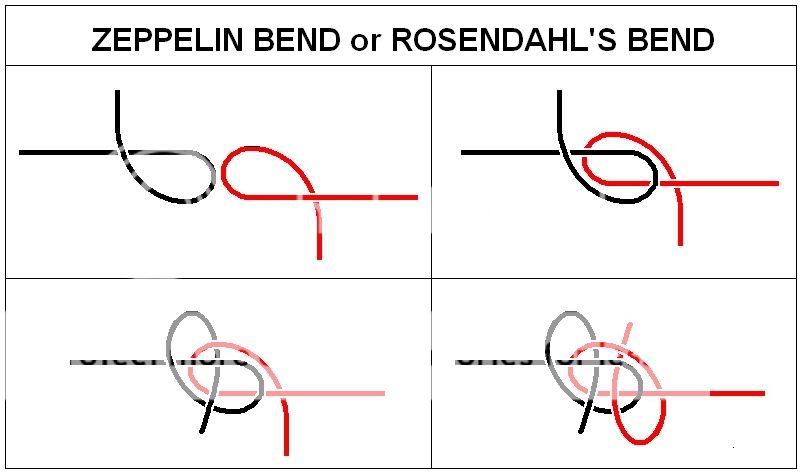
I do this by first wrapping the end around my left index finger. I then wrap the other end around my right index finger. I then place the loop formed around the right index finger behind the loop formed on the left index finger and proceed as in the picture above. I hope this made sense.
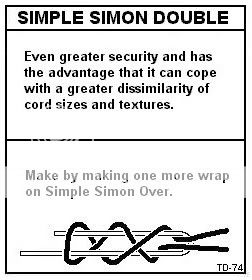
As for unequal diameter bends, I use either the Sheet Bend, Double Sheet Bend (less likely to spill) or if I want total security, the Double Simple Simon.
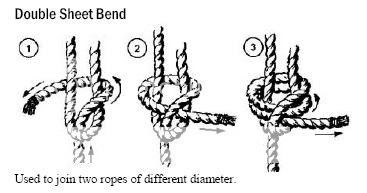
If you stop at step 2, you have a Sheet Bend. Step 3 is the Double Sheet Bend.
Oh, and did I mention I'm a bit of a whack job when it comes to toggled knots?
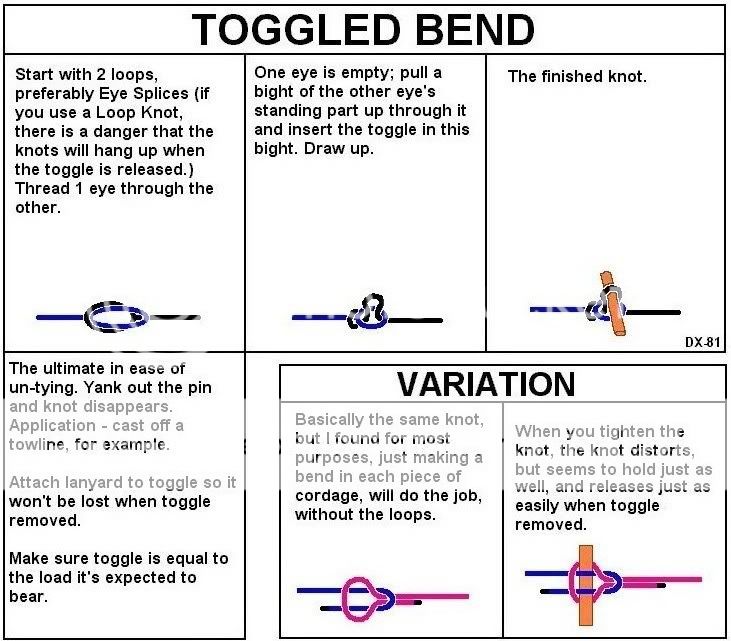
The Toggled Bend:
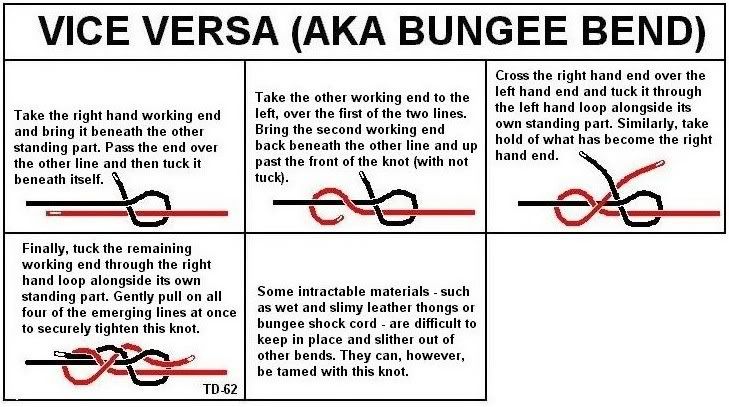
One last thing, any discussion on bends would be remiss if it didn't include the 'Bungee Bend'. Bungee cord can be problematic in tying knots. This is resolved when using the Bungee Bend.
Doc
Ashley defines a bend as "A knot which ties two ropes' ends together."
My favourite and most used bend for joining two ropes of equal diameter is the Strait Bend (AKA the Alpine Butterfly Bend, IIRC). This knot holds very well, and still is fairly easy to untie after a load is applied. Both ends can be run back through to make the knot slippery, as well.
Having said that, I find that more and more I'm using the Hunter's Bend and the Zeppelin Bend. What determines which knot I use, is the ease of tying. Many years ago, I learned to tie the Hunter's Bend, but kept forgetting how to do it, because of the method I learned. More recently, I learned a different method, which is much easier to remember and it improves the knot immensely, for me. Below is the easier method, at least, IMHO.
Brother Coote has mentioned before, of his affection for the Zeppelin Bend. I also used to find it awkward to tie and often forgot how. A newer method has greatly simplified the tying for me, and now find I use it quite often.
I do this by first wrapping the end around my left index finger. I then wrap the other end around my right index finger. I then place the loop formed around the right index finger behind the loop formed on the left index finger and proceed as in the picture above. I hope this made sense.
As for unequal diameter bends, I use either the Sheet Bend, Double Sheet Bend (less likely to spill) or if I want total security, the Double Simple Simon.
If you stop at step 2, you have a Sheet Bend. Step 3 is the Double Sheet Bend.
Oh, and did I mention I'm a bit of a whack job when it comes to toggled knots?
The Toggled Bend:
One last thing, any discussion on bends would be remiss if it didn't include the 'Bungee Bend'. Bungee cord can be problematic in tying knots. This is resolved when using the Bungee Bend.
Doc
Last edited:


