Benefits of D2?

I have CPMD2 in one of my knives and I've never had any issues with sharpening or rust and it's a bead blasted blade. Granted I live in Nevada where our humidity is under 20%.
I've found that with the SM and an old belt it takes probably 50% more time for me to sharpen it than CPM154 and about the same time as Sg2. This is all completely subjective and my knives have different edge geometries so it's by no means scientific.
It doesn't hold a razor edge forever but it will hold a plenty sharp working edge for quite awhile.


CPM D2 is much more rust resistant that regular D2. Regular D2 doesn't rust bad at all so CPM D2 is probably more like 154CM when it comes to rust.
 
This is a subject that has been around the block many times on this site.

One of the more recent, intelligent threads is here:

http://www.bladeforums.com/forums/showthread.php?t=706657


My two cents is post #18.

Like most of those here, I haven't had any problems with D2. Not sharpening, not edge wear, not edge retention, or anything else. I use a couple of my Queens as work knives, and as far as rusting or corrosion goes, in my sweaty pocket I haven't had any problems. In fairness, it has yet to see a full sweaty work day in the South Texas humidity in my pocket, but then I will switch back to stainless for three months.

D2 has become my steel of preference. You get the edge capability of 1095 and then some, but some good corrosion resistance for a great price.

It isn't a miracle steel by any means, but it does quite well.

Robert
 
"I have looked at the Outcast--the factory bevel is like 45 degrees. At that geometry you could damned near make it out of glass. "

It is thick to be sure, I have one and it chops damn well out of the box with almost no ill effects on the edge. I take any minor edge dings out with a diamond stone and then hone with a ceramic rod and i'm good to go. I had a bit of damage from the February snowfall in which I was forced to process a sizeable limb that fell onto my fence and it was the Outcast that I used for the job. I even like it better than my khukri for these things. I guess people have had the edges thinned and even convexed with good results. I love it.
 
The biggest advantage of D2 is that when it is treated excellently it makes an excellent blade.

Even the best steels can be made into cr*p knives, and poor steels won't make anything else.

Greg
 
I have many D2 Doziers.. I don't consider myself an expert at sharpening, but I have had no problems getting D2 to be razor sharp.. First of all Doziers hold their edge forever.. but I did cut some carpet one time and really dulled the edge.. 5 mins on my ceramics rods/ strop and it was razor sharp again. I love the feel of D2 and find it an excellent steel. I have had zero problem with rust, that being said I am always coating my blades with Mineral oil. I also use the oils from my bald head in a pinch if I have to..
I have recently purchased a Busse/INFI and I can tell you the 2 steels are completley different to sharpen. Not good or bad, just sharing that I was surprised how different they feel to sharpen. I cannot speak of anyone elses D2.. but today if I had to choose one steel for the rest of my life it would be Dozier D2!
 
Hi, guys!

Just wanted to verify: the benefit of D2 is edge-holding (resistance to wear) that's tougher than stainless, but with near-stainless properties, right?

Thanks!

BK86

I have a few knifes with different blade steel.

I think there are too much publicity about this D2....

I've a Rat 7 d2..... good (not excelent) in chopping a small tree. yes, it hold the edge very well, but i think the steel are too hard..... will chipp off when I chop with a harder things. The D2 blade chipped off when i try in 90% style of chopping a old bamboo.
In a thick jungle in borneo ..... this RAT 7 can only cut a small tree. Not a utility knife.... better bring along another smaller and bigger knife (machete) in the jungle. The blade cant even cut the chicken bone or a 1kg of fish bone.... its needs a batton style of cutting just to cut the 1 kg fish bone :confused: Its easier to cut the fish bone with my mora all arround compare to the RAT 7.
I prefer use my cheap 9 inches parang (machete) when entering the jungle ....I think the parang can chop 75% better than a RAT 7 and much more lighter than the RAT 7.

But anyway, I still bring my RAT 7 to the jungle together with my F1 and one more knife depends on the which jungle I going to enter. Why I still bring along the Rat 7? Coz, I already spend RM300 to buy the knife for the shape.

My suggestion..... just buy the VG10 steel or VG 1 steel instead of D2 steel. Or maybe a 1095 blade knife
 
^ alot of what your talking about has more to do with the knife geometry, and not the steels in them. Given the same knife at the same thickness, with the same edge, and the same heat treat, I think you would find D2 to be a better steel than the ones you suggested.
I have all those steels also, and none perform as well as my D2's with the same thickness blade and good heat treat. 1095 is good, but will rust/stain much quicker, which the OP doesn't want. I also like VG-10 as you mentioned, but its not as good as D2 IMHO.


One reason the knife world is so good these days, we all have so much to pick from, and can get materials that fit our own wants and needs:thumbup:
 
I will only resharpen my D2 the same way as my maker does; belt grinder and buffer. The hairs pop!
 
D2 is great steel when properly heat treated. I have experimented with thinning the edge, and when I get below 10 or 12 deg per side, this happens when doing twisting cuts in wood.

queen_4180.jpg


I put a microbevel on this, and removed the damage in 5 min or less. This Queen 4180 will go through cardboard and hold an edge almost forever, the microbevel doesn't slow it down one bit. This has to be one of the best knife deals in the world, no joke. It's one of my favorite knives, blows away many in edge holding, and was under $40.

And yes, when I test, I can be hard on my knives - not to be destructive, but to find the limits. I found it for this one, and it's still a very, very high performer.

I've ALWAYS had superior edge holding with ALL of my Doziers and Queens. I've had mixed results with D2 from other manufacturers. If you keep the primary grind fairly thin, and keep the edge bevel above about 30 inclusive, you'll have a real serious cutter - that's what Dozier does, in addition to a superior heat treat.

D2 is a great steel for it's uses - I like it for hunting and game work. It's ok for wood, but I prefer other steels such as O1 or 52100. The only thing I have accidentally found that rusts D2 is hog blood if left on overnight.
 
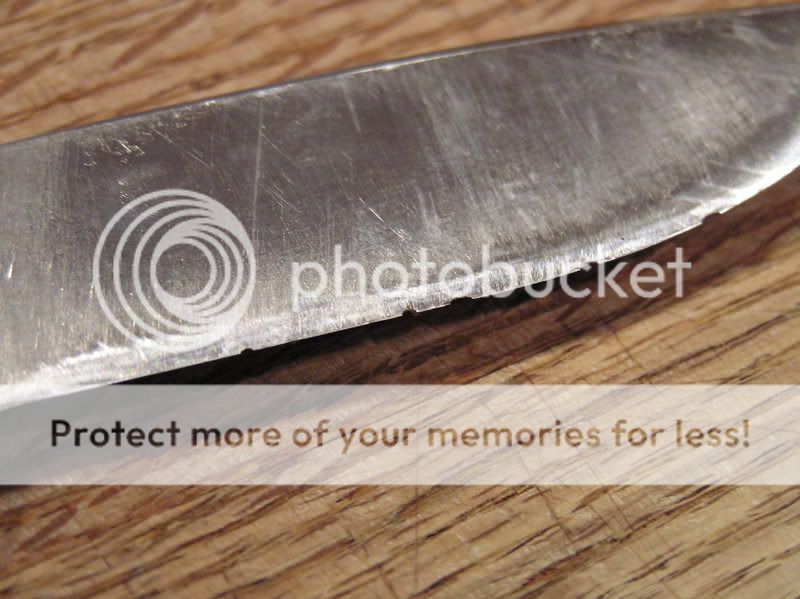
sodak, that looks more like rolling than chipping. It's hard to tell at this angle but if you can't see the grains then it's rolling, if you can then it's chipping. If it's rolling then O1 or 52100 would have the same issue, you can't really blame the steel but the heat treat.
 
sodak, that looks more like rolling than chipping. It's hard to tell at this angle but if you can't see the grains then it's rolling, if you can then it's chipping. If it's rolling then O1 or 52100 would have the same issue, you can't really blame the steel but the heat treat.
Or the guy who thinned it out too much... ;)
 
:thumbup:

Ahhhh..... an honest man!

Robert
Absolutely, 100% my fault. I wanted to find the limit, and I did.

I really have to agree with Ken44. I could have left the edge fairly thick from the factory. It would have held up to wood, and been ok. It would have also been a little harder to sharpen because of the thick bevel. But still not as strong as a fine grained steel for hard, twisting, carving cuts.

So when it's thinned out, it *really* shines. As does ZDP 189, CPM 10V, M2 HSS, etc. You thin those out, and give them a decent microbevel for edge protection, that is really where they shine. Especially when they are run at high RC's, they have the strength to support the edge, and the edge holding properties really shine. That also makes them more single purpose than a jack of all trades, but steels like 1095 are better at being a jack of all trades anyway.

As long as you understand the tradeoffs (and EVERYTHING is a tradeoff), you can get some screaming performance, and have a lot of fun doing it.


My experience with D2 is in the fine knives of Bob Dozier.

There is nothing I have used that holds and edge longer then D2, especially when cutting high abrasion materials (like mud caked boar hide).

The large carbides give it abrasion resistance but also resist sharpening; like others have stated, the right sharpening systems must be employed (i.e., diamond hones and/or power tools work best).

Those large carbides can also be chipped off the cutting edge if abused, making D2 a better choice for a dedicated slicer then for a chopper or hard use "survival" knife.

D2 is fairly corrosion resistant, shows almost no patina, but rust can get a foothold on/around those large carbides if the steel is left with contaminants on the surface. I don't like it around salt water for that reason.

By comparision A2 will patina in a heart beat, but it's fine grained nature helps it fight pitting when put up wet (though it will show rust more readily).


Just one knife users opinion.


Big Mike
 
Back
Top