
-
The BladeForums.com 2024 Traditional Knife is available! Price is $250 ea (shipped within CONUS).
Order here: https://www.bladeforums.com/help/2024-traditional/
You are using an out of date browser. It may not display this or other websites correctly.
You should upgrade or use an alternative browser.
You should upgrade or use an alternative browser.
Best Combat Knives Available Today?
- Thread starter drpolc
- Start date

- Joined
- Sep 19, 2011
- Messages
- 1,945
Anything Scrapyard.


- Joined
- May 23, 2004
- Messages
- 1,496
http://zombietools.net/tools/ third one down

- Joined
- Mar 5, 2011
- Messages
- 546
Hinderer fieldtac

- Joined
- May 15, 2011
- Messages
- 29
If you have an unlimited budget, Jay Fisher makes absolutely the best combat knives and sheaths today (figure an outlay of $2500 to $3500) -- http://www.jayfisher.com. In addition, he has his own special locking system for his sheaths. Anyone who reads that will say "how can you say his knives are the best" and the answer is pretty simple. He has a lot of talent and a lot of years in but more importantly, he has personally dealt with more individual military users over the years than any other knife maker I know, and received their ideas and feedback. A lot of his knives are art with stone handles, but his military knives are all serious business, not cut corners, and all combat tested by experts. Here are some of the reasons his knives exceed:
1) Better design, tested design, package includes specialized sheath
2) High quality materials -- including AISI 304 bolsters.
3) Front and rear bolsters -- you don't see that on a Chris Reeve or most of the other knives people are going to list as the best (a lot of knives have NO bolsters to make construction cheaper)
4) Many of his best models were designed by, for example, Delta force members then translated into workable knives by him.
If you want an affordable D-2 military grade bowie, not in his league but good for more general use from grunt through recon, I like my Hornet design:
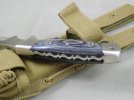
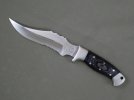
A combat knife is not a pure fighter, it needs to be a pry bar and digging tool as well as killing weapon so that means a full thick tang and a strong blade and nothing too fancy. I can respect Randall's saying they like a hidden tang to resist corrosion, but notice they also came out with a partially exposed tang on some of their combat knives. And I respect my Kizylar Spetznaz knife with its rat tail tang (but not as much as a full tang).
You also need to be able to choke up on it and hold it comfortably in a combat glove.
It needs to be relatively low maintenance, and durable. Even Cerakote will wear out, and if you take a high carbon rust bucket steel the edge would be exposed so one might argue you are better with a bead blast 440C or satin finish D-2 (D-2 at satin grade is pretty quiet if you are worried about reflectivity and D-2 is semi-stainless). The 440C variations tend to lean towards more rust, so take that into account. You want the scales to remain on forever, and the best way to do that is dovetailed bolsters and six to eight pins rather than double screws and a recessed no bolster pair of scales. You want hand protection -- need front bolster. You want to be able to smash something with the butt -- full tang and rear bolster. Once you add bolsters, a powder coat is more problematic for construction (bluing is still easy). You want to be able to baton from a number of directions so you need a flat area of spine and a spot to hammer on the butt with tang there. You want a handle shaped to the hand for better grip (lots of knives do this) and if you can customize to fit your hand or close, you want tactical front and rear bolsters.
From a fighting perspective, you need to be able to penetrate on a thrust, chop/slash, and easily flip to a reverse grip for close in work. For penetration, you need a strong tip still able to penetrate so once again you need to start with thick steel, design for support, and not be too bulky (unless you have a lower level of knife fighting training, then you can pretty much favor the belly over the tip since folks won't be using it as much). It is tough to beat a bowie tip for penetration. My testing has proven to me that a classical hunting bowie front does a better job penetrating than the typical straight line "military" bowie design. Weight and balance are also critical, and so is a really nice thumb rest of which there are about currently 4 good designs out there. Next, for chopping/slicing, again testing shows a well designed recurve kicks the blank out of a straight edge. Unfortunately it also means you need to have the skill and patience to resharpen a recurve, and a lot of folks are unwilling to do that because it is inconvenient. Balance needs to be outstanding so you can flip between front and reverse grip yet still have a strong slash/chop. Knife is ideally at least one inch longer than your opponents if you have a chance to draw it so if opponent has 6" knife m ay ou want 7" and if opponent has 7" you want 8". If you are unexpectedly defending, you may prefer a shorter knife so you can draw. Speaking of draw, you don't want any doo dads on the knife that get caught when you draw it. Finally, you don't want something that is too heavy to carry along with all your other gear.
Finally, a lot of folks want sawteeth and/or a glass breaker. OK, sawteeth really ruin the looks and you can't saw much but folks want them and it makes it tough for someone to grab your blade. Custom knife hand cut sawteeth can be far better than one-sided machine cut sawteeth (check out Jay Fisher's comments on sawteeth at his web-site, they are all true). The glass breaker is problematic because it can easily interefere with the flipping to a reverse grip quickly, and get in the way of your thumb on an ice pick grip. It isn't going to break the glass on an armored vehicle, but it could get a contractor out of a Toyota technical vehicle.
There are ways to minimize that but it is all a trade off.
1) Better design, tested design, package includes specialized sheath
2) High quality materials -- including AISI 304 bolsters.
3) Front and rear bolsters -- you don't see that on a Chris Reeve or most of the other knives people are going to list as the best (a lot of knives have NO bolsters to make construction cheaper)
4) Many of his best models were designed by, for example, Delta force members then translated into workable knives by him.
If you want an affordable D-2 military grade bowie, not in his league but good for more general use from grunt through recon, I like my Hornet design:
A combat knife is not a pure fighter, it needs to be a pry bar and digging tool as well as killing weapon so that means a full thick tang and a strong blade and nothing too fancy. I can respect Randall's saying they like a hidden tang to resist corrosion, but notice they also came out with a partially exposed tang on some of their combat knives. And I respect my Kizylar Spetznaz knife with its rat tail tang (but not as much as a full tang).
You also need to be able to choke up on it and hold it comfortably in a combat glove.
It needs to be relatively low maintenance, and durable. Even Cerakote will wear out, and if you take a high carbon rust bucket steel the edge would be exposed so one might argue you are better with a bead blast 440C or satin finish D-2 (D-2 at satin grade is pretty quiet if you are worried about reflectivity and D-2 is semi-stainless). The 440C variations tend to lean towards more rust, so take that into account. You want the scales to remain on forever, and the best way to do that is dovetailed bolsters and six to eight pins rather than double screws and a recessed no bolster pair of scales. You want hand protection -- need front bolster. You want to be able to smash something with the butt -- full tang and rear bolster. Once you add bolsters, a powder coat is more problematic for construction (bluing is still easy). You want to be able to baton from a number of directions so you need a flat area of spine and a spot to hammer on the butt with tang there. You want a handle shaped to the hand for better grip (lots of knives do this) and if you can customize to fit your hand or close, you want tactical front and rear bolsters.
From a fighting perspective, you need to be able to penetrate on a thrust, chop/slash, and easily flip to a reverse grip for close in work. For penetration, you need a strong tip still able to penetrate so once again you need to start with thick steel, design for support, and not be too bulky (unless you have a lower level of knife fighting training, then you can pretty much favor the belly over the tip since folks won't be using it as much). It is tough to beat a bowie tip for penetration. My testing has proven to me that a classical hunting bowie front does a better job penetrating than the typical straight line "military" bowie design. Weight and balance are also critical, and so is a really nice thumb rest of which there are about currently 4 good designs out there. Next, for chopping/slicing, again testing shows a well designed recurve kicks the blank out of a straight edge. Unfortunately it also means you need to have the skill and patience to resharpen a recurve, and a lot of folks are unwilling to do that because it is inconvenient. Balance needs to be outstanding so you can flip between front and reverse grip yet still have a strong slash/chop. Knife is ideally at least one inch longer than your opponents if you have a chance to draw it so if opponent has 6" knife m ay ou want 7" and if opponent has 7" you want 8". If you are unexpectedly defending, you may prefer a shorter knife so you can draw. Speaking of draw, you don't want any doo dads on the knife that get caught when you draw it. Finally, you don't want something that is too heavy to carry along with all your other gear.
Finally, a lot of folks want sawteeth and/or a glass breaker. OK, sawteeth really ruin the looks and you can't saw much but folks want them and it makes it tough for someone to grab your blade. Custom knife hand cut sawteeth can be far better than one-sided machine cut sawteeth (check out Jay Fisher's comments on sawteeth at his web-site, they are all true). The glass breaker is problematic because it can easily interefere with the flipping to a reverse grip quickly, and get in the way of your thumb on an ice pick grip. It isn't going to break the glass on an armored vehicle, but it could get a contractor out of a Toyota technical vehicle.
There are ways to minimize that but it is all a trade off.
Last edited:


In before someone says "multi-tool".
Whoops...
Despite what I posted earlier, in reference to high-end combat knives: it seems like almost everybody I know who has deployed recently says they are ISSUED a multitool, and they use this more than anything else. So, +1 to the MT idea.
However, I got the feeling the OP was asking more about a "combat" oriented knife (given the examples he listed), so I went that direction. I also just realized the OP was wanting to stay in the $150 range, and for that range, I agree with those who have posted about some of the good carbon steel blades out there. Personally I'd avoid most Gerber stuff. I like my old LMF 2, which is my beater knife, but they no longer make those with the good Sandvik stainless, and the serrations are a pain as well. So, under $150, I'd suggest:
* ESEE 4, 5, or 6
* Swamp Rat Ratmandu
* Scrap Yard 511
* Maybe one of the Ontario "Ranger" series, if you want to go even less expensive but still get good steel.

- Joined
- Aug 26, 2011
- Messages
- 1,007
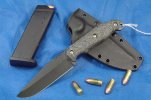
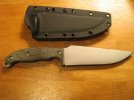
If you can spend around $250-375 check out Okuden knives such as the SST or Ammo Daddy, they are made by Brain Wagner who makes an amazing product and is the king of kydex sheaths too. Here's a pic of each model
SST
ammo daddy
Also check out Spartan knives which are in the $325 area and are made by all ex-SF guys, but as for production knives Gerber's LHR or LMFII are good, SOG has some decent stuff, Benchmade's Nimravus is a great one and again if you can spend the $200+ then put Grayman knives on the top of your list. Their stuff is truly battle proven(if you are actually deploying, this is your company)
SST
ammo daddy
Also check out Spartan knives which are in the $325 area and are made by all ex-SF guys, but as for production knives Gerber's LHR or LMFII are good, SOG has some decent stuff, Benchmade's Nimravus is a great one and again if you can spend the $200+ then put Grayman knives on the top of your list. Their stuff is truly battle proven(if you are actually deploying, this is your company)
- Joined
- Aug 4, 2009
- Messages
- 6,234
Very much a personal opinion, beyond a good high carbon with a good heat treat. Pick the design that you like and ask around if the maker is quality.