Best hardwood for large hard working knife scales

Joined
Dec 12, 2009
Messages
168
I plan on replacing my ugly micarta handle scales on my Swamp Rat Ratweiler and I am considering going with an exotic hardwood as I can do the work myself without the risk of inhaling epoxy dust. My blade color will be a satin metal finish and am toying with a some new scale ideas. I have always loved highly figured claro walnut but find it to be somewhat brittle or at least the pieces I received were. The handles will be mounted using torx screws. Any pics of some of your wood handles on your bare metal blades would be great.
 
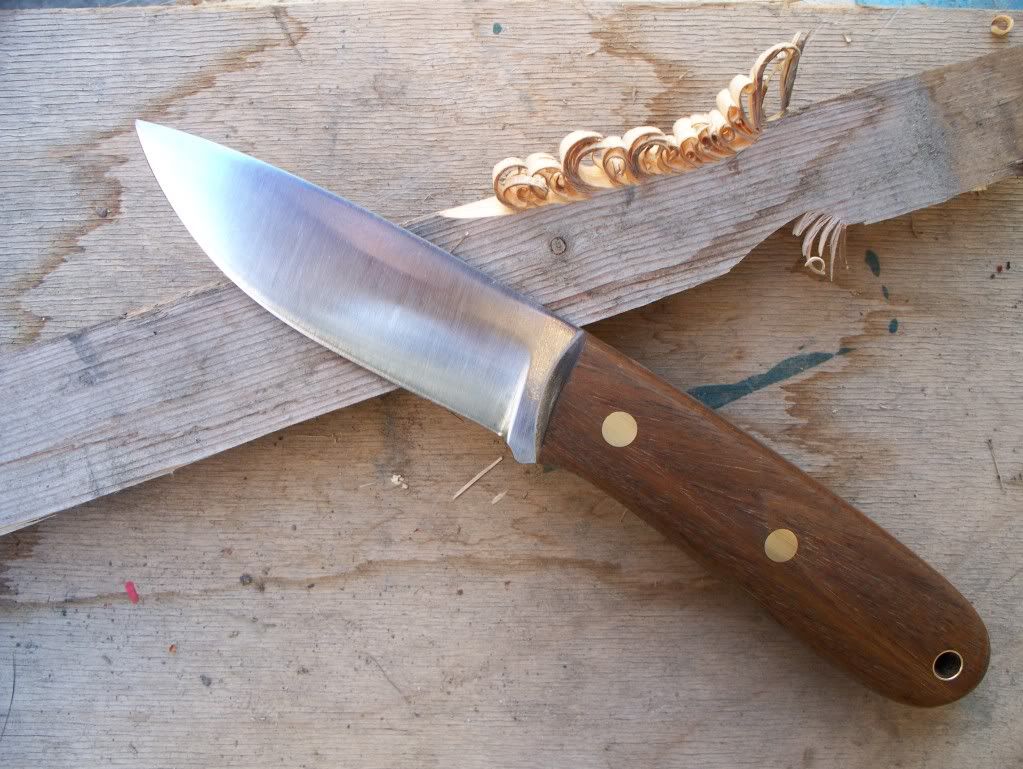
For the ultimate in tough wood, it would be hard to beat lignum vitae. I have some scales ready to use, but I don't have it on a knife yet. I made a knife (with Ray Laconico's help) and put Ipe on it, and Ipe is very hard and tough, too. It looks similar to black walnut:
100_1359.jpg


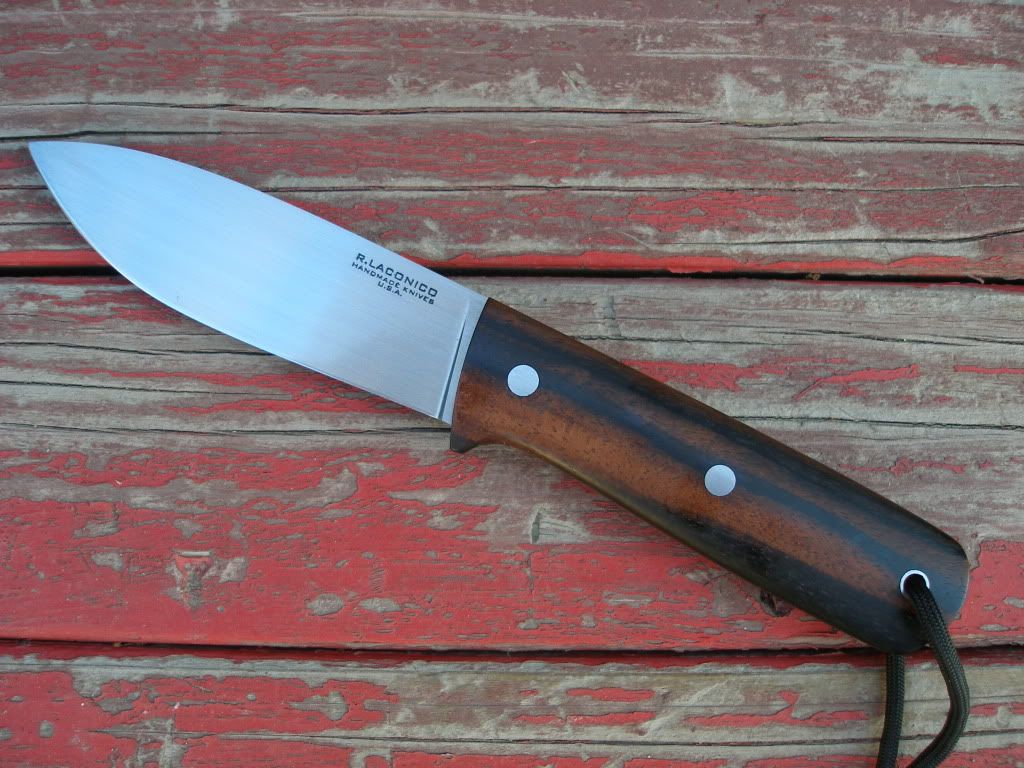
Other favorites, for which I do have examples, are Macassar ebony
11-1-09004.jpg


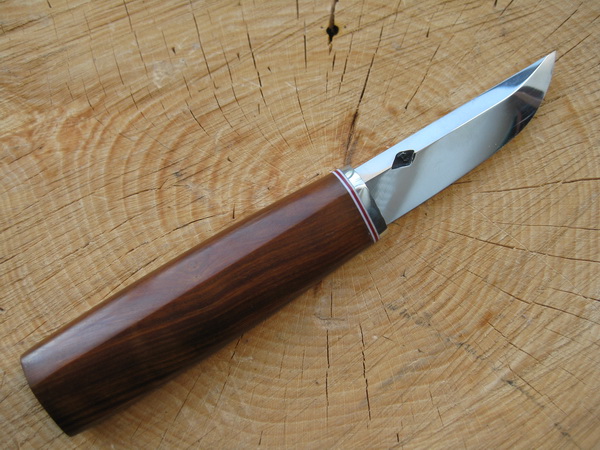
and bloodwood
11-21-09007.jpg


All of those are much harder than oak or cocobolo, and will stand up to a lot of use.
 
Lignum vitae. Just sand (800 or better) and buff. It has so much natural resin that it doesn't need any finish.

Ipe is pretty nice too. I made some scales for a Kershaw Chill. Finished with boiled linseed oil. It has held up very well. Much more available and cheaper than lignum vitae. It too will sink in water. I got a some ipe in the form of flooring scraps. It is also known as brazillian walnut. I think they now commercially grow it.

Osage orange. I haven't used any yet, but one of my carpenter friends said that it is hard and tough. It also looks nice. He gave me a couple of scraps to play with, so I'll see how it works.

i will agree with lambertiana, the lignum vitae is hard to beat and is probably the most durable.


Ric
 
Bois D'arc (Osage Orange) is a great hardwood for a working knife. There are some 100 yr. old fence posts on Texas ranches that stand as a testament to the toughness and durabilty of Bois D'arc.

B_1_SS_Osage_Orange.sized.jpg
 
As a cabinet builder and woodworker, I love teak. I have a shop full of 200yr old teak slabs that make wonderful scales. It's heavy, though. Definitely not suitable for a small blade.
 
Teak is less dense than ipe, lignum vitae, and ebony are. I have used purple heart for handles, too.
 
Lignum vitae is great for a knife handle. Cocobolo of course. Kingwood is very good in my opinion. Curly Bubinga is very nice too.
 
I'm pretty fond of cocobolo, although it's definitely not super dense. That being said, density isn't everything. The bloodwood I've worked with, while much harder (and therefore harder to work), was also a lot more brittle, and broke more easily. I haven't worked with the others, but I've been quite happy with cocobolo so far.

2012-01-27214323.jpg
 
Although not sexy as some of the woods mentioned, I have several old working knives that have commonly found woods that have held up great in work environments for decades.

I have several old (50+ yrs?) butcher knives that are handled with either white oak or hickory. The knives were used hard and cleaned daily all day long. And while the scales aren't as tight as they were, they are still quite serviceable. I also have a machete that was rehandled by a friend, and he purposely chose white oak as he knew it was the wood that was chosen to stand the elements years before we had great paints to protect wood. That machete has been through hell and the handles are terribly stained, but no worse for wear.

Remember, all the great woods we have available to us weren't to knife makers of the past. And they made out just fine with scales of untreated, unstabilized, hard woods that were available.

That being said, Bois D'arc (Osage Orange) is tough to beat. There is an semi pro knife maker that I see at the quarterly gun shows, and he loves the stuff. And yes, he does indeed harvest old fence posts from around here. He has used Ipe, but found it to splintery in the pieces he had.

I have a buddy that is a wood carver, and he used Live Oak to make mallets. Since that wood is so tough, he sells his mallets all over the states. It is known for its extreme toughness and solid grain.

Lots of good choices out there.

Robert
 
I have 2 Knight bowies with african blackwood that have done well but you don't get much pop their just black
 
I love the look and feel of Lig. Vit. but I hear it is hard to glue

In order the best wood handles I have in terms of durability are

Pheasant Wood
Sneezewood
Kingwood
Cocobolo
 
Pekka%25202.jpg


DSC04940.JPG


IMG_1921.JPG


+1 :thumbup: Lignum Vitae,it must be good if it's used for ships bearing ;),a bit on the heavy side though
 
black cherry. i used it on several things misshung some scales on a cleaver went to just smash it off with a hammer it took a surprising amount of hammering much less than black waln8ut.
 
This thread brings back memories. :)

My favorite is teak - I watched the deck of the USS Iowa being refurbished with new teak in Norfolk in 1986, and the last time a significant portion of the deck had been replaced was something like twenty years before.

But, my vote for the toughest wood is Lignum Vitae. If you've got the patience and the right equipment, I can't really imagine any other wood that's tougher. But be prepared - working LV is a chore. I thought teak was the toughest wood out there, until I was a purchaser for a cabinet shop in the early 90's. A local exotic hardwoods supplier brought me some rough-cut, non-kiln-dried Lignum samples. He told me that it didn't need to be finished with any kind of coating, just sanded and buffed. One block he brought me was about 8"x4"x2", and IIRC, it weighed almost three lbs.

It wrecks saw blades, coats saw blades and router bits with hardened resin when it gets hot, and the sales guy's suggestion was turn off the dust collection system, and have one of our guys stand next to the saw with a shop vac to vacuum the dust. Apparently the LV dust is so heavy it collects in various places in the dust system and causes problems later. And the !!@%!#$#*! splinters are little demon spikes from hell. One of our guys experimenting with it with a router found that out the hard way.

I asked the salesman what on God's earth this stuff was good for, and he told me that Lignum Vitae was used for shaft bearings in ship's propeller systems. With all the resin in it, it provided a lot of its own natural lubrication, and rarely wore out. I baked the large block the sales guy brought me in my oven for a couple hours, and ended up with a large (and nasty smelling) puddle in the pan afterward. I had to toss the pan, and the block still feels a little oily, 22 years later. Once I sanded and polished a section of it to 1000 grit, it felt like smooth porcelain.

Be careful. Some of the exotic hardwood sawdust is also hazardous to inhale.
THIS.^ IIRC, the sales guy actually brought paperwork similar to an MSDS (Material Safety Data Sheet) for Lignum and other species he brought samples for. Not sure if OSHA made suppliers do that, or if they did because they knew that respiratory issues some woods can cause.

I love the look and feel of Lig. Vit. but I hear it is hard to glue

The sales guy told us it had to be very dry to work it with glue, and not to bother. Mechanical fastening was the way to go - you just have to be creative to hide the joints. We had an Asian woodworking shop several blocks away from our plant, and they used bamboo dowels for joint connections with woods like LV.

Long-winded, I know, but I hope this helps.

~Chris

 
Last edited:
Back
Top