Best Time To Cut A Tree For The Burl?

DanF

Moderator
Knifemaker / Craftsman / Service Provider
Joined
Apr 17, 2017
Messages
1,673
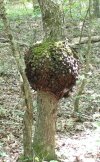
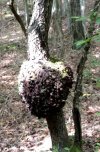
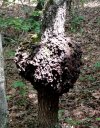
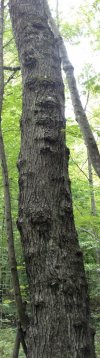
I have a cherry tree on my property, the trunk is roughly 8-10" in diameter and then it swells to 14-17" into a burl about three or four feet off the ground, and then resumes its original diameter of around 8-10" above he burl. First, I've never seen a burl so uniformly formed in a tree, the ones I've seen typically look like a growth coming out on one side or the other. I'll take pics before I cut it down.
What is the best time of year to harvest a tree to use for scales/handles? Would you want to wait until winter to let the sap "fall", or cut while it is in it's active stage?

I Know I won't be able to use this for some period of time (I've read a year for every inch of thickness of board/slab), but thought it would be neat to build a solar kiln and take something from harvest to knife.
Thanks,
 
Cut it in the winter ... around January. Cut it a good foot from the bourl part. Paint the cut ends and 6" up the sides on both ends. Set it aside in a place that gets good airflow, but out of the rain to dry. Let it dry a couple years and then cut the burl in half down the center to see what it looks like. From there you will decide how you want to cut it up. Cut large blocks/pieces and let them dry for a year, then cut into smaller blocks and dry another year. It should be ready to cut into slightly oversize handle blocks then. Cut the blocks and let sit for 6 months until the moisture content is below 10%. Have the handle blocks stabilized.
 
but thought it would be neat to build a solar kiln,

I'm no expert by any stretch of the imagination, and most all my experience is with maple, but trying to speed the process with a kiln is a bad idea, unless you are OK with a lot of checking and splitting.

From what I know, the only way to speed up the process is to move to Washington, west of the Cascades. I've been able to go from tree to usable blocks in about 15 months, but here's what I do. I cut the tree into rounds about 16+"/- thick and store them out of the sun and rain covered with sawdust for about 5-6 months. Then, if there's any checking or splitting, I cut this off and let them sit for another few months. Then I cut them into slightly oversized blocks and stack them on stickers to dry the rest of the way. This may cause a bit of waste and not maximize my yield, but the last tree and burl I cut gave me more than 500 usable blocks.
Here west of the Cascades, when I was cutting beams for a timber frame, I found that using Anchorseal TM to paint the end grain slowed the drying process so much that even after 5 years, the moisture content was still quite high.
 
Thanks Stacy and we. I'll take my time and do it right.
Dan
 
Sorry, that should have read weo.
 
I agree winter is best as well.

After I cut one down, I bring it inside for a few days until the surface dries a bit. (cutting it up into larger parts, or just leaving it as is. Then I glue the end grain of the wood, or all exposed surfaces, spray it with permethrin, and let it sit outside on a shelving unit under a tarp.
 
If the tree was grafted, the burl may have formed where where the bud stock was grafted to the root stock, which could explain why the burl is all the way around the trunk. But 3-4 feet off the ground seems a bit high for that. I'd check the burl with a metal detector before cutting it up, it could have formed due to a wrap of fence wire or something around the tree
 
When I was doing more wood turning I found out about a way to dry wood quickly without checking.
The method involved soaking the piece in alcohol and then wrapping in brown paper. By comparing before and after weights, I could estimate the degree of dryness without a gauge. For some reason the alcohol displacing the water in the cells, supports the cell walls as the wood dries.
This always worked very well for me for bowl blanks up to an inch or so thick. If you are interested, I'm sure a Google search will yield results.
 
I agree with the cut in winter advice. Helps to limit cracking.
If you post a photo we might be able to figure out if it is a true burl -vs- a bunion. A burl will have small points that are dormant shoots. A bunion tends to be swollen growth.
Burl will have eyes showing in the wood. Bunion will have swirly grain.
 
@Burl, that's interesting, never knew that. I'll try to trek back there this weekend and get a pic. If bunion, is it worthwhile?
 
@Burl, that's interesting, never knew that. I'll try to trek back there this weekend and get a pic. If bunion, is it worthwhile?

Beauty is in the eye of the beholder. If you like what you see when you open it, then you are good to go.
See the sprouts that burl source was talking about at the base of the tree?
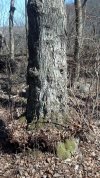
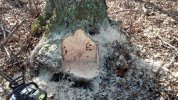
IMG_20170224_115716_617_zps3dg1ca8f.jpg IMG_20170224_122403_229_zpszfim56yw.jpg IMG_20170224_124022_198_zpsspqgekqx.jpg
I think this is the most beautiful wood I have ever seen, but again thats just my personal opinion.
 
Cut you tree in the winter time just before a black moon .When the moon is growing tree takes on water after the full moon the tree is pushing its water out so you wait till almost the end. You wood will dry out faster old people always watch that when they use to cut there wood for boat building around were I came from.
 
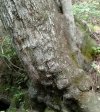
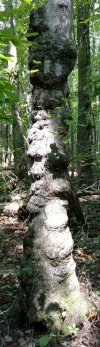
Just went onIMG_20170813_121854.jpg IMG_20170813_121854.jpg IMG_20170813_121804.jpg an interesting walk, found a good number of gnarly-looking trees. I don't have the expertise to determine which, if any would be likely candidates. Maybe the experienced folk could chime in on the pics. The first 3 are the wild cherry I mentioned from different angles, and the rest are maples
 

Attachments

  • IMG_20170813_121927.jpg
    IMG_20170813_121927.jpg
    504 KB · Views: 4
The two larger maples would give me some nice wood for solid wood furniture and the pieces would be large enough to show some interesting grain patterns but I'm not sure they would be suitable for knife scales/ handles.
 
The largest maple is 3'+ in diameter
 
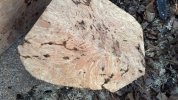
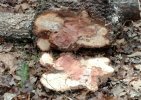
Post #13 shows the Cherry blister pre cut. Took it down today, now have to figure out how to get it 1/4 mile uphill to the house. The blister weighs in excess of 200 lbs. I can lift and walk off with my anvil and stand ( better than 170 lbs combined), but can't budge this big boy. Carved a little piece to peek inside.IMG_20180110_123045.jpg
 
Looks like some good burl.
You might want to cut the big piece in half so you can carry it.
I would suggest painting the cut surfaces with anchorseal or latex paint.
Then put it on a pallet and throw a tarp over it.
Later when you can use a bandsaw cut it into slabs then stack and sticker and let it dry a year or so.
 
Sounds good, I have to get it out before noon tomorrow, we are expecting two days of rain and if that happens I won't get across the creek for another week or so and I don't want to let it lay out that long.
 
THAT was fun (not)!
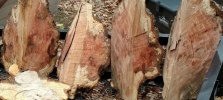
2.5 hrs to get it quartered and out. Had to quarter it because I could not throw 100-125 lbs. 25' across the creek. Pretty stuff, going back down to look at those maples now :).IMG_20180111_115530.jpg
 
Back
Top