Best way to convex a medium chopper

Joined
Jul 14, 2015
Messages
272
What is the best way to put a convex edge on a medium chopper.

The blade it 1/4in think and about 8" long.

I know I am going to do the sand paper on mouse pad, but not sure where to start.

Can I put the convex edge on this way? Or is that for sharpening only.

What grit sandpaper works best?

I looked and couldn't find anything on here!

Thanks for any advice!

VP
 
Flat grind to get it close then set the edge with a not quite so slack belt. I have found that starting on a rotary platen and maybe finishing on the slack belt but right up near the idler wheel works. if you want to know what "too much slack" looks like, go handle a couple of the new Zwilling Kramer Essentials kitchen knives and check out the spine. Most folks do not realize that when Bill Moran convexed his blades, he cut "facets" with big old emery wheel and then went back and blended with a belt grinder lengthwise. Kind of like Japanese sword "polishers" do with stones. He advised against doing it with a slack belt because it exaggerated the convex too much. I have no empirical evidence to prove this, but I suspect that may be how the "Arkansas School" method of doing a flat bevel with convexed edge came about.
 
Are you establishing the secondary bevel completely, or is there already an edge? A slackened belt on a a belt grinder would be quickest, but a mousepad will work too. That or any kind of flexible or radiused sanding block.

You can also get a convex just using a file or a stone, but it takes a little more technique, "rolling" the stone or file as you go.
 
Thanks all. I don't have a grinder and will have to look at the automotive sandingboard to see how that will work.
 
So you are going to try to take a 1/4" thick piece of steel down to a convex edge with sandpaper?
 
So you are going to try to take a 1/4" thick piece of steel down to a convex edge with sandpaper?

Nope. It has an edge on there now, and Ive read that the sandpaper method can help put a convex edge on blades. Not sure how well it works or even if it is a feasible thing to do. But I've read some people have great success doing convex edges this way.

If you have a better suggestion please share!

Thanks

VP
 
Just a misunderstanding, a mouse pad and sandpaper will work fine, a sanding board has a bit firmer rubber and will also work.
 
Just a misunderstanding, a mouse pad and sandpaper will work fine, a sanding board has a bit firmer rubber and will also work.

I'll have to check that one out will probably work better that the mouse pad anyways.

Thanks for the insight!

VP
 
The sandpaper and mousepad trick works really well to create a convex edge, but it takes patience and some trial and error to get a feel for it. Most of the time, I can get a pretty good convex edge simply by starting with 400 grit wet-or-dry paper, then going to 600 grit, then stropping on a leather strop with white rouge. This is my quick and dirty method, although I know other people like to use a much wider range of grits. And it does depend a bit on what blade steel you're dealing with. But this works for me.

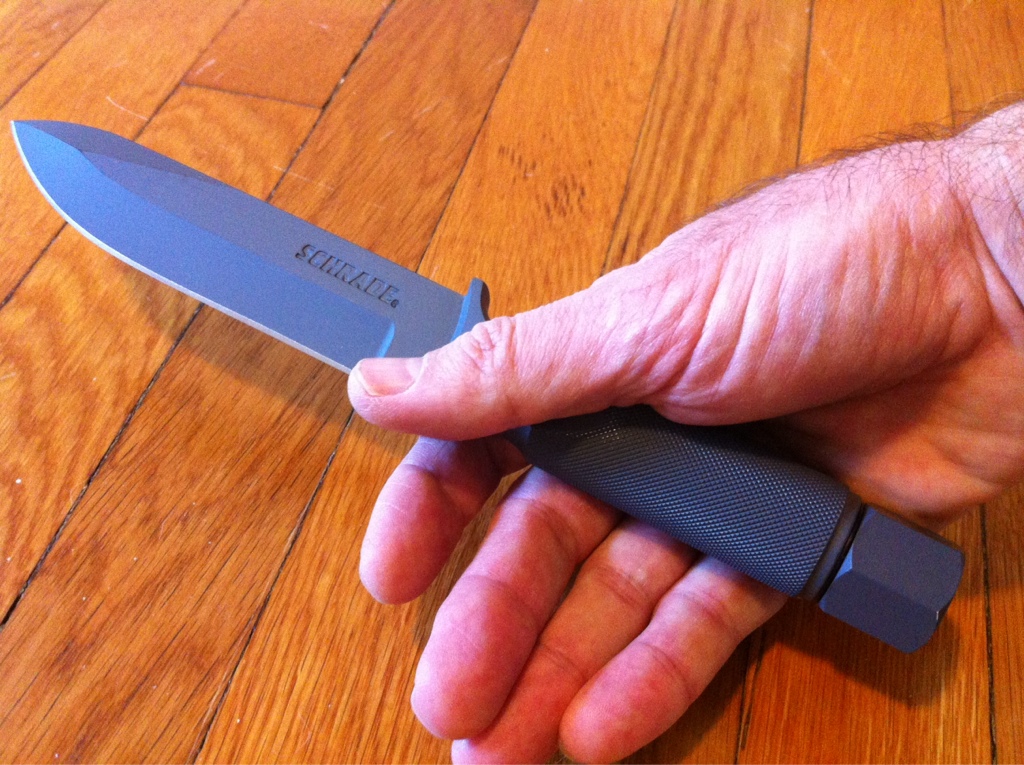
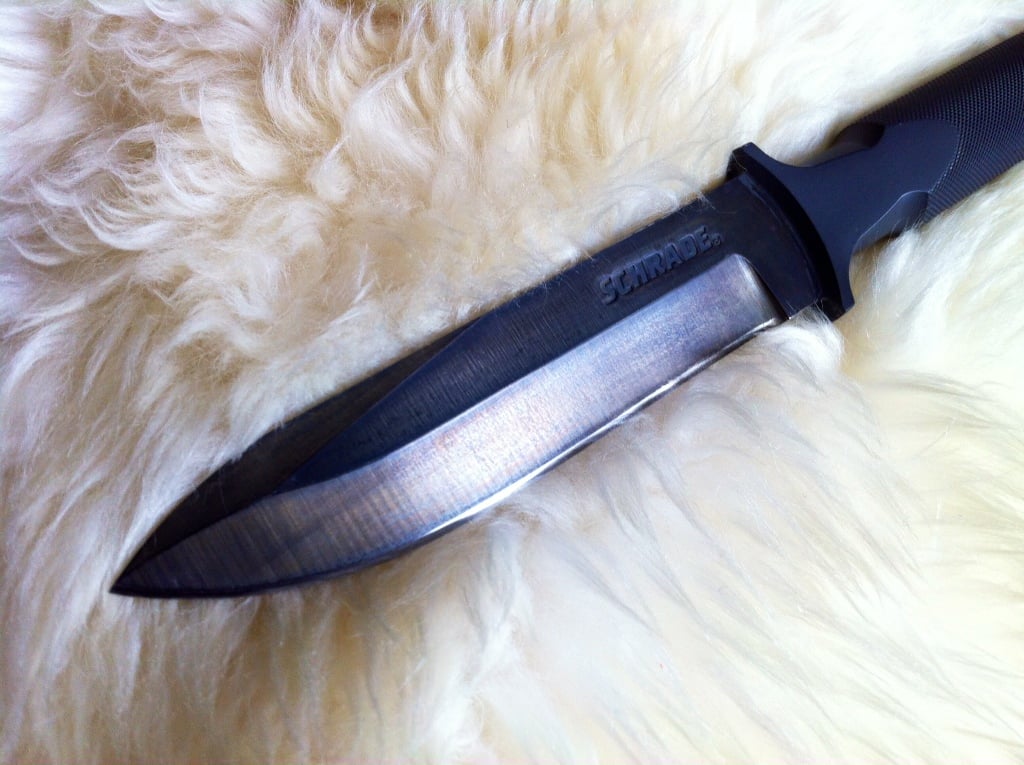
Sometimes more drastic measures are required. I recently put a convex edge on this relatively cheap Schrade "survival" knife. It came with a rather "fat" secondary bevel that made fine cuts almost impossible. There was a kind of square, fat shoulder where the secondary bevel began. I took that down by doing some hand work with a file. I tried to be very careful to only file down that "shoulder" and not touch the cutting edge itself. Then I did the mousepad method as described above. It now filets paper and shaves hair very nicely!

These aren't ideal comparison pictures, but anyway ---

Before:
8e0d04e87e150f1ad23dfcadd3e69e43.jpg


After (also showing fancy new white vinegar patina):
dfc345f50b01d013b30762db0445df5b.jpg
 
If you've got an old dished out carborundum stone kicking around, that and some Simple Green will move metal very quickly.
 
Back
Top