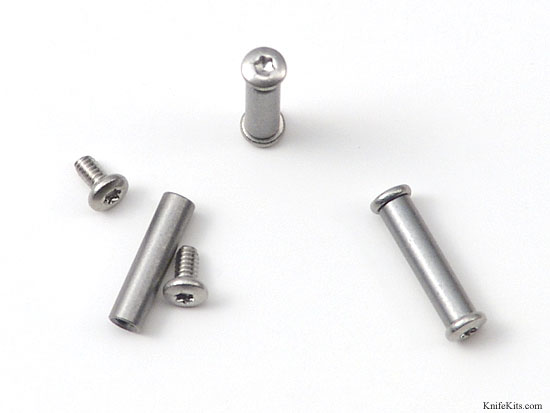
Best way to screw a folder together? HELP!

Joined
Oct 5, 2008
Messages
41
Hi all. I'm about to make my first folding knife. My question is: what is the best way to hold the knife together (using screws)? I don't have access to a lathe so I was hoping to buy some torx bits and pieces to get the job done.

The folder will be constructed with a stainless steel handle, and the sequence of materials is going to be: [SS handle side]-->[spring]<--[SS handle side].

I haven't picked out the handle material yet so I don't have a width, but the blade and spring material is 2.6mm thick if this helps. I guess the SS handle blanks will be no more than the thickness of the spring.

I was looking at knifekits.com and see that they have a few options there - can anyone recommend me a solution?

These are the pages I was looking at:

http://www.knifekits.com/vcom/index.php?cPath=60_91_243

http://www.knifekits.com/vcom/index.php?cPath=60_91_244

I don't mind making some modifications to the thicknesses of the screw bits and pieces in order to achieve a proper fit.

Any help would be appreciated.
 
I use there 256 torx button screws and for the stand offs I just make a titanium back spacer and tapp it.
 
I don't have a tap and die set so I was hoping to get away without having to do any of that. Am I hoping for too much? :( :confused:
 
How do I get them through the spring? I'm making a lockback so I will have 3 different pieces of metal to go through. The diagram on the website has the standoffs holding together only 2 different layers, whereas I want to fix together 3 layers (liner-spring-liner).

drawing_600.jpg
 
I've done a bit more digging, these look like they could be suitable - has anyone used these before?

http://www.knifekits.com/vcom/product_info.php?cPath=60_83&products_id=471

http://www.knifekits.com/vcom/product_info.php?cPath=60_83&products_id=467

http://www.knifekits.com/vcom/product_info.php?cPath=60_83&products_id=468

http://www.knifekits.com/vcom/product_info.php?cPath=60_83&products_id=893

I know they're listed as "pivots" but they should do the trick to hold 3 pieces of steel together where there will be no actual pivot points, especially if they're torx heads, right? That way I can use the same type on all areas I need to join (including where the main spring pivots and also on the pivot for the blade)...I think..:confused:
 
I wouldn't use pivots to screw the knife together. You drill oversize for standoffs and let them float between the two handles or you through drill one scale and the lock and tap the other side. A tap and drill set for your size isn't that expensive in the long run, you don't need a die. Just try not to break your taps :)
 
I wouldn't use pivots to screw the knife together.

Why? Obviously I haven't done this before so any explanations would be appreciated. :thumbup:

I would have thought that as long as the pivot barrel is snug in the hole that is drilled in the spring, that that plus the tension from the torx screws against the steel handle sides would be enough to hold the knife firmly together.

Something like this:

spb8th.jpg


Or am I over-complicating things? It is my first knife after all. Surely there must be a way to get these 3 pieces of metal to hold together without tapping?
 
You can just pivot the lock on a pin which the hole goes through the liners and not all the way though the handles. this was the pin is trapped between the liners. The pivot screw (at the blade) and spacers at the butt on the knife will hold it together. The lock does need to pivot.

the diagram you have is for a lock liner or some other type of lock which does not have the lock bar on the back of the knife.
 
I didn't check the links, but how much are those pivots costing you? $3 each? If you use three of them to put your knife together you're into it for the cost of a tap. If you use standoffs and screws you're getting the same deal without spending the extra money on a specialty item like a pivot. I'm not saying it wouldn't work, I'm just saying I would not use a pivot pin to put a knife together.
 
But my earlier point was that it seems the standoffs will not even work, the reason being because:

I have to join 3 piece of metal together. If I used a standoff (as per the earlier diagram I posted), I can only join 2 pieces together. I'm making a lockback and not a linerlock, so I need a hole drilled in the springs and end spacer, then I will need to keep them in place along with the stainless steel handle blanks on both sides.

So it will need to be:

[stainless steel handle]-->[spring]<--[stainless steel handle].

As the standoffs have the big "shoulders" on them with the thin middle part of the barrel, they don't seem right because I will have to drill a hole in the spring which is the OD of the standoff, but when I center the standoff it will have a heap of play in it because of the small middle section. Hence the reason why I thought the pivots could be the best option as they have a uniform diameter the whole way down the entire barrel section.

Seems at this stage like it could be easier to just hammer home some rivets, except I'd be stuffed if I needed to take the knife apart (which is likely as it is my first effort).
 
Sorry, I didn't understand what you meant by standoffs. When I think of standoffs, they are simply a threaded shaft that is uniform in size. They are very similar to a pivot pin, but they don't usually come with screws, sometimes are knurled instead of smooth and aren't held in quite the same tolerance.
 
If you go to drill and tap these yourself you need a way to hold the piece and the tap very straight and square to the hole. ANY side pressure or flex with a 2-56 tap and it will break. If you have a drill press with a vise, drill the hole then put the tap in the chuck and turn the chuck by hand. This will give you a good alignment and keep you square to the hole. Then move to the next hole. You need to be very careful with these real small taps. I learned the hard way. Jim
 
"Best way to screw a folder together? HELP!"

The best way, is to use a tap and thread the opposite liner or scale.

If you don't want to cut threads, just use pins.
 
Back
Top