- Joined
- Oct 28, 1999
- Messages
- 1,563
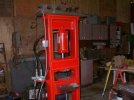
Here are some pics of the bevel dies that I made last night with the advice of Ron Claiborne.
They are mild steel...welded to plates that I preground to fit the press. I ground the die faces at just over 1/8" deep on the edge of the top and bottom die and carried the bevel on out to about 2.25" wide. I left the other side of the die flat for a reason which I will later describe.
First two pics of the dies:


I tested the dies with a 5/16" thick bar of 5160. Rather than forge in the tip I just chop sawed it for a quick test. With the bar good and hot I started the bevel just about the cutting edge and worked from tip to shoulder...maybe just 1/"4 up the edge and worked up from there to about 3/4 of the way up the bevel with subsequent heats. By "subsequent heats" I mean like 3 or 4....this is how fast it put the bevels in! Of course the tip will raise up but I gave it a few whacks with my wooden "schwocker" on the nose and then a few on the side to straighten it. I also found that the tip will drop a bit too by placing the tip onto the flat area of the dies and pressing in the distal taper.
Of course I could have taken the blade out to a thinner edge profile with the dies but this was just a test. Also...the edge will benefit in its geometry with some hand hammering too. But it made VERY short work in forging the blade.
Blade pics:


Lessons learned so far:
Would like to have used thinner stock for the bottom die but it perfectly matched my upper piece and saved me alot of work. Thinner material would have heated up quicker in use....the big die saps heat from the blade at a fast rate.
Heat a piece of scrap steel up and place it in the dies well before forging the blade to preheat them.
Keep the blade HOT HOT HOT....
I suspect that these might be an advantage in bevel forging Damascus blades because of the possible reduction in chance that you may shear a weld.
And last.. ALWAY WEAR SAFETY GLASSES around the grinder. When I was grinding the die faces the flourescent light above the grinder got to flickering so I reached up to tap it without looking....the 3 foot bulb fell out onto the top of the running KMG's belt and literally exploded into a million shards.....I felt them hit my safety glasses like a shotgun blast.
They are mild steel...welded to plates that I preground to fit the press. I ground the die faces at just over 1/8" deep on the edge of the top and bottom die and carried the bevel on out to about 2.25" wide. I left the other side of the die flat for a reason which I will later describe.
First two pics of the dies:
I tested the dies with a 5/16" thick bar of 5160. Rather than forge in the tip I just chop sawed it for a quick test. With the bar good and hot I started the bevel just about the cutting edge and worked from tip to shoulder...maybe just 1/"4 up the edge and worked up from there to about 3/4 of the way up the bevel with subsequent heats. By "subsequent heats" I mean like 3 or 4....this is how fast it put the bevels in! Of course the tip will raise up but I gave it a few whacks with my wooden "schwocker" on the nose and then a few on the side to straighten it. I also found that the tip will drop a bit too by placing the tip onto the flat area of the dies and pressing in the distal taper.
Of course I could have taken the blade out to a thinner edge profile with the dies but this was just a test. Also...the edge will benefit in its geometry with some hand hammering too. But it made VERY short work in forging the blade.
Blade pics:
Lessons learned so far:
Would like to have used thinner stock for the bottom die but it perfectly matched my upper piece and saved me alot of work. Thinner material would have heated up quicker in use....the big die saps heat from the blade at a fast rate.
Heat a piece of scrap steel up and place it in the dies well before forging the blade to preheat them.
Keep the blade HOT HOT HOT....
I suspect that these might be an advantage in bevel forging Damascus blades because of the possible reduction in chance that you may shear a weld.
And last.. ALWAY WEAR SAFETY GLASSES around the grinder. When I was grinding the die faces the flourescent light above the grinder got to flickering so I reached up to tap it without looking....the 3 foot bulb fell out onto the top of the running KMG's belt and literally exploded into a million shards.....I felt them hit my safety glasses like a shotgun blast.