
Bevels ....what am I doing wrong?

Joined
Jul 29, 2009
Messages
1,724
Hey guys, I need help. I'm new to knife making, I'm using a Craftsman 2x42 with glass platen. Started out grinding small blades and after about 10 of them I decided to try a 5.5" blade using 3/16" stock.
Now I consider myself artistic, with good attention to detail and steady hands, ...but my grind lines look pretty terrible! Kind of wavy, and I keep getting the divot exactly one belt width from the plunge. Now I know, I know, practice practice and more practice.... but I'd like to get some advice on what exactly I'm doing wrong so that I can better know how to correct myself.

So, on this knife I scribed a center line on the edge side of the blade and started grinding my way back towards the spine. I noticed that the edge at the "belly" or curve of the blade near the tip keeps getting thinner and thinner, while the edge at the tip and near the plunge are staying way thick. But I kept going and did my best, making it a full flat grind.

After I got it looking the best I could, I decided to try my hand at adding a swedge grind to the tip/spine. So I thought I'd go ahead and scribe a center line on the spine.... that's when I noticed this:
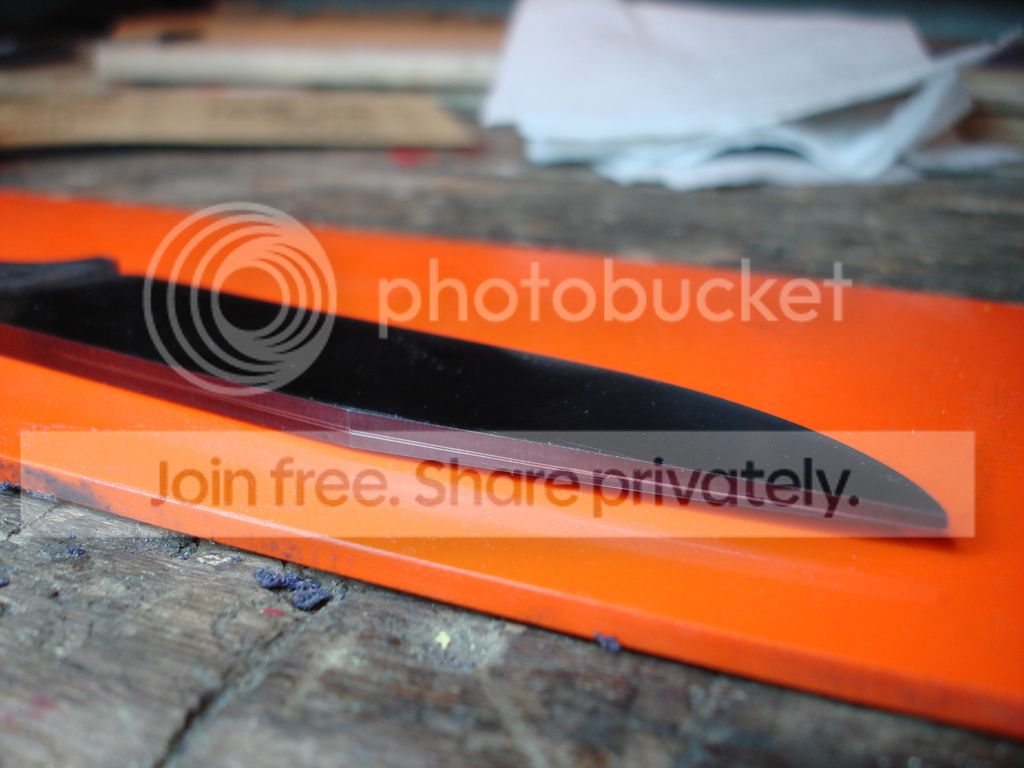



...As you can see, even though I was careful to keep the grind centered at the edge side of the blade, it is all way off center at the spine.
So much so that when I lay the blade flat, you can see that one side of the tip almost lays flat, while the other side is raised up quite a bit....




Also, as I mentioned, the "belly" portion of the edge is super thin compared to the rest of the edge. ??

Any thoughts?

I've been trying to find how-to's on how to grind the tip portion of blades, but I can't find anything. I don't really know how I *should* be doing it? Keeping the blade completely flat, (like it's in a jig) doesn't seem to work for the tip? Unless I'm missing something? So do you angle the blade as you grind the tip area or what?
And if so, which way should it be angled? Like the tip goes up the belt, or tip goes into the belt? If that even makes sense?

Video would be great, as this is sort of hard to explain with words, but I'm having no luck finding videos that specifically address this.
All the vids I watch go something like: "Start your grind like this!" then the video skips ahead and they hold up a fully ground blade with perfect grind lines....?


edit: -Forgot to mention that I was using a "Bubble Jig" for the first time with this knife. So, supposedly I was at least holding the blade at a pretty constant angle.
 
Last edited:
I noticed that the edge at the "belly" or curve of the blade near the tip keeps getting thinner and thinner, while the edge at the tip and near the plunge are staying way thick.

When you get to this point you need to stop grinding on the thin area and work on bringing the other areas to the same level. The divot is because you're likely stopping there or applying an increase in pressure.

You have to be consistent. How you're holding the knife(as in all angles), pressure applied throughout the pass, how long you're dwelling in one spot, etc.

As far as how to work the tip, you'll see guys using all the methods you described. Depends on your style and what you want the end result to be. For a full flat grind most guys will hold the blade level throughout the pass- note that this is easier said than done in the beginning.

By your picture, your knife is NOT way thick at the tip as you described in words, you blew past your scribe line, meaning you're way thin.

Remember that you cannot put material back on, when you are too thin in an area, grinding it more won't fix that.

Have a pic of the edge scribe?
 
When you get to this point you need to stop grinding on the thin area and work on bringing the other areas to the same level. The divot is because you're likely stopping there or applying an increase in pressure.

Hhmmm... I tried, but I'm not sure how to go about evening out the thick areas without touching the thin part? If I just focus on grinding one part of the blade won't I make it uneven?


By your picture, your knife is NOT way thick at the tip as you described in words, you blew past your scribe line, meaning you're way thin.

Tried taking a pic just now, but I can't get my camera to focus! Though I can say that at the EDGE side of the blade the grinds were almost perfectly centered. And by way thick, I mean that the tip was over twice as thick as the belly portion of the edge.

I think that somehow when trying to thin the tip out I must have been grinding toward the spine on one side without realizing it? Or something, ...I don't know?
 
Yea, it would be nice to see pics the edge side showing the scribed lines.

Hhmmm... I tried, but I'm not sure how to go about evening out the thick areas without touching the thin part? If I just focus on grinding one part of the blade won't I make it uneven?

In order to grind the part of the edge that is thicker (not as close to the scribed center line) without grinding more away from the thinner part (closer to, or at the scribed center line) you DO NOT want to lay the bevel flat against the platen so that it is all making contact with the belt.

Instead you want to cant the blade at an angle, so that only the thicker area is being ground and not the thinner portion. For example, if the edge is thicker right at the plunge line (ricasso) than it is about two inches further down the bevel, slightly cant the blade so the tip of the blade is further away from the belt, and so the plunge cut area is only touching.

The easiest way to fix this issue when you are just learning how to grind, is to not have it. The best way to do this is to first grind both sides of the blade to the scribed center line(s) at a steep angle, like 45 degrees, so it looks as if you are grinding a short scandi grind on the blade.

Then once you have both sides ground to the lines, use that as you refference point and make sure NOT to take away anymore material from the edge. Just continue walking the bevel up the blade by gradually tilting the spine of the blade closer to the platen, thus raising the grind height.

I think that somehow when trying to thin the tip out I must have been grinding toward the spine on one side without realizing it? Or something, ...I don't know?

As for this issue, what you did on that blade was essentially you ground in a "distal taper" on only one side of the blade. You did basically just as you described above. On the one side (the side where there is a larger gap between the tip and the flat table) while you were grinding, you were twisting the blade as you got closer to the tip, I use to do that all the time on accident, still do sometimes lol. It helps to scribe the center lines on the spine as well before you start grinding, so that you can keep track of the amount you are grinding off the spine side. Just try not to put extra pressure on the blade/spine when you reach that area as you are making you pass on the grinder.

As for the grinding mark that is 2 inches away from your plunge line, that is happening because you are spending too much time there when making contact with the belt, its a mistake everybody makes when they first start grinding, it's called "2 inch-itis" lol. A good way to avoid that is to not make your first contact with then belt right at the plunge, but instead make grinder contact using light pressure about a half inch away from the plunge cut, then "slide" the blade in reverse so the belt goes back into the plunge, and then make you normal grinding pass. This technique has helped me out a ton with my 2 inch-itis, and many others as well!

Hope this makes sense and helps a bit, if not just let me know which part you still don't understand and I, or somebody else much smarter and better at grinding than I am will pitch in :D

~Paul

My YT Channel Lsubslimed
 
Last edited:
You let the blade rotate in your hand as you worked the clip; probably in opposite directions depending on which side you were grinding. I usually do this intentionally to create distal taper, the angle gets steeper as I get closer to the tip. It is all about control and there are a lot of axes to be in control of. When I'm grinding, I can see my scribe line so that's the easy part. I concentrate on where the belt is coming off the blade. I try to visualize the line (or arc) of the belt and its' entire path through the steel. Like you said, practice, practice, practice. I once (not really that long ago) posted a thread asking how many blades it generally took to become competent in grinding. The consensus seemed to be around fifty blades. I cheated and got some very good help in learning to grind; it still took about fifty blades to really start to feel and understand what is going on.

Bob
 
Coldsteelburns, and RangerBob, yeah that all makes sense. Thanks for the tips!
I'm also going to keep looking for videos that show others grinding technique, and just keep practicing I guess.
 
Its possible that some of the offset is actually warpage. Is the original scribe line on the edge side still parallel to the table when you lay it flat?
It looks like you are trying to grind it with even, full-length passes. This is the proper technique for smoothing and finishing a bevel, but dosent always work for tuning the edge thickness. Learning to grind in sections and then blend them into the rest of the bevel is also an important skill, as well as tilting the blade slightly so you can grind more at one edge of the belt when needed, as already mentioned. I pull very slightly away from the belt at the opposite side when grinding at the plunge, this helps keep the edge thickness consistent into the choil area and helps avoid that line forming 2" out from the plunge.
 
It's possible to get warpage from trying to grind one side fully instead of switching from side to side.
 
Its possible that some of the offset is actually warpage. Is the original scribe line on the edge side still parallel to the table when you lay it flat?
It's possible to get warpage from trying to grind one side fully instead of switching from side to side.

I did make sure the blank wasn't warped *before* I started the bevels, I'll have to check the edge side again by re-scribing it when I get home, as I had already sanded off the original edge center scribe before I snapped those pics above.
Mael, I did switch from side to side as I was grinding, (and hand sanding).

It looks like you are trying to grind it with even, full-length passes. This is the proper technique for smoothing and finishing a bevel, but dosent always work for tuning the edge thickness. Learning to grind in sections and then blend them into the rest of the bevel is also an important skill, as well as tilting the blade slightly so you can grind more at one edge of the belt when needed, as already mentioned. I pull very slightly away from the belt at the opposite side when grinding at the plunge, this helps keep the edge thickness consistent into the choil area and helps avoid that line forming 2" out from the plunge.

You are correct, I was trying to stay with "even, full-length passes" , I thought that was how it was supposed to be done!? Good to know that I can/should try some varying pressure and angles when creating the grind and edge thickness!

Thanks for the advice guys!
 
Back
Top