Big thumbs up to 15n20

I sold a 15n20 Chef's knife to a full time Chef who also makes knives... he told me the edge retention is the best of anything he owns including exotic and high end alloys. It has only been stropped over several years of use!
 
I sold a 15n20 Chef's knife to a full time Chef who also makes knives... he told me the edge retention is the best of anything he owns including exotic and high end alloys. It has only been stropped over several years of use!

Impressive... Do you remember your heat treat? Curious about how hard you left it.
 
Everyone is a little surprised that 15n20 is my most used and favorite steel. I had one else guy ask why I used "that Damascus filler crap". It's just a great, finew grained steel that I can HT easily at home without much worry, and the price point is low we nought I can do many test coupons to hone in my treatment.
 
I sold a 15n20 Chef's knife to a full time Chef who also makes knives... he told me the edge retention is the best of anything he owns including exotic and high end alloys. It has only been stropped over several years of use!

I sold one to a line chef about a year and a half or two years ago. 8h per day, every day. Needed a light touch up after 6 months. Just strops it every so often. It's like a non stainless aeb-l. People are shocked with how well such a simple low alloy steel performs. He emailed me after he nearly cut his finger off through his protective glove at the end of a shift after using it for about a year.
 
When Voestalpine Strip started shipping the thick AEB-L, either Chuck or the VP or Sale from the company said that with the new strip mill in Austria, they also had the capability to roll 15N20 to the same 5mm thickness as the AEB-L. Has anyone heard anything more about that?
 
This has got me thinking about forge welding 3 .09 sheets together. never know, if it works out I might toss a few in the for sale section.
 
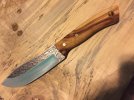
Some stock thicker than 1/8" truly would be nice. Here is one in 15n20 that I am close to having finished up. It definitely is a great steel to work with and use.
image.jpg
 
Last edited:
Well I tested the blade to failure today.

I started with splitting a dime. No problem and not even a dent in the edge.
Photo%20Oct%2007%2C%203%2059%2021%20PM.jpg


Photo%20Oct%2007%2C%203%2059%2049%20PM.jpg


Photo%20Oct%2007%2C%204%2000%2005%20PM.jpg


Then I thought let's try some mild steel .125 thick angle iron. I really went at it with the hammer to see what it would do. The edge did degrade and roll but no chipping, shocked.
Photo%20Oct%2007%2C%204%2003%2052%20PM.jpg


Photo%20Oct%2007%2C%204%2004%2026%20PM.jpg


So then I thought let's try a bend test. And I was surprised I as able to snap it without to much effort which really shows its hardness. The grain looks nice and find and you can see actually how thin the profile is. The spine of that knife is like .065 thick.
Photo%20Oct%2007%2C%204%2005%2057%20PM.jpg


So yet agian I am left impressed with the results. I have tested 5160 with these same tests and when real thin like this it chips out rather bad at any high hardness.
 
I've been using 15N20 for kitchen knives and smaller carry knives for some time, and have been very impressed with the performance. The fact that you can get it in thin sections makes it even better.
 
I was thinking about the cost of steel for say a lightweight 1/8 bushcraft knife because the stuff I wanted to compare is all avalibel in that thickness. O1 has been the go to for bushcraft blades for a lot of folks, but now you see some people using 1095. My guess is that is a cost issue for some. You also see A2 used quite a bit. So I decided to price out these common bushcraft knife steels plus AEB-L and 15N20 using Aldo's prices. The numbers were interesting. I used a .125-.130 piece that is 1.5 wide x 9 long as a "baseline". The numbers that I came up with were $6 for mill finish O-1 and $9.50 if you wanted the decarb ground off. The ground O1 was the most expensive steel and the only one where you had the option of grinding. Much of what I have seen people use has been PG O1 stock which might typically cost more. 1095 was the cheapest at $3.50. What was interesting is that the strip steels with their nice smooth finish were cheaper than the tool steels. AEB-L was $6.50 and 15N20 was $5.50. That really made me think that thicker 15N20 stock would be a really good lower cost option for inexpensive user knives and in addition, it is arguably the one steel of those 5 that really doesn't require very sophisticated heat treatment equipment. I think that the thicker stock could be a good seller.
 
I asked Aldo about the option of thicker stock a while back, and he said the 80CRV2 fit the roll of a tough workhorse steel, and is available in multiple thicknesses. I recently bought some 80CRV2 for some machetes, but would have preferred 15n20, just because I'm pretty familiar with it and have a dialed heat treat. I'll probably start stack welding some 15n20 once I get around to finishing my press.
 
The 80CrV2 is actually about 50 cents more for that baseline piece than 15N20, but certainly in the same neighborhood.
I asked Aldo about the option of thicker stock a while back, and he said the 80CRV2 fit the roll of a tough workhorse steel, and is available in multiple thicknesses. I recently bought some 80CRV2 for some machetes, but would have preferred 15n20, just because I'm pretty familiar with it and have a dialed heat treat. I'll probably start stack welding some 15n20 once I get around to finishing my press.
 
The 80CrV2 is actually about 50 cents more for that baseline piece than 15N20, but certainly in the same neighborhood.

I'm sure the machetes in 80CRV2 will be fine. I just KNOW a machete at Rc60 in 15n20 would be perfect. I'm just going to follow the aks guidelines for heat treat.
 
The only thing that I don't know about the 80CrV2/1080+/L2 daily is whether or not they can take the very fine stable edge that some of the other steels that we have been talking about can? it seems like that May be a difference between high hardness 15N20 and some other tough steels. What we do know is that Dan Winkler found 80CrV2 to be an good substitute for both 5160 and 52100 in the Winkler II line.
 
I saw the voestalpine guy at a hammer-in this summer and he said they could get it in .230". He is checking on a price for me now. Didn't seem like something they have on hand all the time, and there is a four hundred dollar minimum.
 
Back
Top