Binoculars?

I have a pair of Brunton 7x42 binoculars that I got for my birthday in 1985. They've gone just about everywhere with me and have stood up quite well (I have not treated them delicately). This is a good size for my uses -- small and light enough not to be a burden but with enough light-gathering ability that I can use them for occasional star-gazing.

I don't know if Brunton's product has the quality today that it had back then, but it seems worth checking out.
 
I'll stay away from recomending brands but offer some advice on the specs. 7 or 8 power is probably best. Go for at least 300 foot field of view at 1000 yards. 32 to 40 mm objective lenses will gather plenty of light without being too heavy (although that may be too big if you want compact binos).

It is wise to handle them before buying. Check the close focusing - if you want to observe butterflies you will want to be able to focus within 8 feet or so (although the ability to focus on your own feet is best - there is nothing worse than constantly backpedaling to put your subject into focus). :) Check the action on the focus wheel (and stay away from those focus lever things) - you want to be able to focus from one extreme to the other without an excessive amount of turning the wheel. I wouldn't buy any that require more than one turn.

Stay away from "no focus" and "zoom" binos.
 
Check out the "Barska" brand that Cabelas offers. I bought a pair for my birdwatching momma so she could retire her 1981 vintage Tasco Triplevisonmigraineinducers. The price is cheap and the clarity of view equals that of my Zeiss 10X40 BGAT.:thumbup: :thumbup: :thumbup:
 
I think you should get a pair of Nikon Monarchs in 8x42. These are well within your price range (under $300), are fully waterproof, fogproof, shockproof, have excellent brightness, clarity and field of view and are fairly compact and light considering their power.

They are very highly regarded by birdwatchers, the binocular 'experts'. For example, they ranked number 2 in the Cornell Ornithology Lab's comprehensive test of binocs. See here:

http://www.birds.cornell.edu/Publications/LivingBird/winter2005/Age_Binos.html

Have a look here for another review:

http://binoculars.org/birding/Reviews/Nikon/MonarchATB8x42.htm
 
My vote is for Steiners! I have an M22 7x50 military surplus set (new in the box) that I got for an awesome price off e-Pay, but the quality is top notch. They make other bino's with lower prices too. Don't be afraid to check them out.
 
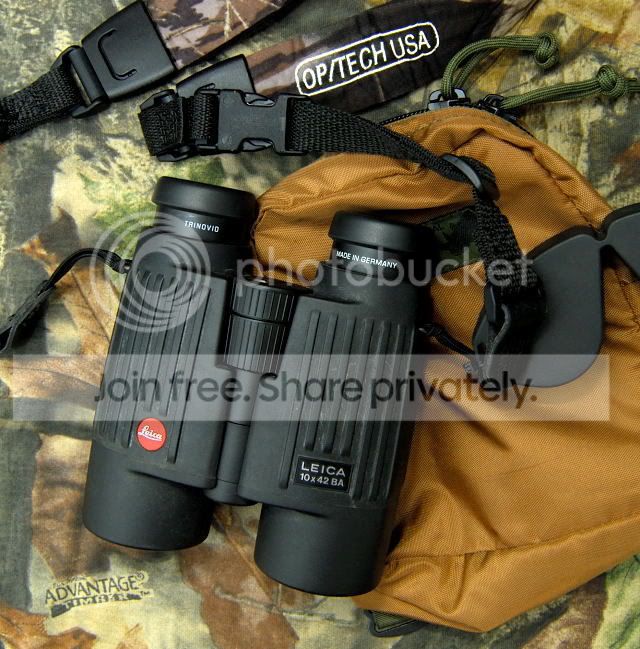
There could be some great deals on the used markets. I got this used Leica several years ago and it has served well. It can handle dust, mud and pouring rain, and the optical quality is great. I wish I had gotten an 8X, because 10x is just too much for me...

LeicaBino.jpg
 
I have a pair of Steiner 10X50 Police Model. I like the "always in focus" feature. I just wish that they came with a case.

FWIW

Ciao
Ron
:D
 
For hiking and hunting, if money doesn't matter get either a

Zeiss 8x50 Conquest.
or Leica Trinovid 8x50 BA

Both are out of this world as far as clarity and craftsmanship is concerned.

If money matters get a
Steiner Merlin 8x42
or a Steiner 7x50

If money matters a lot look at the Nikons.


If you look through a Zeiss at dusk or dawn once you know what I mean.
 
Just a thought, monoculars work for some people, like me! I have a weak and don't really use my left eye anyway (unless I have completely shut the right one). No use in carrying around the extra weight for me.

Yeah, the $1000 is better than a $500 set of binos, in much the same way as a custom 300 wsm bolt action is far superior to used 30/30 lever. Or a ferrari is far superior to a Chevy truck. But most of the time a 30/30 or an old Chevy works well enough.
 
I've been very pleased with the Nikon 10x25 lightweight field glasses I've had for a few years.I admit that I wouldn't like to use them in a total downpour(would you see much anyway??)but their lightweight and compact size means you can walk for hours without them burdening you and they are fast to deploy.
Other posters have gone on about 1200 dollar binoculars being so much better but I remain sceptical.That's a lot of money to expend on something that could get lost or broken and ARE they so much better or is it the intoxication of price?
 
Just a thought, monoculars work for some people, like me! I have a weak and don't really use my left eye anyway (unless I have completely shut the right one). No use in carrying around the extra weight for me.

Yeah, the $1000 is better than a $500 set of binos, in much the same way as a custom 300 wsm bolt action is far superior to used 30/30 lever. Or a ferrari is far superior to a Chevy truck. But most of the time a 30/30 or an old Chevy works well enough.

I suspect the Chevrolet truck breaks down a great deal less than the Ferrari wonder-car:D

Monoculars are a good call:thumbup: Wonder why they aren't more popular?
 
Binoculars have been a lifelong interest for me.

It would be innapropriate to give a tutorial here about how they work. Many of the other posters have touched on some of the key points and given good info.

I believe you stated that compactness and light weight were important and performance in low light was only a small factor. Therefore, I would recommend either an 8X20 or 10X25 binocular. Both have 2&1/2 mm exit pupils which is about the same size as most people's eye pupils on a sunny day.

These are the lightest and smallest with 8X20 holding top honors. 10X25 is still light and compact but with 20 percent more magnification. That means hand tremor (which is not normally noticeable) will be magnified also.

Taking a guess from your post, you will usually not be using your binocs for any prolonged and continuous viewing. So, if your hand is pretty steady, I would recommend the 10X25s.

Which brand to choose is subjective but only down to a certain point in diminishing quality. Generally, the better makers make either 8X20s or 10X25s smaller but not necessarily lighter weight than the lesser brands. Not only that but the better ones will usually be weather proof, more durable and give a much clearer, brighter view in any magnification or lens diameter.

I recommend spending the money and getting Zeiss, Leica, Swarovski. They are among the best. Steiner, in my opinion is a notch down but still excellent. I would trust Nikon's top models and Pentax is supposed to give a good bang for buck. I would also trust Cabela's.

I agree totally with everyone who said that with binocs, you generally get what you pay for.

Roof prism binocs will be the lightest and most compact.

 
There has been some awsome advice on this thread. I want to thank each and everyone of you. At this point, I still have no idea what to do simply because I can't translate your advice into a tangible understanding of binoculars from a price/performance/weight ratio. I think I really need to get to a store and actually handle a few of them.

I'm also now intregued by monoculars. For hiking and casual wildlife usage, that actually might be the best of all possible worlds.

Thanks again for the advice.
 
Just my own opinion, based on experience, but I would not recommend a monocular. Yes, they are more than half lighter, smaller and cheaper. But if you want to really see what you are looking at, you need binocs.

The brain evolved to process visual information through binocular vision and viewing through only one eye is a big compromise.

A monocular would be good for distant flag recognition or vehicle identification, for example. But for a quality view, binocs much better.
 
While you lose it at great distance anyway, using a monocular abolishes any chance of depth perception. Depth perception requires two objectives and the greater the distance between them, the better the depth perception at longer ranges. One more thing to consider if looking into monoculars.
 
While you lose it at great distance anyway, using a monocular abolishes any chance of depth perception. Depth perception requires two objectives and the greater the distance between them, the better the depth perception at longer ranges. One more thing to consider if looking into monoculars.

Yes. Conventional Porro prism design actually widens the interocular distance at the objective lens, making depth perception better than the human eye(s). A big Porro prism binocular will give good depth perception from the closest focus out to maybe a couple hundered feet. In my experience, depth perception becomes negligable at really long ranges because the twin lines of viewing become more nearly parallel as distance lengthens.

Most roof prism designs give less depth perception than Porros because the design places the lenses closer together. But roof prism binocs are so much more compact and lighter than the Porro binocs of the same power and light gathering ability.

But beyond the absence of depth perception, a good monocular is just a prism loaded, compact version of the old time, hand held telescope (Aye me hearty). It is good for detail identification but a strain to use for more than a short time. Trying to get absorbed in the subject becomes difficult. Observing a bird for more than 5 minutes, through a monocular would be hard for most people.
 
Go to a place like Bass Pro, Cabelas, Sportsman Warehouse and look at lots of different binoculars. Spend some time and then buy something. I love my Nikon 8x42 Monarch's. There are better binoculars around, but these are great for the price and very user friendly. If you want something smaller or more compact, really look them over. I keep a small pair of Nikons tucked in my fishing vest for wildlife opportunites.
 
Back
Top