Blade Etching, first time questions,,,

Joined
May 23, 2006
Messages
122
Tried the search function, nota,,,,,

Finaly found a RadioShack 'full' of Ferric Chloride , so dipped a few blades, and think I have more questions then answers now.

What am I looking at, I see the transession lines, but maybe just don't understand what the enchant dose.

The blades are 52100 and have been deferentially quenched 3 times and tempered 3 times for 2 hours each draw.

The Perch-Belly blade will out cut the others by nearly twice in 3/4" manila rope and seems to hold the best edge, I blame that mistake on forging it from a bigger stock.
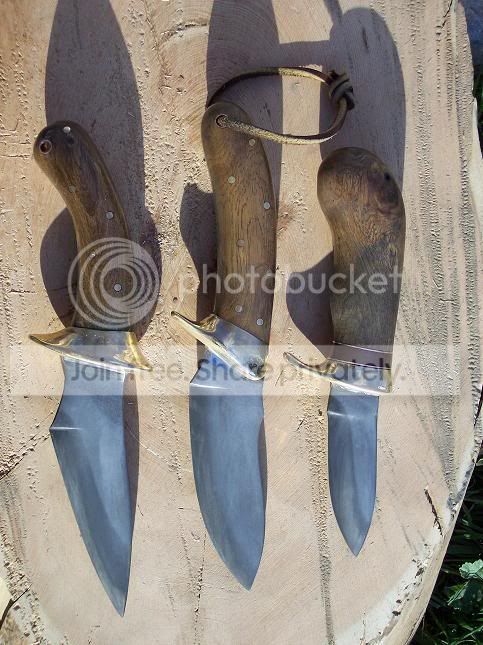
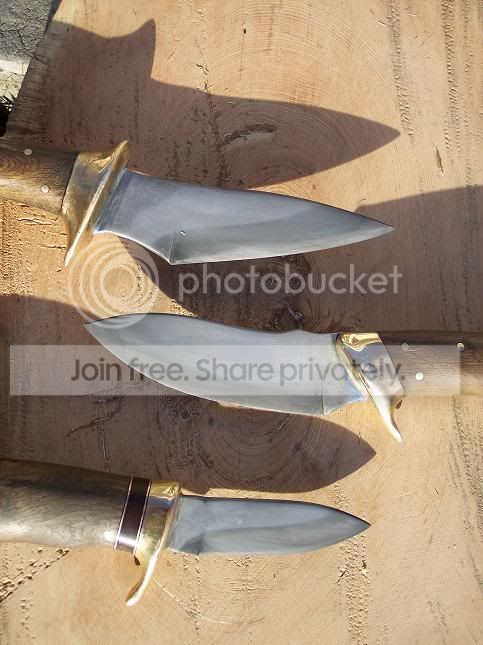
3bladesetchedNS25per.jpg


3bladesetched25pera.jpg


Personaly pleased with the results, just hoping to understand the proses better?

Thanks in advance!
 
You have tootsite or tempered martensite, below the "temper" line and the softer steel structures above. The acid etches them differently. Cut the ferric
chloride 3 to 1 with water. It works better. Also the hardened steel is etched quicker than the softer parts. If you leave it in for an extended time it will really show.
Are you sure that you are using 52100 steel? Normally you will not get this pronounced a temper line with that specific steel.

Nice looking knives, Fred
 
Thanks Fred!

Yes, it's 52100 from Rex Walter's stash, I'm sold on how it works and performs!

3 : 1 , as in 3 parts water and 1 part FC?

Couple more questions if I may?

With it diluted, what is a good 'dip' time? And is there a good way to finish after etching to keep the lines? I have noticed that the etch just dose not buff out.

Is there a good 'home' base to neutralize the enchant?

Thanks for the kind words, I am pleased with the progress my blades are showing!
 
Fred,It's called troosite. It is the border between the softer Pearlite and harder Martensite,and as Fred said, is tempered martensite. Troosite etches darker than the fully hardened martensite,and shows the line sharply against the grayer pearlite. In a true hamon the ghostly line is a mixture of both structures.
Neutralize FeCl with windex.
Nice knives,BTW.

Stacy
 
What these guys are saying is what's happening. Just a thought though, my experiance with 52100 has never given me the clear transition lines that your show. IMHO, 52100 requires you to hit the heat treat right on the money or you won't get the desired quality blade. That may be the reason the one blade seems much better.
Rick
 
"Troostite"... wow, we are either dating ourselves or the books in our collections, could there be any sorbite in there? This kind of reminds me of the Columbium vs Niobium debate:D. I make many of the same faux pas myself due to the fact that the most affordable metallurgy texts are the older ones, however material science has now put these structures on the shelf with unicorns and leprechuans since they discovered they were just variations of bainite or very fine pearlite. I love to look at etched blades and point out precipitated zones of secondary smegmite, when folks ask me to analyze on the fly :D

The fact is that dipping blades in ferric will of course only show macroscopically the overall effect of accumulated microscopic effects. Dark edges show a hardened condition resulting from a finer strucure, it could be tempered martensite or varying degrees of mixed in fine pearlite or bainite. So you know it is different or even harder but you can't be certain as to why without more in-depth examination. Kind of like Rockwell numbers, I often get set numbers on hardness but have no idea as to why unti I use other methods of analysis. A blade with a 59HRC could be from tempered martensite or untempered martensite riddled with fine pearlite, One is great, one kind of sucks, and the Rockwell can't tell you which it is :(.

The lighter spine will be coarser structure and softer, resulting more from diffusive transformations, coarser pearlite or bainite. Secondary bands between the two would be from varying degrees of these or spheroidized and undissolved materials from insufficient re-austenization on another hardening attempt. One may also be able to make out the anisotropic flow of the steel from the rolling process at the mill, which could show if the blade was forged to shape or not, particularly if there is a choil at the ricasso area or if it all kind of comes together at the tip.
 
Fred,It's called troosite. It is the border between the softer Pearlite and harder Martensite,and as Fred said, is tempered martensite. Troosite etches darker than the fully hardened martensite,and shows the line sharply against the grayer pearlite. In a true hamon the ghostly line is a mixture of both structures.
Neutralize FeCl with windex.
Nice knives,BTW.

Stacy
:thumbup::DMy brain new that but my index finger just was not going to cooperate.

Kevin,

Most all my metallurgy books are from the 60's and 70's. My brother in law
was a student at Ohio State, during that time. He was kind enough to pass them along to me when I opened shop.
Have you checked the price on some of the new books? :eek::D
I love that free stuff.

Regards, Fred
 
I have found a few things successful when wanting to etch a blade, or anything for that matter - wrought iron, Damascus, etc.
1.) Bring the piece up to FULL POLISH first! And, in case you haven't learned this yet, a good mirror polish job does NOT result from a lot of polishing - it results from a lot of sanding! Remove all scratches from the previous grit progressively from, say, 220 up through 1500. When you hit the buffer - POW! mirror polish.
2.) Cleanliness. I may go a little overboard, but, first I wipe the blade with Acetone to dissolve any residual buffing compound. Then I spray it down with brake cleaner to dissolve any Acetone petroleum distilates. Then into the house and wash in hot water and dish soap to further clean it. Back to the shop and wipe off with denatured alcohol.
3.) 3:1 distilled H2o:FeCl.
4.) Dip and wipe with cotton balls to clean a little bit.
5.) I etch for about 30 minutes. Suspend blade in FeCl for 10 minutes. Then remove without touching blade and wipe off accumulated oxides. As the 'black' stuff builds o the surface of the blade, it creates a barrier between the FeCl and the blade! No etching is occuring! So, I wipe off with cotton ball. I do this three times for a total of 30 minutes.
6.) Remove and then I keep a wide mouth gallon jar of TSP and wipe the blade off with 0000 steel wool and TSP. Really scrub it to remove ALL the oxide. I don't like black sh** on my hands, so I take it back to the sink and wash and clean it good with hot water and soap with a toothbrush.
7.) Back to the shop and buff the snot out of it with a designated wheel and Brownelle's 555 Grey.
Done.
Note in the picture that the bottom hardened portion is shiny! I mean I really buff the heck out of it. It has been etched so deeply that it'll stay that way for the life of the knife.

ab5-1.jpg
 
Quick question so I understand the process. Do you etch blade before you put on the handle?? And what is TSP thx
 
A question for you experienced guys. How about the alternative of distilled white vinegar as an echant?
 
Quick question so I understand the process. Do you etch blade before you put on the handle?? And what is TSP thx

Yes. As soon as I have completed finishing out the blade following heat treating.
Trisodium Phosphate. Can be found in almost any hardware store, plumbing supply, etc.
 
A question for you experienced guys. How about the alternative of distilled white vinegar as an echant?
I've used a mixture of 60% ferric and 40% vinegar and it's worked well. Course that was etching Damascus.
 
Back
Top