Blade etching question ...... yes, another one. lol

Joined
Feb 12, 2007
Messages
155
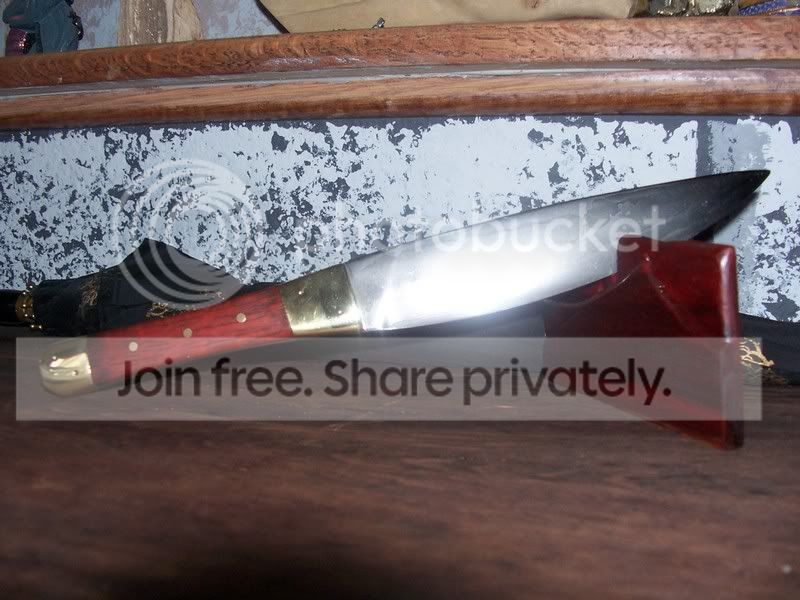
First, I want to show off a pic of my bowie I finally finished and took pictures of. This was my first forged blade. Just looking for honest opinions.

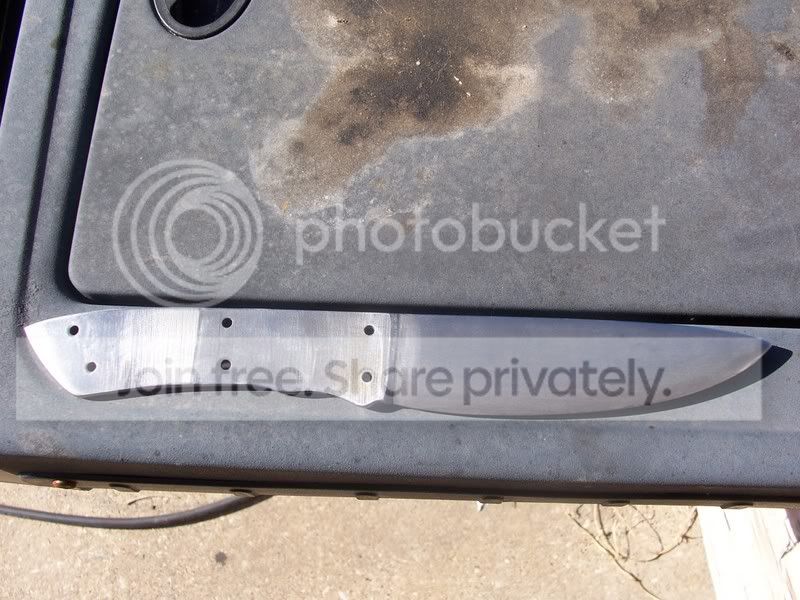
Second, I made another blade, heat treated it, and after etching and sanding with 1500, there is a cool grain pattern in the blade. Although the pattern looks interesting, the blade overall looks a bit dull.

Is this a desirable feature among knifemakers and collectors? I don't want people to think I was lazy and didn't clean up the blade. It's glass smooth, but the oxidation in small spots is making it look dull.

Thanks for looking.
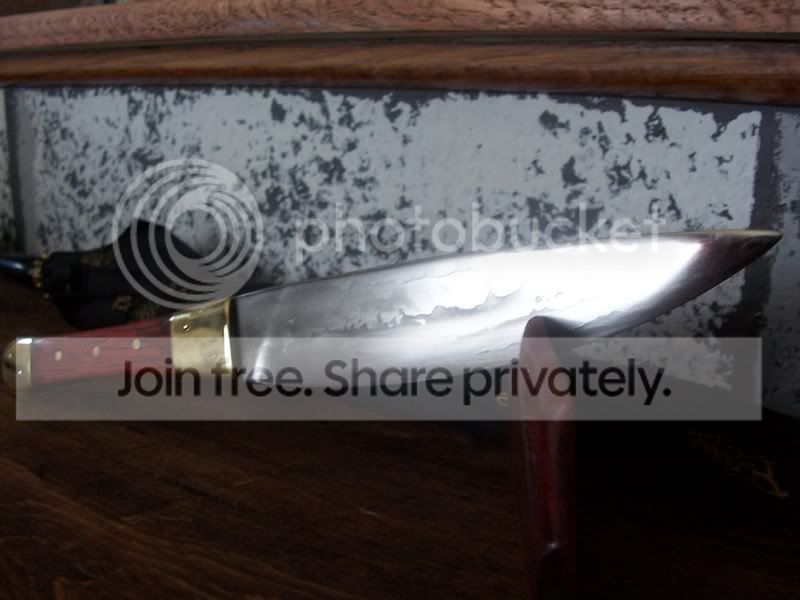
DavesKnives018.jpg

DavesKnives016.jpg

DavesKnives012.jpg

DavesKnives011.jpg
 
Thank you Mr. Barke (I assume)
They're both 1050 steel.
The bowie has padauk scales with brass bolster and butt. There is no glue anywhere.

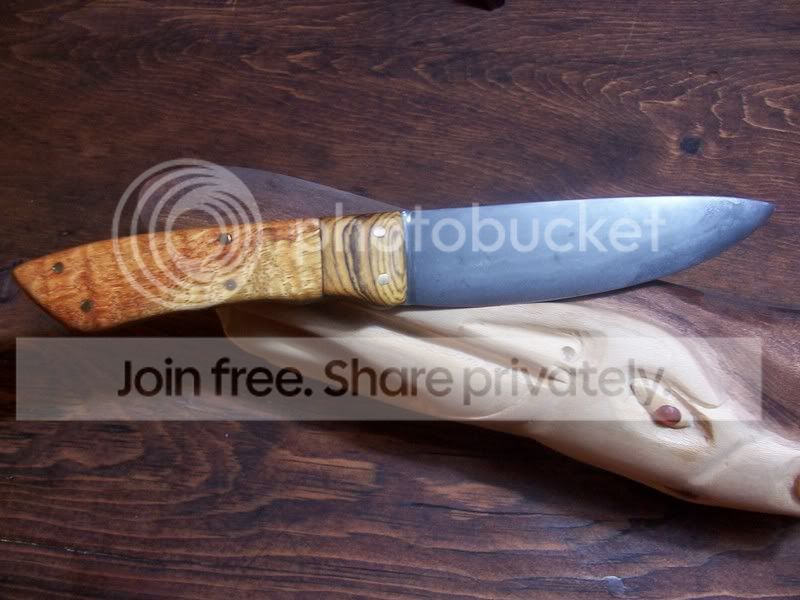
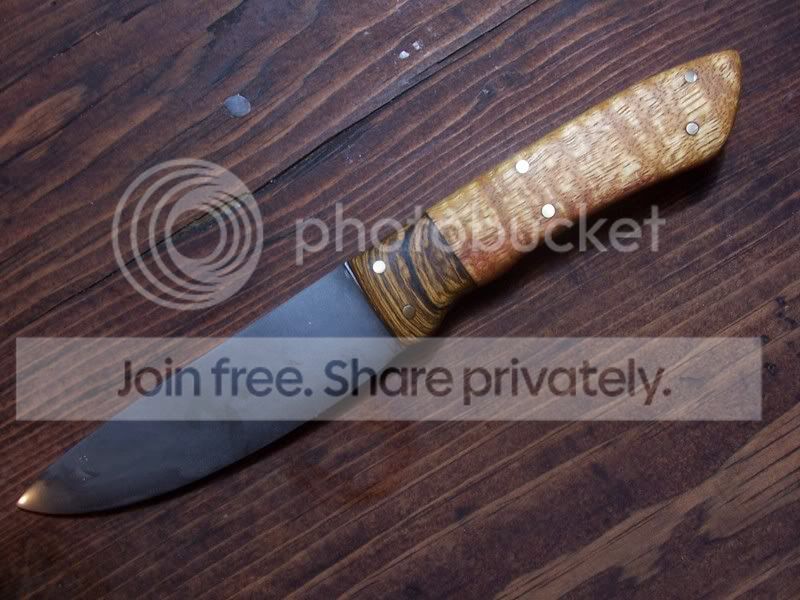
The other blade will be outfitted with afzalia scales and probably nickle silver butt to even out the weight. Bolster will be cross grain bocote. Should be finished out by this weekend. I'll post up a pic.
 
Dave, I believe you have a mixed crystal structure going on there. A description of your thermal cycling, followed by how you heated to harden (forge, torch, furnace; magnet test; hold time, etc) and quench would probably aid in someone helping you decipher what is going on.
 
Dave, I believe you have a mixed crystal structure going on there. A description of your thermal cycling, followed by how you heated to harden (forge, torch, furnace; magnet test; hold time, etc) and quench would probably aid in someone helping you decipher what is going on.

It was normalized by heating to critical, then allowed to cool at room temp (seperate process after it was forged.)

Then it was put into the forge, brought up to non magnetic. I'm thinking it was in about 10 minutes or so.

Took it out, quenched in a bathtub with ambient room temp water.
One quick quench, taken out for about 2-3 secs, then quenched 3 times at about 1/2 to 1 sec each. then a final quench submerged for about 5 more secs.

Then immediately taken to the oven and cooked at 450 for 2 hours.

sanded through 400 grit, then hand sanded wet with 600. Etched with FC 3 times then wet sanded with 1500.

I really love the crystalline structure (looks really cool under a jewelers scope) but the dull finish concerns me. I guess I shouldn't worry so much about what other people think, but then again, I want to know what you all think. lol
 
Well, to be utterly honest, it's really beautiful but doesn't look as a bowie at all to me. It almost seems like a crossbreed between a bowie and a thai knife (can't remember right now how they are called).
It's really nice and, by all means, DO NOT polish it more! The "dull" lines you have are temper line, and it's a very nice one indeed!
Did you use cold or hot rolled 1050?
The multiple temperlines are the result of your quenching method. You got a really nice piece of steel there! :thumbup: ;)
 
I think the second knife looks cool, but I'm very interested in what fitzo can tell us about mixed-grain structure.
 
Well, to be utterly honest, it's really beautiful but doesn't look as a bowie at all to me. It almost seems like a crossbreed between a bowie and a thai knife (can't remember right now how they are called).
It's really nice and, by all means, DO NOT polish it more! The "dull" lines you have are temper line, and it's a very nice one indeed!
Did you use cold or hot rolled 1050?
The multiple temperlines are the result of your quenching method. You got a really nice piece of steel there! :thumbup: ;)

Thank you Alarion and Gibson fan. The hamon on the finished knife was done intentionally. Also, here's a link to a similar blade pattern by A.G. Russell. http://www.agrussell.com/knives/by_type/straight/bark_river_rogue_bowie_mesquite_handle.html

I'm not sure if the 1050 was hot or cold rolled. I'm working out of Dan Davis' forge with his materials.

The cool grain pattern I was talking about was on the second blade. I'm just curious if I should leave it or polish it out more. I'm also wondering what is going on with the wierd crystal structure. I'm also hoping it's not a bad thing. I'm going to try to duplicate it and do a bend test.
 
Let us know the results of the bend test, even if I'm not a great fan of this system... It gives out how the grain behaves, and shows how fine it is, but functionally proves little. Knives are not prybars.
But I'm curious to see if the crystal structure you've got will fail with a plastic failure or fragile fracture.
If you have one, try putting the broken section on a flatbed scanner and scan a section at the highest possible resolution, then magnify it. It can yeld interesting results...
 
I am a bit confused about the appearance of the second blade, so I don't want to hand out misinformation.

It could be the result of under- or overheating resulting in carbon segregation. If it was an alloy steel, I would say it was alloy banding, but that isn't the case with 1050 unless it's caused by the manganese.

It could, on the other hand, be a simple, ordinary result of being a hypoeutectoid steel (less than 0.8%) and not having sufficient carbon to even out and provide all one crystal type (martensite).

I'm simply not sure, so it would be inappropriate to guess and further contribute to the large body of misinformation already out there. I have written someone asking that they comment. Perhaps mete will happen along and see this also if we keep it toward the top.

I think it is important enough as an educational opportunity that we get someone in the know to comment. We can all learn something then!!
 
Great. I am very interested in what's going on here and what caused it. (so I can either duplicate it, or avoid it... )

I guess before I do a stress test, I should just see if it takes and holds an edge first. If it doesn't hold an edge, I'll do the test on this blade and see what happens.

I wish the picture did it justice. It looks like mini-damascus. :thumbup:
 
Dave, I got a reply to my email.

My source agrees that it is indeed segregation of some sort. He also found it an odd behavior for 1050 steel, this being a more familiar phenomenon when caused by alloying elements or in a steel with excess carbon. First thought is that you should verify the identity of your steel.

If indeed it is 1050, then the mechanism of segregating the carbon is not clear and it is not "ordinary". The banding itself would likely be varying consistencies of ferrite. Since there is not enough carbon to go around to form martensite as it is, banding can only reduce the quality of the blade for cutting and is thus undesirable.

I recommend that you verify the id of your steel. It also sounds like there is need for more control of your thermal cycling, heating/soaking process.
 
Thank you Mr. Barke (I assume)
They're both 1050 steel.
The bowie has padauk scales with brass bolster and butt. There is no glue anywhere.

The other blade will be outfitted with afzalia scales and probably nickle silver butt to even out the weight. Bolster will be cross grain bocote. Should be finished out by this weekend. I'll post up a pic.


And thanks Dave for signing my Guest Book on my website. Call me some time and we will talk about shop setup. God bless.

Barkes
http://my.hsonline.net/wizard
:thumbup:
 
Thanks for the info Fitzo. I'll double check the steel, but I'm sure it was marked 1050.
I ended up re-sanding and re etching it, and left more oxide on it this time. The temper lines are more prominent and the grain pattern is a bit more hidden. It looks better I think. Anyway, I went ahead and finished it out. Still have some detailing to do, then I'll put the edge on it and see how it cuts.

Here she is.
DavesKnives022.jpg

DavesKnives021.jpg
 
I hope you'll post how well the edge held up to cutting, David.

It's a nice looking knife...
 
Back
Top