Blade Finish

Joined
Jan 10, 2006
Messages
43
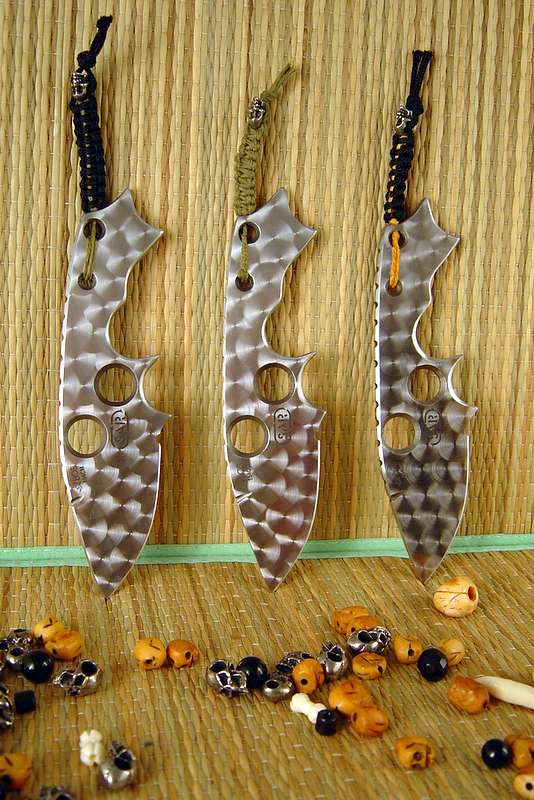
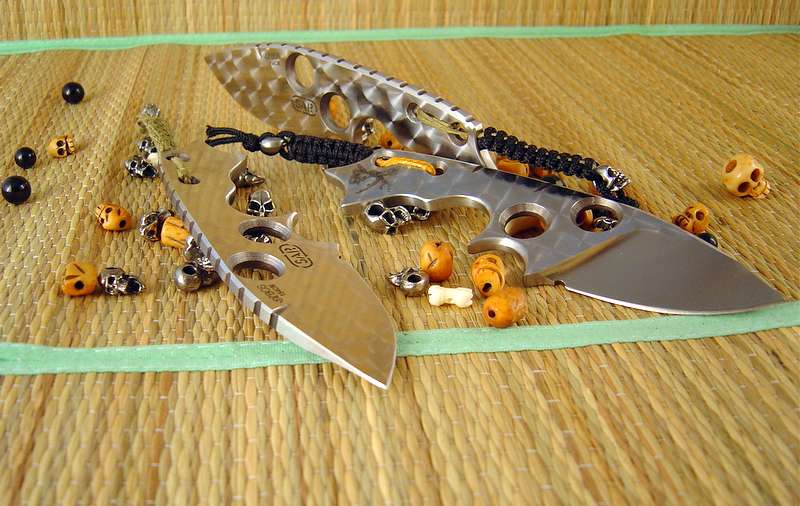
Have any of you ever tried this on any of your knives before? I can't remember where I saw it, I think maybe it is called jeweling? Anyways I tried it on one of the chute knife kits from knifekits.com. What do you think of it?

jeweling.jpg


jeweling2.jpg
 
Not sure what you used to get that efect but if you glue a piece of sctochbright on a mandrel then put it in a pedastill drill it will come out a lot better, I use it all the time on the back of motorcycle parts I make.
Richard
 
I used a wire brush attached to a dremel tool. Tinbasher, do you have any pictures of the motorcycle parts so I can get an idea how they look?
 
The process you are looking at on your blade is known as jeweling. The best way to do this is on a milling machine in order to control the pattern. If you want a nice looking and uniform pattern you will need to make sure the finish on your piece is very nice first. The next thing you will need to do is determine the size of the pattern you want to put on your piece. There are 2 ways that we did this in the tool room. 1) use a hickory dowel that has been faced off in a lathe to make sure you have a good flat surface on the end of the dowe. 2)Use a rubber impregnated rod with the grit in it. If you use the hickory dowel you will need to use a very fine lapping compound. If you use the rubber rod, watch the outside as it will flare out. You will need to keep the skirt trimmed or it will muddle the finish. Just to give you an idea of a pattern, you can use a 1/2" dia rod and when you move the spacing, move 1/4" on each move. Over lap each row the same amount also. Use a high r.p.m. and a light touch. Move the quill up and down with each touch so that you can see the pattern. Be careful and try not to do it with just a one time pressure application, or you will end up with swirls that have deep looking scratches. If you will do a search on the internet for "rifle bolt jeweling" you can see some examples of what you are doing. Good luck.

 
Isn't it also called "machine turning"?
 
I don't have a mill, but instead use my drill press. I put in a piece of regular wood dowel in the size I want and use valve grinding compound for the grit. I square up the dowel by putting a piece of sandpaper down on my drill presses work top and sand the dowel while it's in the chuck turning at high RPM. The only time I've had issues is with a tapered tang knife. I'll post some of my examples. Sorry about the quality of the pictures, since these were taken many years ago with a camera that was about 1 megapixels, and before I had any knowledge of how to take pictures.
 
The sign of an old school master jeweler or watchmaker was that he/she jeweled plain metal surfaces. Not because they needed it, but because the craftsman could. It shows patience, attention to detail, and an eye for the beauty in simplicity.
Stacy
 
Cool, I have a drill press, but I had to leave it at my parents when I left for college, not much room for it in my apartment. I'll give it a whirl with the press next time I go visit them.

hmmm.....I wonder how long its gonna take me to hand sand out the "jeweling" I did with my wire brush .......
 
I find Cratex cylinders do the best jeweling. Use the hardest type and a coarse or medium grade. The cylinders come in plain rods,and with 1/8" shanks (for dremels and flex shaft use). You can learn to do it by hand with care and a steady hand. A press is easier and more uniform.
Stacy
 
That is also preferred as Engine Turning. You can also find it on various types of handgun. S/W produced that pattern on a lot handguns just before blueing. It looks nice and sweet on your blade. ------------------:thumbup:
 
I used a wire brush attached to a dremel tool. Tinbasher, do you have any pictures of the motorcycle parts so I can get an idea how they look?

Sorry matt,I have only just returned to this thread ,if you email me I can send you a picture showing what the stippling should look like.
 
Here are a few that I have jewled, use rubberized abrasives found at MSC.com. I just use my drill press as well.


spencer
 
Those are pretty cool looking, how well does it hold up? I wouldn't want to use them :)

Actually, jeweling tends to hide minor scratches from normal use fairly well. I use it mostly on kitchen cutlery, but have used it on a few hunters or skinners.

Here are a few examples of my efforts at jeweling.

Ickie
 
it is called engine turning in the machine industry. It is used to hold lube. It has been used for many years in the firearms industry. Especially on rifle bolts and the sections of fine double guns and over unders. When done in fine swirls it is called jeweling. If you are in a bind and don't have the proper tools, or abrasives, you can use an old fashion ink pen. The type that looks like a pencil with the white ind eraser on the end. They have a very fine abrasive in them that works well. Brownell's sells a fixture that hold the cratex abrasives for your drill press. These seem to work the best. There is also a type used in the jewelery business that uses very fine glass rods in what looks like a mechanical pencil. You can run out new rods when they become worn. These work very well on gold and platinum.
 
I use the Brownells kit with the small spring-loaded wire brush and loose grit and oil in my milling machine. I like it on the inside of folders and for moving parts that need to hold lubricant. It can really be overdone on a blade IMHO.
 
Back
Top