
Blade Hardness: Where do you stand?

Rick Marchand

Donkey on the Edge
Moderator
Joined
Jan 6, 2005
Messages
9,680
Most of the time, I want a knife that keeps a good edge, is easy to sharpen and rolls before it chips(58HRC). There are a few exceptions where maximum edge retention trumps toughness and I go harder(60+HRC). I use carbon steels, mainly.(10XX, 5160, O1)

The last thing I want my Bushknives to do is snap during heavy use... I would rather they roll or bend. I usually go thicker and stronger so it resists flexing when leverage is applied. You can't snap it if you can't flex it, right? I expect these knives to get abused, so there is a compromise in their construction. Sometimes it is a full temper in the higher heat range, othertimes I differentially temper using a torch. They are always fully hardened at the quench... I don't differentially heat treat.

My other blades are made in the spirit of "conventional" knife use.... cutting. I still lean toward the tough side of the fence but these are not the sharpened prybars of my Bushknife line.

Here is a unexpected test that my personal user had to endure on a road trip that I am currently on as I type this. Warning. This link depicts blatent knife abuse.
http://www.bladeforums.com/forums/s...VAL-I-used-my-knife-to-change-a-wheel-bearing

Where do your knives sit in along the toughness/strength spectrum and how to you achieve your results?

Rick
 
I'm usually on the other extreme. Very thin hollow grind that doesn't reach .020" until 1/8" up the edge, and high hardness to support a very thin edge. HRC 62 is not unusual.

The people who use these want something that cuts like a laser beam, and that's what I give them. They're used in kitchens and for processing game. They're more durable than you'd think. If you'll send me a PM with your address and I'll send you one, you might be surprised what it will tolerate.
 
I have a 7 inch overall length fixed blade (3.5 inch edge) of 3/16 inch thick a2 that is 62.5 RC. I let the maker come up with the hardness. He said for a fixed blade of that size, he likes to be around that hardness.
 
I'm usually on the other extreme. Very thin hollow grind that doesn't reach .020" until 1/8" up the edge, and high hardness to support a very thin edge. HRC 62 is not unusual.

The people who use these want something that cuts like a laser beam, and that's what I give them. They're used in kitchens and for processing game. They're more durable than you'd think. If you'll send me a PM with your address and I'll send you one, you might be surprised what it will tolerate.

Cool Nathan, what steel are you using? I experimented with my geometry and hardness to get where I am now. The geometry is equally important as the hardness... you make an excellent point! I may drop you a pm or email later tonight. I'm always willing to try new things.

Rick
 
D-2 and CPM S30-V both 60 Rc. Scandi ground bushknives, thin hollow ground skinners. I have dozens in the field, no complaints about edge retention, chipping or anything negative. If the heat treat and geometry is correct the tool will do what it's supposed to. Coming from a tool and die background I think tool steels and stainless tool steels are superior knife steels.
 
D-2 and CPM S30-V both 60 Rc. Scandi ground bushknives, thin hollow ground skinners. I have dozens in the field, no complaints about edge retention, chipping or anything negative. If the heat treat and geometry is correct the tool will do what it's supposed to. Coming from a tool and die background I think tool steels and stainless tool steels are superior knife steels.

I have 14yrs in tool and die and still love a good carbon steel blade. One of my reasons is that you can't strike a spark with traditional flint and steel using stainless alloys.:D That, and I enjoy forging my blades to shape.
 
Flint won't work but them ferro rods are awesome. I have a great deal of respect for guys that forge. It's amazing the number of machinest and toolmakers who evolve into knifemakers, it's really kind of backwards. During my day job I program Wire EDM's CNC lathes and mills with Gibbs, build dies and automated equipment.But I'm so much happier profiling a piece of barstock on the Bader.
 
Rick - I've actually been pondering the same question lately. I don't have a hardness tester and I do my own heat treating so in all honesty I don't know exactly where my knives would fall on the Rockwell scale. I am thinking about getting some tested to see where they're at. Anyway, on knives that I have and do know their Rockwell score I have been in the same boat as you about thickness and hardness being completely determined by the primary task they are made to perform... I hope you're able to take Nathan up on his offer and report back with your thoughts on his choice of hardness/geometry.

Nathan - Good on ya brother for offering to back up your opinions/process with physical evidence!
 
Cool Nathan, what steel are you using? I experimented with my geometry and hardness to get where I am now. The geometry is equally important as the hardness... you make an excellent point! I may drop you a pm or email later tonight. I'm always willing to try new things.

Rick


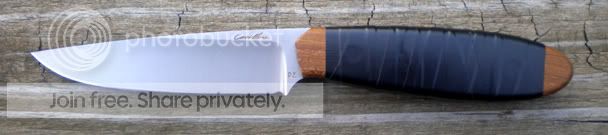
Here ya go Rick, your new knife:

testknife.jpg


It is made of a reject blade and some reject scales. I stuck the scales on with electrical tape for nice ghetto look for you (look out Charlie Mike). In retrospect, a couple drops of super glue would have been a better idea...

It is D2 at HRC 61, with a HT optimized to improve D2's poor fine edge stability. You might be surprised how well this geometry cuts things like cardboard and meat and still tolerates bone and hard clacks against a cutting board etc.

I've done a lot of experimenting with this steel and pattern.
 
I prefer 0-1 at 58-59 rc. A smaller knife will hold a nasty edge and I try and have the larger blades have an edge angle that wont be too thin so it can take a wallop. I have had good results with D2 at about 60 rc. I use an oven for fully hardening D2 and on larger knives fully harden 0-1.
 
The harder, the better personally. The last knife I made for myself was 64-65. No edge issues when batoned, thrown, or used to dig holes in a board. Geometry plays an enormous role. This one was convex ground at about 15 deg/side on 0.058" stock, like a tiny machete. With a different geometry, there's no way I'd try some of the stuff I did with this knife. It's also the only knife I've used that could cut a folded piece of paper standing on a table, and leave the bottom half standing.
 
I can't even imagine using .058" stock for a knife. Just personal taste.
 
The harder, the better personally. The last knife I made for myself was 64-65. No edge issues when batoned, thrown, or used to dig holes in a board. Geometry plays an enormous role. This one was convex ground at about 15 deg/side on 0.058" stock, like a tiny machete. With a different geometry, there's no way I'd try some of the stuff I did with this knife. It's also the only knife I've used that could cut a folded piece of paper standing on a table, and leave the bottom half standing.

This sounds interesting, could you elaborate a bit? What steel? I would really like to understand the paper cutting part.

I like my knives hard and keen as well, and this sounds like a good test. Please tell me how you do whatever you do with the paper. I like to impress my friends and influence strangers. Especially girls. :D
 
The paper cutting test was started by Phil Hartsfield. Roll up a newspaper, put a piece of tape on it to keep it from unrolling. Stand it up on one end. Think Samurai cutting a tatami mat on a bamboo poll. Swing the blade somewhere around 30-45 degrees( obviously not perpendicular) if the edge is keen and the geometry of your grind is low drag, it should glide through the paper and leave the bottom half standing.
 
i end up running harder then most but then again i do mostly kitchen and razor work these days
cpm154 62-63 is normal
 
I'm usually on the other extreme. Very thin hollow grind that doesn't reach .020" until 1/8" up the edge, and high hardness to support a very thin edge. HRC 62 is not unusual.

The people who use these want something that cuts like a laser beam, and that's what I give them. They're used in kitchens and for processing game. They're more durable than you'd think. If you'll send me a PM with your address and I'll send you one, you might be surprised what it will tolerate.

PM Sent Nathan.... wait... You didn't mean all of us?
 
I prefer my knives to be between 58 (soft side) and 60 (hard side) HRC... just personal preference. I use various carbon steels, 1080, 1095, 5160, and 1085 mostly. Anything harder than 60 just seems like overkill, with too much of a chance of chipping and too hard to resharpen, IMO. I've owned knives at 62-63 HRC, and spent more time resharpening than I did dulling them.
 
i usually use s5, or 50CrV sometimes. most of time i salt bath to get a mixture of bainite and matensite. i would like to keep the hardness arround RC 57~59. i have a strange bad habit of hacking and stabing stuffs with swords especiall before or after sex, and sometimes my targets has iron nails or steel bars inside them. so i guess toughness and strength are the No1 importance for me.
 
Well I go with the manufactures recommended hardness on stainless blades that I grind thin. I hate saber ground blades. Now these are not made for chopping wood or such. I make these for doing animals with. I startred out with 440-C heat treated in a vacuum chamber with the crio treatment and went on to ATS-34 a few others and now CPM-154, CPMS35VN, CPM30V, and Elmax.Believe it or not, if you use these yourself, you soon see what they are capable of and how on type may be better in use than the others. I like the convex edge and have found that in the field a steel is often all that is needed to keep the edge up. Frank
 
Back
Top